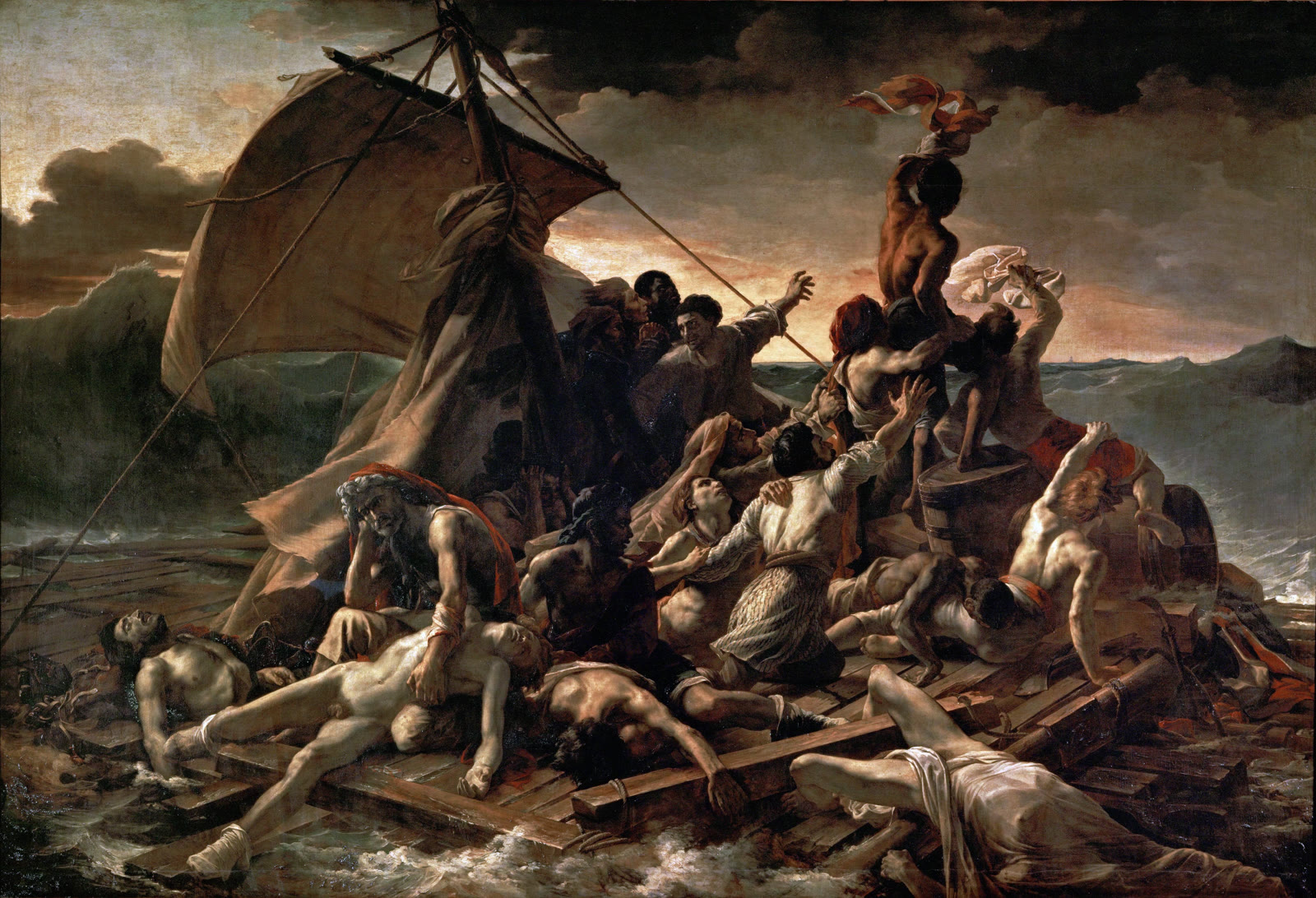
Théodore Géricault’s The Raft of the Medusa is often introduced through scandal first: the 1816 wreck of the French naval frigate Méduse, the incompetent command, the abandonment of the raft, the starvation and cannibalism among the castaways, and the public outrage that followed.[2][3] All of that matters. But the painting’s lasting force comes from a more exact pictorial decision. Géricault does not paint rescue as arrival. He paints rescue as a far-off test of whether hope can remain upright for one more second.[1][2]
The factual spine is clear enough. The Louvre dates the canvas to 1818-1819; it is vast, 491 x 716 cm, and it turns a recent political disaster into a work on the scale of history painting.[1] Khan Academy and Royal Museums Greenwich both note that the scene shows the survivors on the raft at the moment they glimpse the rescue ship Argus in the distance, before salvation is secure and while the whole human pile still hangs between collapse and recognition.[2][3] That suspended interval is the real subject.
The painting rises by stepping over the dead
The first thing to notice is that the composition does not simply surge upward in one clean heroic movement. It climbs through resistance. The lower left is burdened with corpses, partial corpses, and figures too spent to join the final signal.[1][2] Limbs slacken, torsos fold downward, faces turn away from the horizon. Géricault makes death and exhaustion the material on which the living have to build their last upward reach.
From there the eye moves through a steep diagonal of bodies toward the figure at the apex who waves a cloth toward the distant ship.[2] The effect is not triumphant. It is precarious. Hope exists in the painting, but it exists only as something physically assembled out of loss. That is why the raft never reads like a stable stage. It behaves more like a temporary human architecture, always one motion away from giving way.
The rescue ship matters because it is almost too small to count
The Argus is one of the cruelest details in European painting because Géricault refuses to reward the eye with certainty.[2][3] The ship is visible, but only barely. It sits near the horizon as a tiny answer to an enormous canvas, which means the picture’s emotional weight falls not on deliverance itself but on the awful interval between sighting and being seen.
That proportion changes everything. If the ship were larger, the painting would become a rescue picture. If it were absent, the painting would become a pure catastrophe. By making it both present and nearly negligible, Géricault keeps the entire scene balanced between those two states.[2] The viewer has to experience what the castaways experience: not safety, not despair finished once and for all, but the labor of keeping attention fixed on a possibility that could still disappear into weather and distance.
Scale turns current scandal into public history
The canvas uses the ambitions of history painting for an unheroic modern event.[1][2] That choice is central to why the painting still feels so aggressive. The picture is too large for private pity. Its dimensions force bodies from a recent news scandal into the same monumental space that European academies had reserved for biblical, classical, or military grandeur.[1][2]
Yet Géricault refuses academic cleanliness inside that scale. The foreground shoves flesh, timber, rope, and salt-soaked cloth toward the viewer; the dead are not pushed into decorous distance.[1][2] The raft nearly breaches the picture plane. In practical viewing terms, that means the spectator is not granted the safe position of someone studying an event from shore. The painting drags the viewer into the same unstable platform from which the signal must be made.
Sea and sky are built to deny comfort
For a work often filed under marine drama, The Raft of the Medusa is strikingly unsentimental about the sea itself. Water and sky are indispensable, but they do not become sublime spectacle for its own sake.[2] The ocean is the condition that strips human plans down to their last gestures; the sky is broad enough to admit rescue and indifferent enough to withhold it.
That is why the painting’s two main directional forces matter so much. One diagonal rises toward the signal. Another drags downward toward bodies already surrendered to gravity and water.[2] The sea does not need theatrical waves in every corner because the real violence has already been internalized into the human structure on the raft. Nature is present, but the picture’s deepest terror is social and political: people were left here by other people.[3]
Why the painting still feels modern
The work remains immediate because it refuses the consolations that historical distance usually provides. The shipwreck had causes in bureaucratic failure and political patronage, and contemporary viewers knew that.[3] Géricault converts that knowledge into form without turning the painting into a newspaper illustration. He keeps the event recent, bodily, and accusatory, while also giving it the open-endedness of an image that can outlive its first scandal.
That is where the painting’s modernity lives. The raft is not only a literal raft. It is a picture of how institutions fail downward, how hope gets distributed unevenly across bodies, and how public disaster often looks at first like a tiny object on the horizon that may or may not turn toward you.[2][3] Géricault gives that structure a monumental image and then refuses to let rescue close it neatly.
60-second viewing drill
- Start at the lower-left bodies and notice how much downward weight the painting makes you carry before it permits any rise.
- Follow the main diagonal to the waving figure at the top and ask how many separate bodies are needed to keep that signal alive.
- Only then look for the Argus on the horizon; the delay is the point.
Sources
- Musée du Louvre, Le radeau de la Méduse collection entry (date, dimensions, medium, and collection record).
- Khan Academy, Géricault, Raft of the Medusa (composition, historical moment depicted, and formal analysis).
- Royal Museums Greenwich, The Raft of the Medusa object page (shipwreck context, survivor count, and sighting of the Argus).
- Wikimedia Commons, file record for JEAN LOUIS THÉODORE GÉRICAULT - La Balsa de la Medusa (Museo del Louvre, 1818-19).jpg (image record used for the local article image source).