Lois Mailou Jones's Les Fetiches does not present African masks as museum specimens. It makes them collide. Painted in Paris in 1938 and now held by the Smithsonian American Art Museum, the oil on linen gathers several mask forms into a dark, compressed space where central face, striped side form, curved white arcs, small orange figure, and raffia-like crest all press into one another.[1][2] The result is not a still-life inventory. It is a picture of objects that have refused to stay arranged.
That distinction matters because Jones was working inside a charged history of modernism. European artists had already used African sculpture as a formal resource, often stripping objects from ritual, place, and maker in order to refresh Parisian painting. Jones's answer was not to abandon modernist language. It was to claim the right to use it differently. The Smithsonian label records her response to critics who questioned the change in style: if French modernists could use African inspiration, she argued, a Black American artist had an even stronger claim to it as heritage.[1] The painting is therefore not only a formal experiment. It is a fight over who gets to turn African form into modern art.
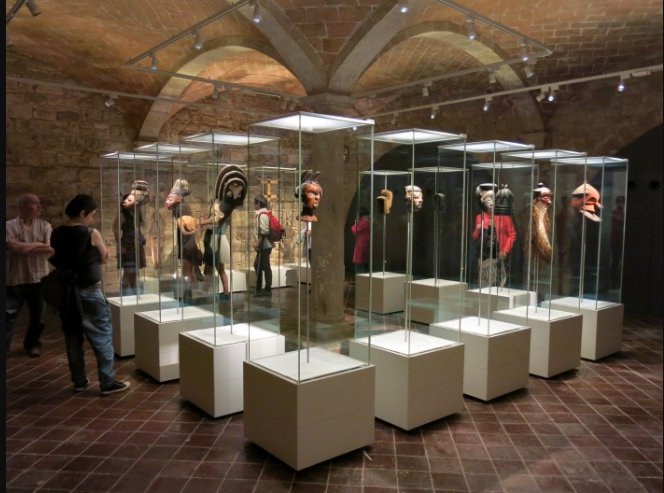
Image context: the cover was replaced during QA with a real museum-gallery photograph of African masks. It is not a diagram, chart, screenshot, map, symbolic collage, or generated visual. The choice keeps the page visually immersive while pointing back to the material display culture, mask study, and staged presence that Jones compressed into the painted field.[1][5][6]
The masks do not sit still
The largest face in Les Fetiches occupies the center but does not stabilize the picture. Its pale planes split across nose, brow, cheek, and mouth, so that the face feels carved by light rather than modeled into softness. The eyes are dark almond openings, less expressive in a portrait sense than electrically alert. Around it, other forms crowd the field: the striped mask at left pushes in horizontally, the reddish crest rises behind the central head, and the right side carries a curved, scalloped form whose edge flickers like motion caught mid-turn.[1]
This crowdedness is the painting's strength. A weaker version of the subject might have lined up masks for comparison: one from here, one from there, each made available to the viewer as a labeled cultural object. Jones refuses that catalog logic. The Smithsonian American Art Museum's artist text says the ensemble hovers apart from ceremony, display, or storage, and that the masks seem to take on a life of their own.[2] The phrase is useful because it names the strange space of the painting. These masks are not being worn by visible bodies, but they do not become inert. They become presences.
The black ground intensifies that effect. It withholds room, wall, table, and floor. Without a stable architectural setting, the masks have to create space through overlap, angle, and contrast. The central mask moves forward because the darker forms behind it retreat. The striped mask at left seems to enter from outside the frame. The white arcs at the edges make the composition feel less like a shelf and more like a performance zone.
Paris gave Jones a language, not permission
Jones arrived in Paris in 1937 on sabbatical from Howard University, studying at the Academie Julian and producing landscapes and figure studies while also entering the city's exhibition life.[3][4] National Museum of Women in the Arts notes that Paris mattered partly because Jones experienced an artistic and social freedom sharply different from the racial limits she faced in the United States.[4] That freedom did not mean she became less conscious of race. It gave her a different pressure under which to paint it.
Britannica places Les Fetiches in this 1937-38 Paris turn and identifies it as a painting of masks in distinct ethnic styles, made after Jones had already designed African-style masks earlier in the decade.[3] That sequence matters. The painting did not come from a sudden decorative interest in exotic form. Jones had design training, theater experience, Howard teaching discipline, and exposure to Harlem Renaissance debates about Black cultural inheritance before the Paris year sharpened the image.[2][5]
Cheryl Finley's essay on the mask as Jones's muse gives the richest account of this background. Before Les Fetiches, Jones had worked on Asadata Dafora's African dance drama Kykunkor, designing headdresses and assisting with costuming; Finley argues that this intensified Jones's interest in African art, performance, and sculpture.[5] That stage history helps explain why the masks in Les Fetiches feel animated. Jones is not only thinking about sculptural form. She is thinking about form in motion.
The painting argues through overlap
The overlap in Les Fetiches is not a technical convenience. It is the argument. Each mask form keeps a specific profile, but none is allowed full isolation. The central face blocks part of the left form. The right-side shape presses behind and beside it. The crest and white arcs rise through the same narrow field. The viewer has to read the painting by adjacency, collision, and partial concealment.
Finley identifies specific African references inside the painting, including the striped form at left as related to a Songye Kifwebe mask and the large central form as drawn from a West African Guru Dan mask.[5] Those identifications keep the work from dissolving into generic "African influence." Jones was not painting a vague idea of Africa. She was studying masks, museums, galleries, marketplaces, dance, and design, then compressing that research into a modern pictorial field.[2][5]
At the same time, the painting does not pretend to restore ritual context. That is its productive tension. The masks hover in a Paris-made oil painting, signed at the lower right, destined for art-world viewing rather than ceremony.[1] Jones cannot undo the displacement that made African objects available to modernist Paris. Instead, she makes the displacement visible. The masks are removed from bodies, yet they still behave like actors. They are transformed into art objects, yet they do not surrender to stillness.
That is why the picture's darkness matters. It is not just drama. It is a way of refusing easy possession. The masks do not sit in bright ethnographic clarity. They emerge, cross, flash, and partly disappear. The viewer is invited close but not granted mastery. Jones uses modernist compression to make the borrowed, studied, inherited, and claimed object harder to consume quickly.
Heritage is not the same as ownership
The painting's strongest claim is subtle: Jones frames African-derived form as inheritance without making inheritance simple. She was born in Boston, taught at Howard, trained across Boston, New York, Paris, Italy, and later Africa, and built a career across landscapes, textiles, watercolors, paintings, collages, Haitian color, and African diasporic abstraction.[2][3][4] Les Fetiches sits early in that long arc, but it already understands heritage as something active rather than automatic.
National Museum of Women in the Arts describes Jones's later career as profoundly shaped by travel, including Haiti after her 1953 marriage to Louis Vergniaud Pierre-Noel and Africa after her 1970 cultural-ambassador work.[4] The Smithsonian artist text similarly stresses the range of subjects and training across her career, while noting that African masks and fetishes became keys for her to infuse art with ancestry's spirit and meaning.[2] Read backward from those later decades, Les Fetiches looks less like a one-time Paris experiment and more like an early hinge: the moment when mask, movement, diaspora, and modernist design first lock together.
The risk, then and now, is to turn the painting into a simple correction of European primitivism: they appropriated, she reclaimed. That frame is partly true, but too tidy. Jones's achievement is more rigorous. She works inside the same modernist field that had made African form newly visible in Paris, but she changes the relation of artist to source. The masks are not props for European originality. They are sites of diasporic thinking, stage memory, research, and formal authority.
Why the painting still feels current
Les Fetiches remains sharp because it treats identity as a visual problem, not a slogan. The painting does not explain itself through captioned ethnography or autobiographical declaration. It lets form do the work: frontal face, oblique stripes, broken arcs, compressed depth, flickering color, and dark surround. Meaning comes from how those elements press against one another.
That pressure is still useful. Contemporary viewers are used to images of cultural heritage being flattened into branding, affirmation, or generic representation. Jones offers something harder. Heritage in Les Fetiches is not a logo to be displayed. It is a set of forms that move, clash, and demand renewed looking. The painting insists that an artist can claim a lineage without freezing it.
The central mask's gaze is the key. It does not look sentimental, wounded, or decorative. It looks concentrated. Around it, other forms continue to turn. Jones made the mask move before it became a symbol because she understood that symbols can become too easy once they stop moving. In Les Fetiches, African form becomes modern not by being borrowed into a new style, but by being kept unstable, overlapping, and alive under pressure.[1][2][5]
Sources
- Smithsonian Institution, "Les Fetiches" - object page for the 1938 oil on linen, including the Smithsonian American Art Museum image used as this article's cover, object details, and gallery label.
- Smithsonian American Art Museum, "Lois Mailou Jones" - artist page with biography, discussion of Les Fetiches, mask imagery, African art, abstraction, and Jones's Howard University teaching.
- Encyclopaedia Britannica, "Lois Mailou Jones" - biographical overview of Jones's training, Howard appointment, Paris sabbatical, Les Fetiches, Haitian period, African research, and later retrospective history.
- National Museum of Women in the Arts, "Lois Mailou Jones" - artist profile on Paris, racial freedom, Haitian influence, African cultural-ambassador work, and the 2010-2011 exhibition A Life in Vibrant Color.
- Cheryl Finley, "The Mask as Muse: Lois Mailou Jones," Nka: Journal of Contemporary African Art 29, Fall 2011 - essay on Jones's mask imagery, Kykunkor, Paris study, specific mask references in Les Fetiches, and later African-diasporic work.
- Wikimedia Commons, "109 Museu de Cultures del Món (Barcelona), sala de màscares africanes" - Enric's 2015 museum-gallery photograph of African masks used as the replacement cover image.