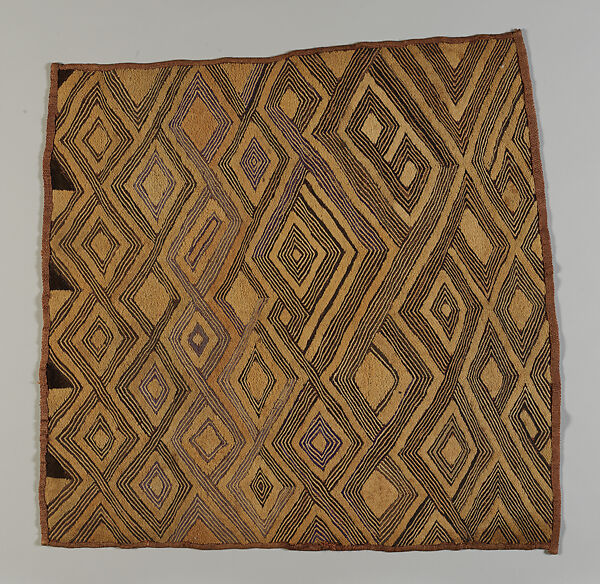
Kuba raffia cloth does not make geometry look cold. It makes geometry look handled. The square panel in the Met's collection, identified as a man's prestige cloth by Kuba peoples of the Shoowa group and dated around 1930-39, is only 23 1/2 by 23 inches, but its surface is busy with decisions: palm fiber, cut-pile embroidery, dark natural dyes, commercial "typewriter" purple, diamonds nested inside diamonds, and lines that move with enough irregularity to keep the field alive.[1]
That liveliness is the point. A Kuba prestige cloth is not a flat pattern waiting to be converted into wallpaper. It is a worked surface whose meaning depends on material sequence. Raffia has to be harvested, stripped, dried, woven, dyed, sewn, embroidered, clipped, named, kept, displayed, and eventually carried into ceremonial exchange. The cloth's abstraction is therefore not a retreat from social life. It is one of the ways social life becomes visible.
Image context: this is a real photographic image of the actual textile object, not a diagram, chart, or generated visual. It belongs here because the technique is visible in the photograph: the raffia ground, dark pile, irregular line weight, hemmed edge, and square hand scale all matter to the argument.[1]
Palm fiber becomes a ground
The first technical fact is almost easy to miss: this is palm leaf turned into cloth. The British Museum's record for a related Kuba textile describes raffia as a grass-like fiber from the raffia palm, widely used among Kuba people for ropes, fishing tackle, and cloth. Young leaves are stripped, peeled, dried, mounted on a loom, and woven by men into textile grounds.[3] The Met's broader note on prestige panels makes the transformation sound less ordinary: raffia-palm leaf becomes a medium through labor, skill, and creative imagination.[2]
That beginning matters because it keeps the cloth connected to use. Raffia is not an imported prestige material like silk arriving already coded as luxury. It comes from a local plant, then becomes refined through work. The force of the cloth is partly that it never entirely hides that origin. The surface remains fibrous, slightly matte, and responsive to touch. Its beauty is not polished smoothness; it is the disciplined conversion of a plant surface into a prestige surface.
The Met's man's prestige cloth shows this especially clearly because the ground is not simply passive backing. The tan raffia field stays visible between the dark lines. It gives the pattern warmth and friction. If the same design were printed onto cotton, the optical rhythm might survive, but the social and tactile argument would weaken. Here, the ground tells the viewer that abstraction has been built from a material with its own resistance.
Cut pile turns line into relief
The second technical fact is the pile. Cut-pile embroidery gives these cloths a low, plush relief often associated with the phrase Kasai velvet, though the textile is not velvet in the European sense. The University of Michigan Museum of Art explains that the velvet-like texture comes from a cut-pile technique in which palm-thread tufts are clipped with a sharp knife.[4] The British Museum describes the process from another angle: colored raffia thread is pulled under the weave so a small piece appears on the surface, then cut back, gradually building geometric blocks of color.[3]
That process changes how the line behaves. A painted line sits on a surface. A cut-pile line rises from it. In the Met cloth, the diamond bands are not just dark marks; they are shallow ridges of worked fiber. They catch light differently from the ground and make the pattern something the eye almost feels with the fingertips. Geometry becomes haptic. The viewer reads the textile by sight, but the image keeps suggesting touch.
This is also why the small unevenness matters. The diamonds are not machine-regular. Their edges bend, thicken, and narrow. Some interior diamonds sit confidently inside larger frames; others look slightly pressured by neighboring diagonals. That variation is not failure. It is evidence of a system in which memory, handwork, and repetition meet without becoming mechanical. The cloth's refinement comes from controlled variation, not from industrial sameness.
A divided labor system makes one surface
Kuba raffia cloth is also a collaboration across kinds of expertise. The Met states the pattern of labor plainly: men weave the base cloths, while women embroider and paint them; artists elaborate designs from memory, and motifs may carry evocative names significant to the wearer.[1] UMMA gives the same structure and adds that women design, dye, and embroider the cloths, with designs often named after the women who created them.[4]
That division should not be reduced to a footnote about production. It is part of what the object is. The cloth's surface joins different acts that remain legible: the base weave sets the physical field, the dye shifts the visual temperature, the embroidery creates raised pattern, and the final design turns repeated motifs into a named social object. The result is not anonymous ornament. It is a surface where collective technique and individual invention can coexist.
The naming of designs is especially important because it changes how abstraction is understood. A modern viewer may see diamonds, chevrons, crossings, and fill patterns. Within Kuba contexts, those patterns could have names and associations, though the same pattern might receive different names from different people.[4] That does not make the pattern a puzzle to be decoded once and for all. It means the cloth lived in a culture where abstraction could carry memory, authorship, local interpretation, and social recognition.
Prestige is a function, not an afterthought
The word "prestige" can sound vague unless the cloth's social circulation is kept in view. The Met says Kuba and related textiles were worn or displayed during ceremonial occasions as emblems of prestige, wealth, and status, and that they were sometimes used as currency.[1] Its prestige-panel entry widens the picture: such works could be worn by high-ranking people, distributed as wealth, used in dowry payments, and displayed as funerary shrouds that reflected the importance of the deceased and the extended family.[2]
The British Museum's related textile record is even more specific about status and funerary use. Cut-pile cloths, it says, indicate status within Kuba society, are collected by chiefs or men of high rank, may be given for relatives' funerals, and in many cases are displayed at the owner's own funerary ceremony to confirm status among the living.[3] UMMA adds that decorated raffia cloth was used as currency, tribute, legal settlement, public display, and initiation object.[4]
Those uses explain why the technique had to be durable in more than one sense. The cloth needed to survive handling, storage, display, and movement. It also needed to survive socially: as property, sign, memory, payment, and ceremonial presence. A prestige cloth did not merely show wealth. It helped wealth move through marriage, mourning, rank, and public recognition.
This is why the square Met panel feels larger than its dimensions. Its pattern is compact, but its job is expansive. A twenty-three-inch textile can participate in family history, hierarchy, exchange, and ceremony. The small scale concentrates rather than diminishes the stakes.
Geometry as living discipline
Kuba textiles are often admired for geometry, but the geometry works because it is never only optical. In the Met cloth, nested diamonds pull the eye inward, while long diagonals make the square feel as if it is being gently twisted. Parallel lines generate rhythm, but their hand-made spacing keeps the rhythm breathing. The pattern holds together without freezing.
That balance is the medium's special achievement. Raffia fiber provides texture and resistance. Cut-pile embroidery gives line physical body. Dyes create contrast without erasing the plant ground. Gendered labor structures production without collapsing the work into a single maker myth. Named designs allow abstraction to carry social memory. Ceremonial use turns the finished cloth into property, prestige, and public sign.
The Met's prestige-panel note includes a striking historical point: in the seventeenth century, the founder of the Kuba leadership dynasty identified so closely with the patronage and promotion of woven and embroidered textiles that he adopted the raffia-palm term "shyaam" as a name and metaphor for his reign as "Shyaam the Great."[2] Whether one approaches the cloth through a museum case, a photograph, or a history of central African design, that connection between leadership and textile patronage matters. Raffia cloth was not peripheral decoration. It belonged near the center of how refinement, rank, and inventive surface could be imagined.
Seen this way, Kuba raffia cloth teaches a sharper lesson about abstraction. Pattern is not automatically universal, disembodied, or decorative. Here, pattern is a social technology. It organizes touch, labor, plant matter, gendered skill, wealth, mourning, and memory into a surface that can be worn, shown, exchanged, and kept. The geometry feels alive because it has been through hands before it reaches the eye.[1][2][3][4]
Sources
- The Metropolitan Museum of Art, "Man's Prestige Cloth" - object page for the cover image, date, dimensions, materials, Shoowa attribution, cut-pile embroidery, gendered production, named motifs, prestige use, and currency context.
- The Metropolitan Museum of Art, "Prestige Panel" - object page and curatorial note on Kuba and Kongo raffia textile traditions, ceremonial finery, wealth, dowry, funerary display, and Shyaam the Great.
- The British Museum, "cloth; textile" - collection record describing a related Kuba/Shobwa/Bushongo raffia textile, cut-pile embroidery technique, named geometric patterns, status use, and funerary display.
- University of Michigan Museum of Art, "Raffia Textile Panel" - object page explaining Kuba raffia symbolism, men's weaving, women's design/dye/embroidery, cut-pile texture, prestige, currency, tribute, legal settlement, and named geometric patterns.