Felix Gonzalez-Torres is often introduced through beautiful disappearances: a candy spill that shrinks when visitors take from it, a paper stack that thins and returns, two clocks that begin together and drift apart. That shorthand is accurate, but it can make the work sound fragile in a sentimental way. His art is more exacting than that. It asks viewers, owners, and institutions to keep making decisions after the object has already entered the room.[1][2][3]
The materials are deliberately ordinary. Wrapped candy, commercial paper, battery-powered clocks, lightbulbs, billboards, and printed sheets all belong to everyday systems of use, replacement, purchase, timing, and public address.[4][5] Gonzalez-Torres turned those systems into emotional form. The result is an art of participation that does not flatter participation. To take a candy is to enjoy sweetness, but also to help change the portrait. To replenish a pile is to care for the work, but also to acknowledge that care is never neutral. To watch clocks move out of synchrony is to see time become intimate without becoming private.[1][2][3]
That is why an artist profile needs to begin with procedure rather than biography alone. Gonzalez-Torres was born in Cuba in 1957, grew up in Puerto Rico, and worked primarily in New York from the late 1970s into the 1990s.[4][5][8] His practice belongs to conceptual art, Minimalism's afterlife, queer cultural memory, and the AIDS crisis. But the art does not simply illustrate those contexts. It builds situations where public and private meaning have to be remade by use.
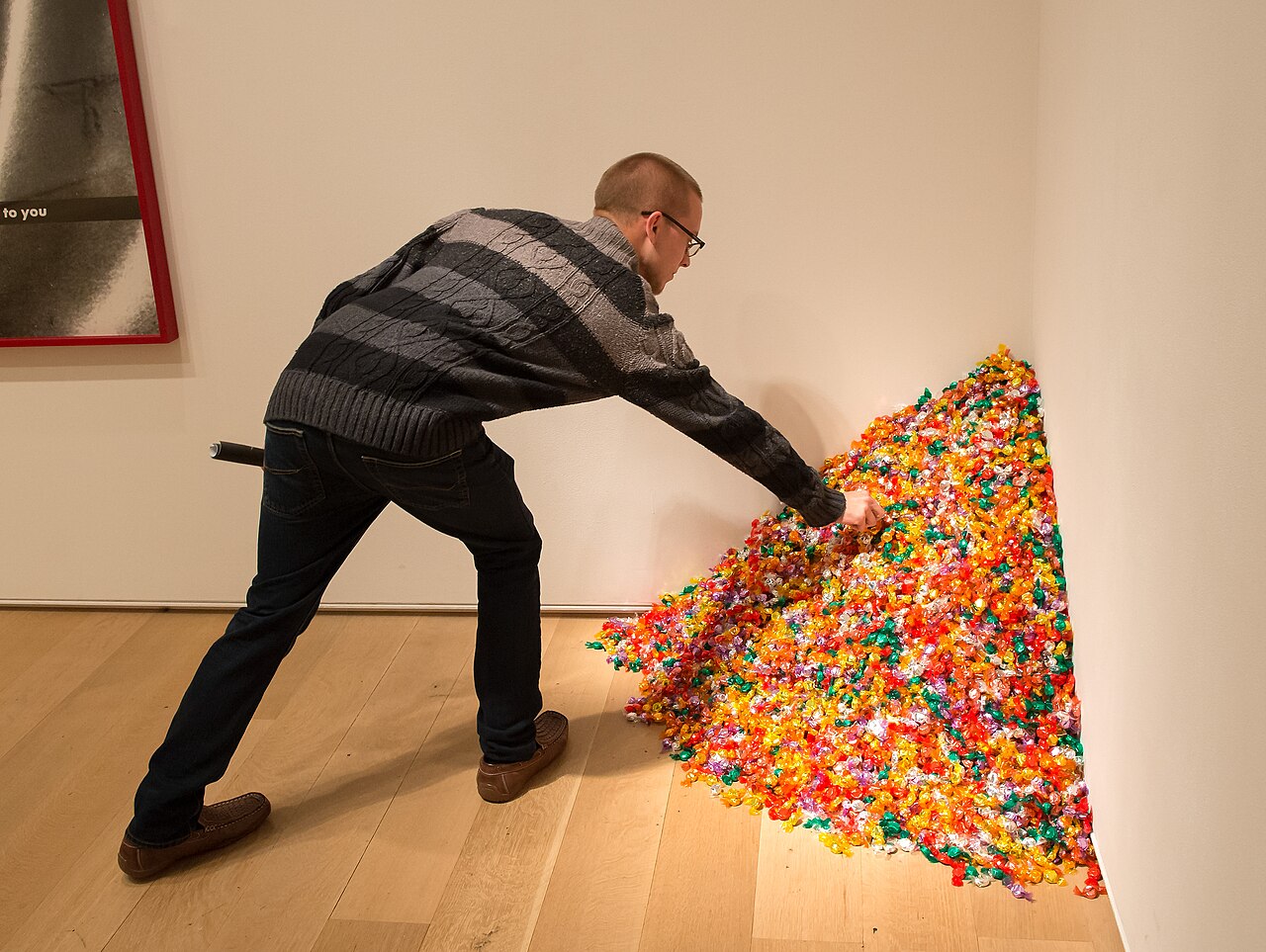
Image context: this post uses one real photographic artwork image, not a diagram, chart, or generated visual. The photograph shows a visitor taking candy from Untitled (Portrait of Ross in L.A.), a 1991 candy work in the Art Institute of Chicago collection. The gesture matters because the portrait exists through exactly this kind of permitted taking and institutional replenishment.[1][2][6]
The candy is a portrait because it can change
The Foundation's work record for Untitled (Portrait of Ross in L.A.) gives the basic facts with unusual conceptual force: 1991, candies in variously colored wrappers, dimensions that vary with installation, and an ideal weight of 175 pounds.[1] A normal portrait promises likeness. This one refuses the usual likeness entirely. There is no face, no body, no photographic resemblance. There is a pile of candy whose weight, title, and permission structure make absence perceptible.
That refusal is not evasive. It is precise. The parenthetical title names Ross, while the 175-pound ideal weight gives the portrait a bodily measure without turning that measure into a wall-label explanation.[1] The Foundation's core-tenets document notes that the ideal weights for portrait-titled candy works conceptually referred to body weights, while Gonzalez-Torres chose not to define those references in the works' captions.[2] The portrait therefore appears as mass, sweetness, and loss rather than as image. It is not a body represented from outside. It is a body translated into a changing public arrangement.
The Foundation's 2026 core-tenets document makes the operating logic even clearer. The candy works include the idea of an endless supply; visitors must be permitted to choose whether to take candy; and exhibitors have to decide how replenishment and maintenance will happen over the life of a manifestation.[2] This is not a casual invitation tacked onto a sculpture. It is the work's structure. The viewer's action, the owner's responsibility, and the institution's maintenance all become visible as parts of the same form.
That structure keeps the piece from becoming pure elegy. If the candy only disappeared, the work would risk becoming a theatrical metaphor for wasting away. Replenishment complicates that reading. The pile can diminish and return. Loss is present, but so is repeatable care. The portrait is vulnerable, but not sealed inside disappearance. It is kept in public through a cycle of taking, tasting, replacing, and returning to form.[1][2]
Participation is not decoration
Gonzalez-Torres's participatory works can look generous because they give something away. That generosity is real, but it is only one layer. The deeper force lies in how he makes a viewer responsible for crossing a line. In many museums, touching art is forbidden. Here, taking may be allowed, even required for the work's fullest encounter.[2][4] The viewer has to decide whether to act.
That decision is quiet, which is why it is effective. There is no heroic performance. A person bends down, takes candy, and leaves with a small object that is no longer the artwork by itself.[2] The action is modest enough to feel almost socially awkward. Yet the work has changed. The pile is lighter. The museum floor looks different. The viewer has converted looking into participation without being able to control the whole meaning of the act.
This is one of Gonzalez-Torres's most durable inventions: he lets the museum's ordinary rules become the medium. Permission, hesitation, signage, replenishment schedules, ownership certificates, and visitor behavior are not administrative background. They are how the artwork thinks.[2][4] The candy spill needs color and sweetness, but it also needs a social contract.
The same pattern runs through the paper stacks. SFMOMA describes one 1992/1993 stack as mass-produced prints that viewers are encouraged to take, with the work depending on master photographs, a certificate, and permission to keep duplicating the image.[3] Again, the art object does not sit still as a single precious thing. It exists through a controlled form of distribution. A sheet leaves, another can appear, and the work remains itself while refusing to behave like a fixed commodity.
The clocks make love measurable and unstable
If the candy works turn portraiture into replenishable mass, Untitled (Perfect Lovers) turns intimacy into timekeeping. The Foundation's work record dates it to 1987-1990 and describes it as two wall clocks, ideally installed above head height.[7] The basic emotional mechanism is severe because it is so legible: paired clocks can begin together, but batteries, drift, and failure mean they may eventually move apart or stop.
This is a brutally simple object. Two clocks do not need biography to be moving. Anyone can understand synchrony and drift. Yet the work gains force because Gonzalez-Torres made an everyday instrument of measurement behave like a relationship. Time is not a neutral grid around love. It is the condition that love has to endure.
The clocks also clarify why the candy works should not be read as only about consumption. Gonzalez-Torres repeatedly chose objects that already belong to systems of maintenance. Batteries must be replaced. Candies may be replenished. Paper stacks can be reprinted. Light strings can be configured differently. The art survives by making maintenance visible as a kind of fidelity.[2][3][4][7]
That fidelity is not sentimental perfection. Perfect Lovers begins in alignment but contains failure from the start. The clocks are ordinary machines, so their future mismatch is not a betrayal of the work. It is the work's condition. Like the candy pile, the piece understands care as ongoing rather than final.
Why the work still feels current
Gonzalez-Torres remains current partly because he refused the false choice between formal elegance and political pressure. Public Art Fund's biography is useful here: it places his work across billboards, paper stacks, candy, lights, puzzles, and text portraits, and stresses that audience participation mattered because viewers completed many works by taking a candy or poster.[4] That participation is never merely interactive in the thin digital sense. It is ethical, institutional, and bodily.
The Whitney's account of Untitled (America) makes the same point from another angle. It describes a mutable light-string work whose configurations can vary widely, and frames Gonzalez-Torres's practice as an ongoing exchange among artist, owner, viewer, and presentation context.[8] The word "exchange" is crucial. The work does not pretend that meaning belongs only to the artist or only to the audience. It appears between instructions, material limits, public histories, and lived response.
That helps explain why his art can look cool and still feel devastating. Minimal forms often promise neutrality. Gonzalez-Torres used that promise against itself. A pile, a pair, a stack, a string: these are clear structures. But once the viewer enters them, clarity becomes unstable. What looked like a simple arrangement begins to ask about illness, citizenship, desire, mourning, ownership, generosity, and the difference between possessing something and caring for it.[4][5][8]
The best reason to keep returning to Gonzalez-Torres is not only that his work is moving. It is that it changes what "moving" means. Feeling is not delivered as expression from the artist to the spectator. It is produced through a situation the spectator helps complete. The candy tastes sweet because it is candy. The clocks tick because they are clocks. The paper leaves because a person takes it. The art begins when those facts stop being ordinary and start becoming obligations.
Sources
- The Felix Gonzalez-Torres Foundation, "Untitled (Portrait of Ross in L.A.)" - work record for the 1991 candy work, including medium, variable dimensions, ideal weight, images, and exhibition history.
- The Felix Gonzalez-Torres Foundation, Core Tenets for Gonzalez-Torres's candy works, draft dated April 27, 2026 - guidance on endless supply, visitor taking, replenishment, certificates, variable manifestation, and the list of candy-work captions.
- SFMOMA, "Felix Gonzalez-Torres, Untitled, 1992/1993" - collection page explaining the paper-stack work as reproducible prints that viewers may take.
- Public Art Fund, "Felix Gonzalez-Torres" - artist biography on his media, audience participation, conceptual art, public projects, and major themes.
- Britannica, "Felix Gonzalez-Torres" - biographical overview of Gonzalez-Torres's life, media, conceptual practice, paper stacks, candy works, viewer participation, and AIDS-era context.
- Wikimedia Commons, "File: Untitled (Portrait of Ross in L.A.) by Felix Gonzalez-Torres.jpg" - Mark Mauno's 2013 photographic source for the cover image, showing a visitor taking candy from the artwork.
- The Felix Gonzalez-Torres Foundation, "Untitled (Perfect Lovers)" - work record for the paired wall-clock work, including date, medium, parts, dimensions, edition, images, and exhibition history.
- Whitney Museum of American Art, "Felix Gonzalez-Torres" - artist and collection page discussing mutable installation, participatory candy and paper works, biography, and themes of change, impermanence, and loss.