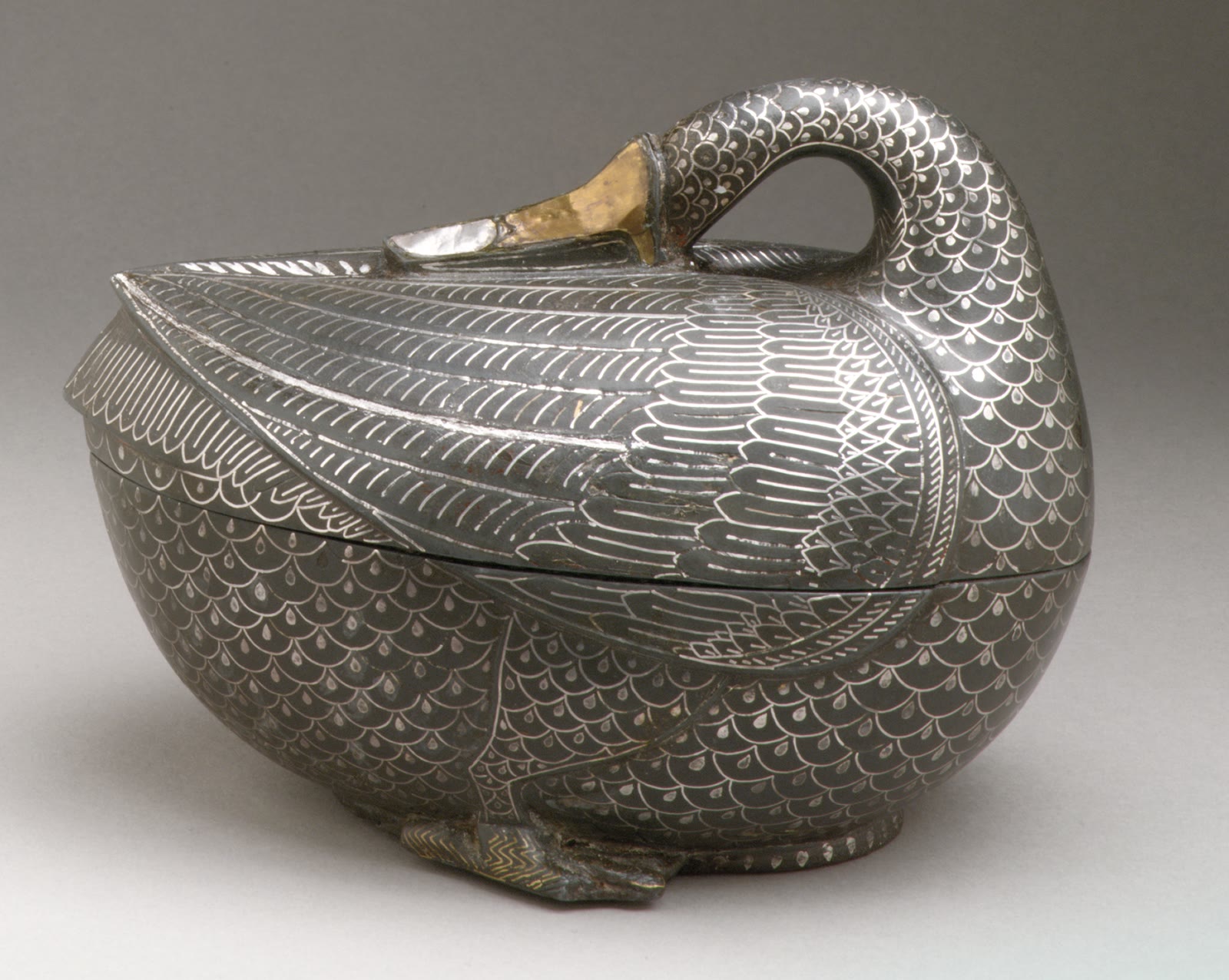
Image context: the cover is The Metropolitan Museum of Art's public-domain photograph of the exact Deccani pan box discussed below. Its resting-duck form makes the technique unusually easy to read: brass and silver marks remain bright while the zinc-rich body recedes into a deep black field.[1]
The duck appears to have settled its weight and tucked in for the night. Its rounded body is also a box, made around 1700 to hold the ingredients of pan. What looks at first like pale drawing across black metal is neither paint nor a coating laid over a dark vessel. The bright lines and shapes are metal embedded in metal. More surprisingly, the darkness came last.
That reversal is the key to Bidriware. A maker begins with a pale zinc-rich casting, cuts channels into it, hammers in silver or brass, files the metals level, and only then transforms the exposed ground. The final patination selectively darkens the alloy around the inlay. Pattern does not cover the surface; chemistry reveals the pattern by changing everything left visible around it.[2][3]
The result can feel almost immaterial—silver floating against black—but it depends on an exact sequence of heavy operations: melting, casting, filing, drawing, chiselling, hammering, polishing, heating, rinsing, and oiling. Bidriware's visual elegance is not an escape from labor. It is labor made difficult to see.
The object begins as a casting, not a black ground
Bidri takes its name from Bidar, the Deccani city with which the craft has long been associated. The Bahmanid dynasty moved its capital there in the fifteenth century; after that kingdom divided, the Barid Shahis ruled the city from the early sixteenth into the seventeenth century. Bidar belonged to a wider network of Deccani courts whose metalwork, painting, architecture, music, and poetry developed through exchanges among South Asia, Iran, Turkey, Africa, and Europe.[5]
That cosmopolitan setting is firmer than any neat invention story. The Met's catalogue Sultans of Deccan India, 1500–1700 notes that little documentary evidence survives for Bidriware's origins and that precise dating of early pieces is unusually difficult. Even a huqqa base sometimes treated as the earliest dated example carries an indistinct, disputed inscription. The honest history therefore begins with an association—Bidar, courtly Deccan, at least the seventeenth century—not a single named inventor or an unbroken tale of transmission.[2]
The base material is also less simple than the phrase “black metal” suggests. Historical Bidri objects are cast from alloys dominated by zinc, often around ninety percent, with smaller amounts of copper and sometimes lead, tin, or iron. Laboratory examination of museum vessels found copper ranging from roughly two to ten percent.[2][4] Those secondary metals are not incidental impurities. Copper, in particular, helps determine whether the final black surface can form.
Once cast, the object is rough and pale. Filing establishes its contour and gives the artisan a workable face. A temporary wash of copper sulphate may then darken the surface just enough for a freehand stylus drawing to remain visible. This first black is a guide, not the finished effect. The distinction matters because the making process passes through darkness twice: once to let the design be drawn, and again—after the inlay has been secured—to make the design shine.[3]
A chisel turns drawing into a mechanical lock
The drawn line is only a proposal. Small chisels convert it into a groove, and that groove has to be calibrated to the metal that will occupy it. Fine silver wire can carry a narrow geometric line; flattened wire or sheet can fill a broader leaf or petal. The inlay is hammered into the cut rather than painted, printed, or simply glued to the top.[2][3]
This changes how the ornament belongs to the object. A brushstroke rests on a support. Bidri inlay enters the support and relies on the pressure of its channel. Every curve requires two acts of control: removing enough alloy to admit the brighter metal, then driving that metal into place without distorting the cast form. Repetition magnifies the stakes. A border made from dozens of small units must keep its rhythm while each unit is individually incised and filled.
After inlaying, the maker files and buffs again. For a revealing interval, the surface approaches one metallic register: the zinc-rich ground is pale, and the silver can become difficult to distinguish from it. The design is physically complete but visually dormant. This midpoint overturns the finished object's apparent logic. The black is not a blank sheet onto which silver has been drawn. It is a later condition imposed on the areas that were left open.
The duck-shaped pan box makes that logic playful. The Met identifies it as a zinc-alloy Bidri object inlaid with both brass and silver and suggests that its resting-bird form may reflect Chinese porcelain duck boxes circulating in eighteenth-century India.[1] The maker did not choose between container, animal, and patterned surface. The casting supplies the body; the inlay describes it; the patina lets the bird appear to gather itself out of darkness.
The blackening is selective, not simply “oxidation”
Workshop descriptions commonly give the finishing recipe as earth associated with the interior of Bidar Fort mixed with ammonium chloride and water, applied to or around a heated object. The ground darkens while the silver remains bright; rinsing and oiling deepen the matte finish.[3] It is an irresistible story because geography seems to become an ingredient: the city does not merely name the technique but enters its surface.
Yet “special soil turns zinc black” is too tidy as an explanation. Susan La Niece and Graham Martin's technical examination of Bidri vessels found that pure zinc treated in their replication process developed a whitish-grey surface, not the characteristic black. Zinc-copper alloys did blacken, while standard brass inlays were unaffected. Their experiments produced black rapidly in a warm solution of potassium nitrate and ammonium chloride, and they concluded that copper content in the base alloy was critical.[4]
The proposed mechanism is a sequence at microscopic scale. Ammonium chloride preferentially removes zinc at the surface, leaving it richer in copper; an oxidizing agent then acts on that altered layer. The researchers could demonstrate the importance of alloy and solution, but they did not identify the final black compound or claim to have closed every chemical question.[4] That boundary is important. Laboratory replication does not make workshop knowledge false, and workshop tradition does not make the chemistry magical.
The better account lets the two kinds of evidence correct each other. Artisans preserve a situated recipe involving heat, timing, sal ammoniac, soil, rinsing, and oil. Materials analysis shows why the alloy itself has to be understood as active: the treatment does not behave identically on pure zinc, zinc-copper ground, silver, and brass. The surface is selective because each metal responds differently.
Contrast is made by controlling what does not change
Bidri's final effect depends as much on resistance as transformation. The ground must change dramatically. The inlay must not. Silver or brass becomes legible because it survives the bath close to its earlier color while the surrounding alloy moves toward black. The image is therefore produced by unequal reaction.
That inequality gives makers a remarkable range without adding pigment. A hairline of silver can behave like a drawn contour. Sheet inlay can become a pale silhouette. Brass can warm the palette without breaking the underlying rule. Dense ornament can make black read as a network of narrow intervals; sparse ornament can make it feel like depth. All of these effects originate in the same constraint: bright metal has to be mechanically secure before the dark field is chemically formed.
It also explains why conservation requires restraint. The 1987 technical study began from a practical problem: the matte black patina can be damaged by cleaning methods used on silver inlay.[4] An aggressive attempt to make the bright passages brighter may erase the very surface that gives them force. What resembles tarnish or accumulated dullness is part of the artwork's designed contrast.
The duck box is especially good at exposing that dependence. Remove the black and its bright feathering loses the night against which it reads. Remove the inlay and the dark body loses much of its articulation. Neither material supplies the image alone. The work resides in their controlled difference.
A finish reorganizes everything that came before it
Technique deep dives often move toward origins: the first mold, the first mark, the first decision. Bidriware asks us to look in the other direction. Its defining event occurs near the end. Casting makes the object possible; engraving and hammering construct the ornament; filing brings the metals into one plane. Only the last chemical operation separates them optically.
This does not make patination a decorative afterthought. It makes the finish structural. The final treatment reorganizes every earlier stage without covering it. Channels become lines, inlaid pieces become light, a pale alloy becomes a black field, and a small box becomes a sleeping bird whose surface seems to hold its own dusk.
Bidriware makes darkness after the inlay is set because its makers understand contrast as an order of operations. First secure what must remain bright. Then change the world around it.
Sources
- The Metropolitan Museum of Art, “Pan Box in the Shape of a Duck” — official record, dimensions, function, Deccani attribution, brass-and-silver Bidri medium, possible porcelain connection, and public-domain photograph used for the cover.
- Navina Najat Haidar and Marika Sardar, eds., Sultans of Deccan India, 1500–1700: Opulence and Fantasy. The Metropolitan Museum of Art, 2015 — “Bidri Ware” section on alloy, inlay, patination, object types, trade, documentary limits, and dating debates.
- National Portal and Digital Repository for Museums of India, “Bidariware,” Allahabad Museum — official object record and stepwise account of casting, temporary darkening, engraving, silver inlay, finishing, fort-soil treatment, and oiling.
- Susan La Niece and Graham Martin, “The Technical Examination of Bidri Ware,” Studies in Conservation 32, no. 3 (1987), 97–101 — alloy analyses, patination experiments, the role of copper, selective chemical response, and conservation risk.
- Marika Sardar, “Islamic Art of the Deccan.” Heilbrunn Timeline of Art History, The Metropolitan Museum of Art, 2003 — historical context for Bidar, the Barid Shahis, Deccani court culture, and Bidri metalwork.