Kerry James Marshall's Many Mansions first offers the viewer a garden, then makes the word "garden" difficult to trust. Flowers fill the foreground. Three men in white shirts and dark trousers tend the beds with the calm concentration of caretakers, churchgoers, or stagehands preparing a ceremonial ground. Behind them rise Chicago public-housing towers. Across the top, a red ribbon carries the altered biblical promise of "many mansions." The painting is lush, formal, almost festive, and the more carefully it organizes pleasure, the more pressure the scene begins to hold.[1][2]
The Art Institute of Chicago identifies Many Mansions as the first of Marshall's five large paintings about public-housing projects in Chicago and Los Angeles, including Stateway Gardens, Rockwell Gardens, and Wentworth Gardens.[1] That sequence matters because Marshall is not painting housing as background scenery. He is working through a civic euphemism. "Gardens" was the language of reform, planning, fresh air, and social improvement. In the painting, that word survives as visible landscaping, but it no longer behaves innocently. The flower beds do not erase the towers. They make the towers stranger.
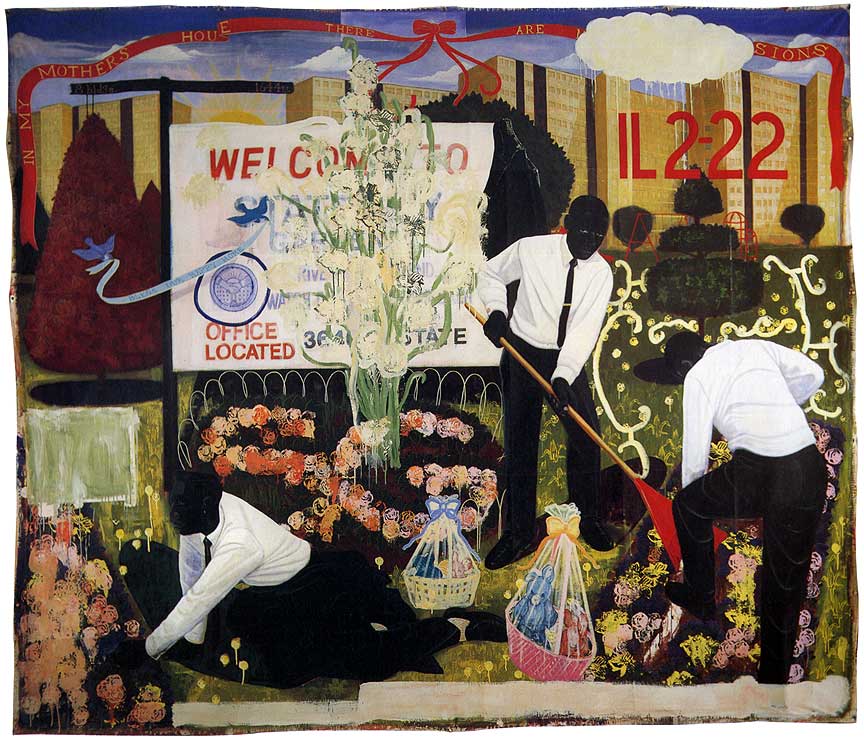
Marshall's strongest move is to refuse misery as the only available visual language for public housing. The scene is not gray documentary proof. It is bright, staged, and full of art-historical ambition. Art21's interview with Marshall records him describing the painting's Renaissance-like geometric order: a pyramidal structure, cross-angles, and a deliberate relation to grand narrative history painting.[3] That formal borrowing changes the social stakes. The figures are not inserted into a minor anecdote. They occupy the kind of compositional authority historically reserved for saints, heroes, rulers, martyrs, and national drama.
That is why the white shirts matter. They are not just local costume. Against the emphatically dark figures, the shirts create an immediate ceremonial contrast. The men look as if they belong to several systems at once: gardeners, mourners, deacons, workers, allegorical figures. Marshall keeps those identities unresolved. If they were only laborers, the painting could become a social-work scene. If they were only Sunday figures, it could become nostalgic uplift. Instead they work among flowers in clothes that make practical labor feel ritualized. The painting asks whether tending a public landscape can be an act of care, an act of performance, and an act of survival at the same time.
The background does not sit quietly. The towers are rendered with enough clarity to keep the painting tied to a real urban system, but they also behave like theatrical flats. The Art Institute's object text stresses the contradiction between the cheerful landscape and the failed promise embedded in public-housing names like Stateway Gardens.[1] Marshall turns that contradiction into the painting's spatial engine. The flowers are close enough to touch; the towers are present but flattened; the red ribbon floats above like a civic slogan that has learned to decorate itself. Nothing in the picture lets the viewer decide whether beauty is compensating for deprivation or exposing it.
The title sharpens the problem. The Art Institute notes that Many Mansions varies the biblical phrase from John 14:2.[1] In its usual devotional setting, the phrase promises shelter, abundance, and a prepared place. Marshall reroutes that promise through the language of public housing. The result is neither simple blasphemy nor simple consolation. The painting asks what happens when a phrase about heavenly dwelling meets a landscape shaped by scarcity, segregation, public policy, and managed aspiration. "Many mansions" becomes an unstable phrase: too grand for the towers, too hopeful to dismiss, too ironic to trust.
Marshall's Black figures are central to that instability. In Art21's interview, he explains that the flat, unequivocal blackness of his figures began as a rhetorical device, a way to turn visibility and invisibility into a pictorial problem rather than a slogan.[3] Many Mansions puts that device under special pressure. The figures are unmistakably present, yet their faces resist the easy legibility that viewers often demand from representational painting. They do not perform identity for quick consumption. They hold the scene together by being visually powerful and withheld at once.
That restraint is one reason the painting avoids sentimental rescue. The men are not asking to be pitied. They are not posed as passive evidence of institutional failure. They are making the garden, or remaking it, or maintaining a fiction they did not invent. Their care is real even if the name around it is suspect. This is the painting's hardest moral tension: beauty can be a form of dignity, but it can also be a mask placed over structural harm. Marshall does not choose one answer. He paints the tension so precisely that the answer keeps changing as the eye moves.
The larger career context supports that reading. The Museum of Contemporary Art Chicago's Mastry exhibition framed Marshall as an artist who examines the Western canon through history painting, landscape, portraiture, mural traditions, and comics, all while addressing what the museum calls a vacuum in the image bank.[4] The Met's version of the same retrospective described his work as a sustained effort to reassert the Black figure inside Western painting's inherited forms.[5] Many Mansions is a perfect test case because it joins landscape, history painting, urban memory, and civic critique without letting any one category govern the whole work.
The National Gallery of Art's biography also helps explain why public housing is not incidental in Marshall's art. It notes that his subject matter is rooted in African American culture and in the geography of his upbringing, including his family's move to the Nickerson Gardens public-housing project in Watts in 1963, before the Watts rebellion.[6] Many Mansions is not autobiography in any narrow sense, but it is made by an artist for whom housing projects were not abstractions in a policy report. The painting knows that a project can be a home, a failure of planning, a neighborhood, a stigma, a memory, and a pictorial problem all at once.
Look again at the flower beds. They are excessive in the best way: pinks, whites, yellows, curling lines, baskets, painted blossoms that threaten to become decoration and then become evidence. If the scene were barren, the argument would be too easy. A ruined landscape would tell viewers what to think. Marshall gives the viewer cultivated beauty instead, then asks what kind of beauty can grow in a setting already compromised by its own promises. The garden is not false because it is beautiful. It is suspicious because it is beautiful under a name that history has made difficult.
That is the enduring force of Many Mansions. It does not expose public housing by stripping away ornament. It exposes public housing by making ornament carry the contradiction. The red ribbon, the flowers, the Sunday shirts, the grand composition, the biblical title, and the high-key color all participate in the pressure. Marshall paints a scene that looks prepared for celebration, memorial, and maintenance at once. The viewer has to stand inside that overlap.
The painting's achievement is not that it turns Stateway Gardens into paradise or into indictment. It is that it refuses to let either category win cheaply. In Many Mansions, the garden is real, the care is real, the towers are real, and the promise remains damaged. Marshall makes those facts share one monumental surface. That is why the picture still feels fresh: it understands that representation is not only a matter of adding Black figures to art history. It is a matter of making the inherited forms of beauty answer to the places where people have actually had to live.[3][4][5]
Sources
- Art Institute of Chicago, "Many Mansions" - object record for Marshall's 1994 painting, including public-housing series context, Stateway Gardens, medium, dimensions, and biblical title note.
- Art21, "Kerry James Marshall: 'Many Mansions' (1994)" - gallery page and source for the artwork reproduction used in this article.
- Art21, "'Many Mansions'" - interview in which Marshall discusses the painting, its geometric structure, grand history-painting ambition, and his use of emphatically Black figures.
- Museum of Contemporary Art Chicago, Kerry James Marshall: Mastry - exhibition page placing Marshall's paintings in relation to history painting, landscape, portraiture, vernacular forms, and the "vacuum in the image bank."
- The Metropolitan Museum of Art, Kerry James Marshall: Mastry - retrospective overview on Marshall's 35-year career, the Black figure in Western painting, and his reworking of canonical pictorial forms.
- National Gallery of Art, "Kerry James Marshall" - artist biography covering Birmingham, Watts, Nickerson Gardens, Otis Art Institute, Chicago, teaching, and major career milestones.