CoBrA lasted only a few years, but it still feels more like a weather front than a style label. The name came from Copenhagen, Brussels, and Amsterdam, the cities tied to its founding artists, and the movement was officially formed in Paris on November 8, 1948, while Europe was still measuring the moral and material damage of war.[1][3][4] That timing matters. CoBrA did not ask how painting could return politely to culture. It asked what art might look like if return itself was the wrong ambition.
The group's answer was noisy, colorful, and deliberately hard to civilize. Karel Appel, Constant, Corneille, Asger Jorn, Christian Dotremont, Joseph Noiret, Pierre Alechinsky, Lucebert, and others treated painting, poetry, journals, drawing, sculpture, and collective work as parts of the same experimental field.[1][2][3] They were not united by a single polished technique. They were united by a refusal of neat postwar repair. Against the restored museum voice, they offered animals, masks, childlike forms, urgent brushwork, and a belief that freedom had to stay visibly unstable.[1][4]
The Name Was a Map, Not a Brand
CoBrA is easy to remember because the acronym is compact. That compactness can mislead. The movement was not a tidy northern-European club with one headquarters and one doctrine. The Stedelijk's exhibition history describes the artists as "experimentalists" who published a journal called CoBrA, after which the name increasingly attached to the group itself.[2] The Cobra Museum frames the group even more broadly as an international movement of young progressive artists whose shared program was freedom, experiment, and spontaneity after the nightmare of war.[3]
That structure is important because CoBrA's visual wildness was not simple individual release. It was collective. Journals, manifestos, exhibitions, and cross-border alliances mattered because the artists were trying to build an atmosphere in which disagreement could stay productive. The movement's short life, from 1948 to 1951, was part of its intensity rather than a sign of failure.[3][4] It burned through a problem quickly: how to make art after inherited cultural order had lost moral authority.
This is why the geographic acronym still works. Copenhagen, Brussels, and Amsterdam were not decorative initials. They named a route through which postwar artists could refuse national isolation without submitting to a single capital's taste. CoBrA was international, but not smooth. It wanted friction, translation, arguments, and the energy of artists discovering that they did not need Paris or official academies to authorize experiment.[1][2][3]
Childlike Did Not Mean Naive
The most common weak reading of CoBrA is that the artists painted like children because they wanted to become innocent. That misses the point. Britannica's account lists children's art, folk art, film, poetry, and so-called primitive art among the group's influences, while also stressing brilliant color, spontaneous brushwork, distorted human figures, and a kinship with action painting.[4] The childlike mark was not a retreat from history. It was a weapon against cultural manners that had proved useless.
The Cobra Museum's anniversary text is useful here because it preserves the hostile response. Dutch critics spoke of "scribble, claptrap and splotches," a phrase that accidentally clarifies the stakes.[3] The insult assumes that good art should demonstrate control, finish, and adult seriousness in recognizable forms. CoBrA answered by making disorder look chosen. The artists did not merely forget how to draw; they moved drawing toward a rougher register where an animal, face, sign, or body could appear before academic correction arrived.
That is why the best CoBrA works can feel both primitive and urban, playful and furious. A bird, beast, child, or mask may enter the picture, but it does not settle into folk charm. The forms are often compressed, scratched, swollen, or pushed through fields of hot color. The picture seems to have been made fast, yet its speed has a social meaning. It refuses the slow etiquette of repair.
The Stedelijk Became a Test Site
Amsterdam's Stedelijk Museum was central to the movement's public afterlife. Its pages note that the 1949 CoBrA exhibition at the museum caused a stir, and later Stedelijk collection histories describe CoBrA as one of the most interesting bodies of work assembled in the second half of the twentieth century.[2] That institutional route matters because CoBrA's art was made against cultural domestication and then had to survive being collected, exhibited, and explained.
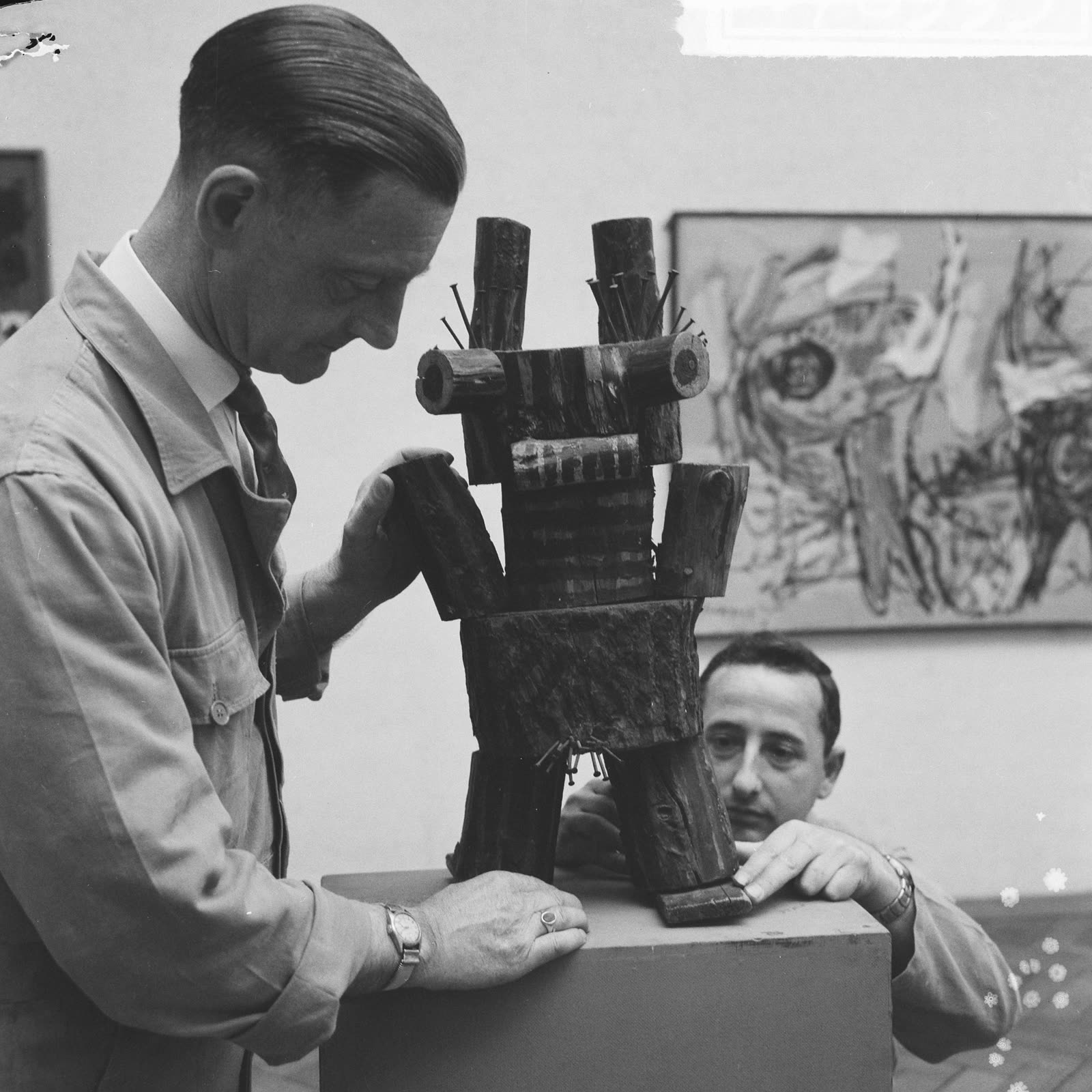
The image used for this article captures that tension from a later moment.[5] It is not a diagram or a generated illustration, but a real 1965 black-and-white archival photograph by Jack de Nijs for Anefo, showing a Karel Appel wooden figure displayed at the Stedelijk Museum.[5] The date is after CoBrA's brief official life, yet the photograph is useful precisely because it shows how one of the movement's central figures continued to trouble the museum frame. The wooden figure looks bodily, handmade, and a little unruly even while it stands inside exhibition order.
That is a strong visual clue for reading the whole movement. CoBrA did not reject museums by disappearing into private gesture. It forced museums to deal with an art that made finish look suspicious and vitality look rough. A gallery could hang the works, but it could not make them behave like polite European reconstruction.
Freedom Needed Matter, Not Slogans
The word freedom can become empty in art writing. CoBrA keeps it material. Freedom appears as thick paint, violent color, odd bodies, beast forms, collaborative publications, improvised figures, and the refusal to let one medium sit safely apart from another.[1][2][3][4] It is not freedom as lifestyle, nor freedom as decorative looseness. It is freedom as a working method.
That method had limits. CoBrA's fascination with children's art and non-Western forms can now feel historically tangled, especially when older European language about "primitive" creativity is left unexamined.[4] The movement's rhetoric of universal spontaneity could flatten the particular cultures it admired. A strong reading should keep that problem visible. CoBrA was not pure liberation. It was a postwar European avant-garde using available ideas, some of them powerful and some of them compromised, to escape a damaged inherited order.
Yet the force of the work remains. CoBrA matters because it made repair look suspect before repair could become style. It understood that after catastrophe, the polite return of culture might itself be false. The group's brief life produced a language in which the human figure could reappear distorted, the animal could become an emblem of unruly life, color could refuse civility, and collective experiment could matter more than a stable school.
The movement's strongest lesson is not that art should always look spontaneous. It is that spontaneity can be constructed as an ethical refusal. CoBrA used roughness to keep postwar culture from sounding too healed. It made freedom look unfinished because, in 1948, finished freedom would have been a lie.[1][3][4]
Sources
- Stedelijk Museum Amsterdam, "Le groupe experimental Hollandais: Appel, Constant, Corneille" - collection record for the 1949 CoBrA publication involving Appel, Constant, Corneille, Christian Dotremont, and Editions Cobra.
- Stedelijk Museum Amsterdam, "cobra & the stedelijk" - exhibition archive on the museum's CoBrA collection, journal context, experimentalist framing, and member range.
- Cobra Museum of Modern Art, "Cobra 75: A Cry for Freedom!" - exhibition page on the movement's 1948 founding, postwar freedom, spontaneity, Dutch critical reaction, and long influence.
- Encyclopaedia Britannica, "COBRA" - reference overview of the art group, its Copenhagen-Brussels-Amsterdam name, exhibitions, members, influences, color, brushwork, distorted figures, and impact.
- Wikimedia Commons, "File:Tentoonstelling werken van Karel Appel in Stedelijk Museum, houten poppetje van, Bestanddeelnr 917-8993.jpg" - Jack de Nijs/Anefo archival photograph from June 24, 1965, sourced from the Dutch National Archives and used as the article image.