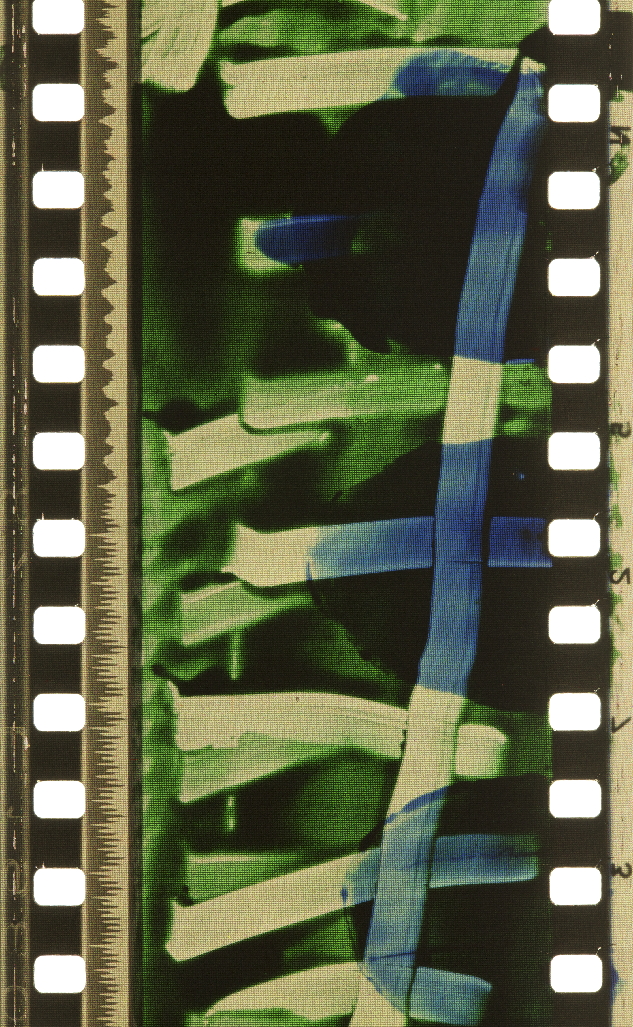
Len Lye's A Colour Box is only a few minutes long, but it changes the terms of animation almost immediately. Instead of photographing drawings, puppets, or staged movement, Lye painted and worked directly on the film strip, then let projection turn those marks into rhythm.[2][3][4] That technical fact is not a backstage curiosity. It is the whole artistic proposition: color is no longer filling a drawn figure, and motion is no longer attached to a character. The painted film surface itself becomes the performer.
The short was made in 1935 for the British General Post Office's GPO Film Unit, with John Grierson as producer and music by Don Barreto and his Cuban Orchestra.[2][3] That origin can sound oddly bureaucratic for such an exuberant object. Yet the commission is part of the work's tension. A Colour Box is both abstract film and postal advertisement. It asks a public audience to enjoy hand-painted color, syncopated movement, and then a commercial message about parcel post.[2][3] The result is not a compromise between art and utility so much as a collision that Lye makes productive.
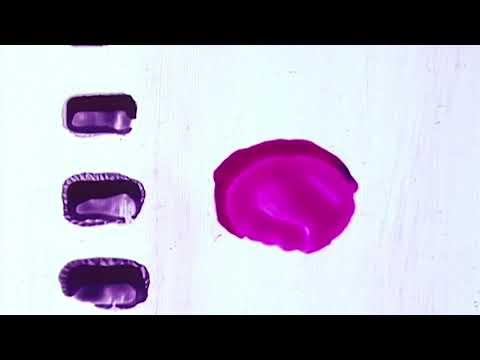
The video embedded below is useful because it restores the work's primary condition: it must move. Still images from A Colour Box are beautiful, but they can make the film look like a sequence of modernist textile samples. In motion, the marks behave differently. Lines jab, fields pulse, color seems to arrive in beats, and text appears as another graphic event rather than as a polite caption. Watch the film once for pleasure, then watch it again for how carefully the marks listen to the soundtrack.[1][4]
Image context: the cover now uses a real-world photograph of the Len Lye Centre rather than a film still, generated image, chart, or explanatory diagram. It grounds the article in the public institution built around Lye's kinetic and experimental-film legacy, while the Dufaycolor frame evidence remains in the source discussion below.[5][6]
The film strip is not a support. It is the instrument.
The first lesson of A Colour Box is that "direct animation" is a material decision before it is a style label. ACMI describes the film as Lye's first experiment with painting in color directly onto celluloid, later acquired by Grierson for the GPO and re-released with the parcel-post message.[3] The Govett-Brewster/Len Lye Centre program gives the fuller vocabulary: Lye used direct techniques such as painting, scratching, stencilling, stippling, lettering, and other mark-making on film.[4] That range helps explain why the film never settles into one type of abstraction. It keeps changing because the tool changes.
This is why the film still feels fresh. Many abstract animations organize geometry as if the screen were a stage: shapes enter, exit, and transform within a stable rectangular field. Lye's marks feel closer to gestures passing through a projector. The edge of the frame matters, but so does the length of celluloid moving through time. A line does not simply appear on screen; it has been placed on a strip that will be pulled past light at a fixed rate. The motion is mechanical, but the mark is handmade. The artwork lives in the friction between those two facts.[4][5]
Around the opening movement, look for how quickly the film establishes a grammar of impact rather than depiction. Shapes do not need to represent objects to feel timed. Their force comes from arrival, duration, interruption, and color change.[1] The music makes that legible. Lye and the sound track do not sit in parallel; the film seems to strike, slide, and flare in response to musical accents. The Govett-Brewster text quotes Lye's idea of "composing motion," and A Colour Box makes the phrase practical: motion is built as carefully as melody.[4]
Color behaves like rhythm, not decoration.
Because the film is so bright, it is easy to praise it with vague words: lively, playful, jazzy, psychedelic before psychedelia. Those words point in the right direction but miss the technical intelligence. The Timeline of Historical Film Colors identifies the work as a hand-painted film transferred to a Dufaycolor print and illustrates it through photographed archival frames from the BFI National Archive.[5] That matters because the color is not a later digital mood applied to an old film. It belongs to a historical color process and to a handmade surface.
The Dufaycolor context sharpens the viewing. Lye was not merely choosing color over black-and-white; he was making color carry timing. A red patch can behave like percussion. A yellow field can feel like a sustained note. A black interval can reset the eye. The film's small scale makes this more impressive, not less. In a short advertising film, every second has to do structural work. Lye turns that compression into velocity.
The commercial text near the end is therefore not an embarrassing add-on to be ignored. It tests the abstraction. When the GPO message appears, the viewer has already been trained to read letters as moving graphic forms. The words still sell parcel post, but they also belong to the film's visual rhythm.[2][3] The advertisement does not erase the abstraction; it reveals how confidently Lye can absorb practical text into an image system built from color and beat.
Why this little film still matters
The strongest reason to revisit A Colour Box now is that it refuses a familiar split between art and media format. Lye did not treat film as a neutral carrier for images. He treated it as a material that could be touched, scratched, painted, synchronized, projected, and made public.[4][5] That makes the work important for animation history, but also for art history more broadly. It belongs beside painting, experimental film, design, and kinetic art because it asks the same modernist question in a different medium: what happens when the support stops hiding and starts acting?
The BFI's basic record is concise: United Kingdom, 1935, directed by Len Lye, produced by John Grierson, running about four minutes.[2] Those facts anchor the piece in institutional film history. ACMI and Govett-Brewster add why the facts matter: direct celluloid painting, GPO sponsorship, restoration history, and Lye's larger pursuit of "art in motion."[3][4] The video supplies the missing experience, which is speed. It shows that A Colour Box is not a relic of early color novelty. It is a compact argument that animation can begin at the physical surface of film and still reach a mass audience.
That is the durable lesson. Lye made a postal advertisement behave like a hand-painted performance. He made color do rhythmic labor. He made text enter as part of the dance. Most of all, he made the strip of film visible as an artistic site. Once that clicks, A Colour Box stops looking like an oddity from 1935 and starts looking like a clear ancestor of later cameraless film, music visualization, motion graphics, and every moving image practice that treats the medium itself as something to be played.
Sources
- optimisticwombatninja08, "A Colour Box - Len Lye (1935)" - YouTube video used for the embedded viewing copy.
- British Film Institute, "A Colour Box (1935)" - film record with director, producer, country, running time, and BFI Player listing.
- ACMI, "A Colour box" - collection record on Lye's direct painting on celluloid, GPO acquisition, advertising re-release, and restoration note.
- Govett-Brewster Art Gallery / Len Lye Centre, Projection Series #1: Len Lye's Colour Box - program PDF on direct film techniques, "composing motion," and Lye's experimental-film context.
- Timeline of Historical Film Colors, "A Colour Box (1935)" - Dufaycolor record and photographed archival film frames credited to the BFI National Archive.
- Wikimedia Commons, "Len Lye Exterior.jpg" - real-world photograph of the Len Lye Centre exterior in New Plymouth.