Joseph Beuys remains one of those artists whose reputation can feel larger than any single object. That scale is part of the difficulty. He was a German artist, teacher, performance artist, and theorist associated with Fluxus, public discussion, and an "extended definition of art" that tried to pull artistic practice toward society and politics.[1] That ambition made him magnetic to some viewers and intolerable to others. The useful way to approach him now is not to begin with the myth of the charismatic sage. It is to begin with a structural question: what happens when an artist treats speech, teaching, argument, and collective maintenance as sculptural material?
That question explains why Beuys still matters. His real wager was that sculpture did not have to remain a bounded object on a pedestal. It could become a form for organizing relations between people, institutions, and the built environment.[1][2] The phrase most closely attached to that wager is "social sculpture," a theory Beuys developed in the 1970s around the claim that every aspect of life could be approached creatively and that society itself might be shaped as a work in progress.[2] That claim can sound vague when it is reduced to slogan. It becomes sharper when one looks at the actual forms Beuys used: blackboards, lectures, microphones, campaign structures, vitrines, cars, spades, basalt markers, and oak trees.[2][3][4]
The first thing to notice is that Beuys did not simply abandon objects. He changed what objects were supposed to do. The Guggenheim's collection text on his later work marks a decisive turn by 1962: Beuys ceased creating conventional objects and moved toward performance and sculptural experiments with nontraditional materials.[4] That shift is often described as dematerialization, but that is only half right. His work did not become immaterial. It became infrastructural. Materials such as felt, fat, copper, cord, blackboards, and tools were asked to carry memory, instruction, and social choreography rather than just formal presence.[4]
This is why the classroom matters so much in a Beuys profile. Tate's account of Information Action at the Tate Gallery in 1972 describes a lecture-discussion in which Beuys used blackboards to diagram human creativity and the political possibility of direct democracy, while the audience argued back in real time.[3] The work's force did not sit in a polished finished object. It sat in the way a blackboard, a microphone, a gallery floor, and an assembled crowd structured who could speak, how authority appeared, and how disagreement was staged.[3] Tate's essay makes the key point clearly: the media of delivery were not neutral supports, because they shaped the very social relation the work claimed to examine.[3]
That observation helps rescue Beuys from both easy admiration and easy dismissal. If one looks only at his rhetoric, one may hear messianic inflation. If one looks only at relics, one may see leftovers from performances that are gone. The stronger reading sits between those poles. Beuys was trying to give politics a form that could be felt materially. His lectures were not secondary explanation attached to an artwork elsewhere. Very often they were the artwork's central mechanism.[3] The blackboard mattered because it turned abstract civic language into a visible diagram. The microphone mattered because it distributed speech unevenly, making democracy's problem legible inside the event itself.[3]
Seen from that angle, "social sculpture" becomes less mystical and more demanding. Tate's glossary defines it as Beuys's theory that life itself could be approached creatively and that everyone helps shape the social form.[2] The line is famous, but the more interesting part is practical. Beuys attached the idea to environmental and political concerns, not just to a generalized celebration of creativity.[2] He wanted social form to be organized, argued over, and materially built. That is where his best-known public project, 7000 Oaks, becomes indispensable.
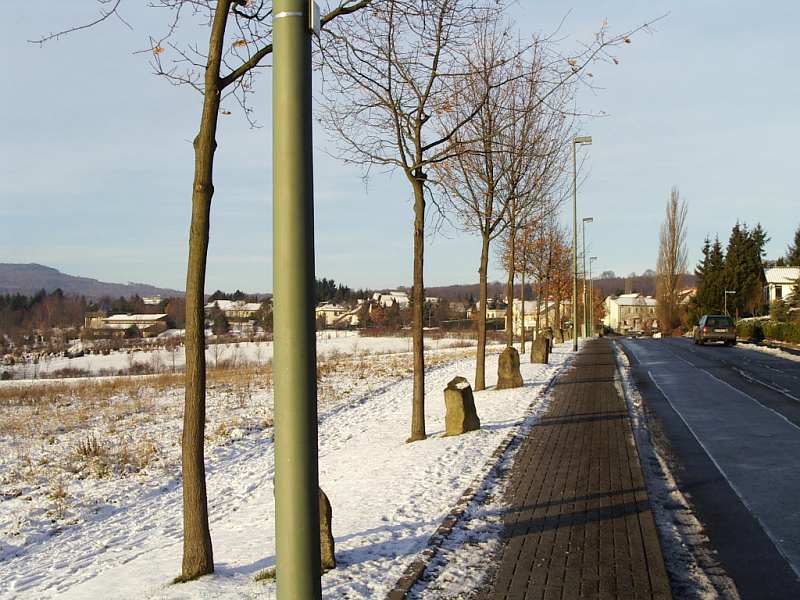
Tate describes 7000 Oaks as a five-year project begun in Kassel in 1982 that involved planting seven thousand trees and raised questions about city planning, environment, and social structure.[2] The work's importance lies in its refusal of instant completion. Trees grow slowly. Stones remain. Municipal space has to absorb the work over time. A public sculpture in that sense is not an event one attends once. It is a long negotiation between concept, maintenance, neighborhood memory, and ecological change.[2][5]
The lead image for this article, drawn from a Wikimedia Commons photograph of 7000 Oaks in Kassel, shows exactly why the project is stronger than the caricature of Beuys as a pure provocateur.[6] The basalt marker is blunt and heavy. The oak is living duration. Neither element alone is the work. The sculpture happens in their pairing and in the city's obligation to live with that pairing. Beuys's public form is therefore not immaterial after all. It is stubbornly physical, but physical in a slower register than traditional monumentality.[2][5][6]
Guggenheim's collection text on F. I. U.: The Defense of Nature makes the same point from another side. It links Beuys's ecological campaigning in the 1980s to the Free International University and notes how performance materials such as a car, pamphlets, copper tubing, spades, and blackboards could become artworks that also funded future projects.[4] That circulation is crucial. For Beuys, art did not end when action started, and action did not end when an object entered a museum. The two states bled into one another. A campaign could generate a sculpture; a sculpture could carry the residue of a campaign.
That is the profile worth keeping. Beuys was not significant because every pronouncement of his now sounds persuasive. He was significant because he forced a harder question onto postwar art: what if the boundary of sculpture were not the edge of the object, but the edge of a public process? His answer was uneven, theatrical, and sometimes exasperating. It was also genuinely generative. Later artists working with pedagogy, environmental practice, social participation, and institutional critique keep returning to problems he made difficult to ignore.[2][3]
The durable Beuys is therefore not only the felt, the fat, or the self-invented legend. It is the artist who tried to make form answerable to civic life. Blackboards, arguments, organizational structures, and oak trees were his way of testing whether art could hold that burden without collapsing into propaganda or decor. The test remains unfinished. That is one reason the work still feels alive.
Sources
- Tate, "Joseph Beuys 1921-1986" - artist page with biographical overview, Fluxus context, Free International University, and Beuys's extended definition of art.
- Tate, "Social sculpture" - glossary entry on Beuys's theory and the civic-environmental stakes of 7000 Oaks.
- Tate, "Joseph Beuys 1921-1986 Information Action 1972" - research essay on blackboards, microphone politics, lecture form, and direct democracy in performance.
- Guggenheim Museum, "Untitled" - collection text discussing Beuys's shift from objects to performance, the Free International University, and F.I.U.: The Defense of Nature.
- Dia Art Foundation, "Joseph Beuys, 7000 Oaks, 1982-1987" - current site page for the long-duration Kassel project.
- Wikimedia Commons, "File:Kassel-beuys-7000-eichen-wegmann-v-o.jpg" - source page for the photograph of 7000 Oaks used as the article image.