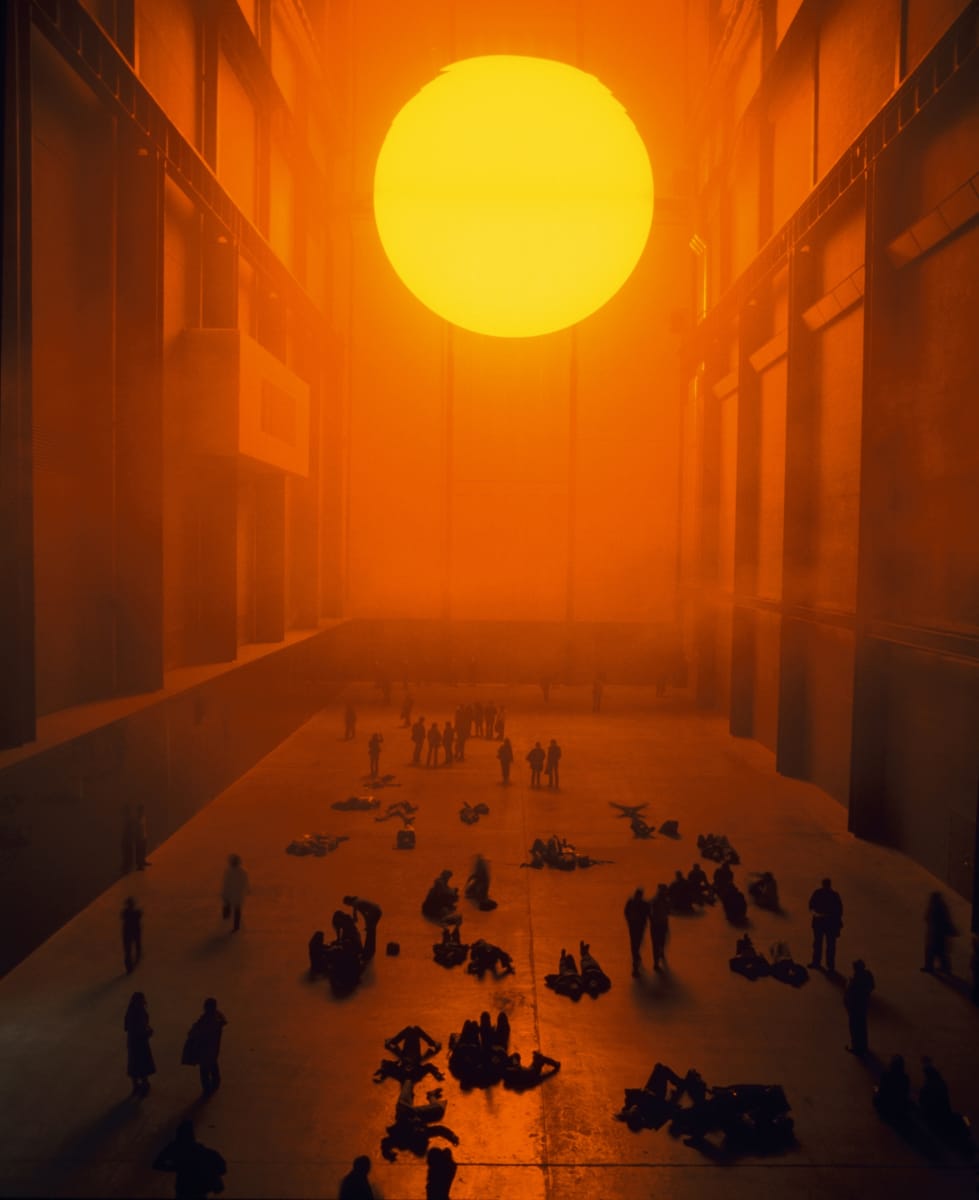
Olafur Eliasson's The Weather Project is easy to remember as a spectacular fake sunset. That memory is accurate, but incomplete. The installation's lasting power came from the fact that it did not simply place a glowing object in Tate Modern's Turbine Hall. It rebuilt the hall into a weather system that viewers had to enter with their full bodies.[1][2] Haze made light feel thick. A giant mirror ceiling doubled the room. The artificial sun was only a semicircle, completed by reflection. What looked at first like a natural phenomenon was, on closer inspection, a carefully staged machine for public self-awareness.[1]
That is why a close reading matters more than a simple account of the work's popularity. Eliasson's own studio description is unusually clear about the mechanics: a semi-circular screen, mirror foil on suspended aluminium frames, artificial mist, and about 200 mono-frequency lamps produced the illusion.[1] The important part is what those materials did together. They made weather look constructed without making it feel fake in a dismissive way. The point was not to trick the visitor into believing the sun had entered the building. The point was to show how quickly a built environment could become emotional, social, and collective once light, scale, and reflection were rearranged.[1][4][5]
Image context: the cover uses Studio Olafur Eliasson's installation photograph from Tate Modern rather than a later reproduction or crop from a catalogue. That choice matters because this essay depends on the work as a lived public scene: people standing, drifting, and lying on the concrete floor under a suspended orange glow, not a detached object shot in isolation.[1]
1) The work begins by splitting the sun in half
The first strong decision in The Weather Project is geometric. According to the studio's artwork page, the "sun" was not a full disc mounted on the far wall but a semicircular screen whose reflection in the mirror ceiling completed the image.[1] That matters because the work begins as an admission of incompleteness. The installation needs the room in order to finish itself. It needs architecture, reflection, and viewer position. The visitor does not face a self-sufficient sculpture. The visitor faces a condition.
This split sun changes the emotional logic of the piece. A complete disc would have behaved more like a monumental object, something to admire at a distance. The reflected semicircle behaves differently. It depends on alignment. It makes the eye collaborate with the room. From some positions the image reads as a stable orb, but the viewer is never allowed to forget that the whole thing is a contract between material setup and perception.[1] The work is therefore immersive without pretending to be innocent. It says: this atmosphere has been built.
That built quality helps explain why the installation still feels more exact than many later immersive rooms. Nothing here is overloaded. The materials list is almost austere: monofrequency lights, projection foil, haze machines, mirror foil, aluminium, scaffolding.[1] The reduced palette keeps the experience legible. Instead of a flood of effects, Eliasson gives one dominant chromatic field and one governing spatial operation. The hall becomes both larger and flatter at once: larger because the mirror doubles it, flatter because the glowing disc compresses distance into one luminous horizon.
2) Haze turns light into a material you can almost touch
The installation would be much weaker without fog. Eliasson's description stresses the artificial mist, and that detail is structural rather than decorative.[1] Haze gives the light something to inhabit. It makes illumination stop behaving like invisible support and start behaving like a visible substance. The room is not merely lit orange; it is filled with orange atmosphere. That shift is why visitors did not just look at the work. They seemed to bathe in it.
This is where the piece becomes art rather than event design. Weather normally surrounds people without asking to be examined. The Weather Project slows that relation down. It lets visitors notice that atmosphere is not background but condition. Louise Hornby's essay on Eliasson is useful here because it emphasizes the enlarged scale and colored fog through which spectators become newly aware of both environment and their own position inside it.[5] Whether one finds that politically expansive or overly centered on human feeling, the formal observation is correct. The haze turns perception itself into content.
It also changes time. Fog softens edges, slows the eye, and encourages lingering. In ordinary museum viewing, the body tends to move from object to object. Here the room becomes the object, and the object has no sharp contour that would let viewing end cleanly. The light does not conclude at the edge of a frame. It extends into the air between strangers. That is one reason the installation encouraged loitering, reclining, and group stillness rather than brisk circulation.[1][4] The work asks for duration because atmosphere cannot be consumed in one glance.
3) The mirror ceiling turns the crowd into part of the image
The most memorable social effect of The Weather Project may be the simplest one: people lay down on the floor and looked up. The mirror ceiling did not only double the hall; it folded the audience into the piece.[1][3] Once visitors saw themselves reflected high above, the public inside the museum became a temporary skywriting of bodies. Couples, clusters, solitary viewers, and improvised human patterns all became part of the visible field.
That move is central to the work's intelligence because it changes spectatorship from private absorption to shared display. A conventional painting can gather viewers, but those viewers remain external to the image. Eliasson removes that separation. You come to see the work and discover that the work includes your posture, your scale, your social distance from others, and your willingness to become visible inside a collective reflection.[1][4] The installation therefore behaves like a public square disguised as weather.
The Commons file page for a 2003 photograph of the installation captures this well in documentary form: bodies are scattered across the floor rather than lined up before a wall.[3] That arrangement is not incidental crowd behavior. It is a formal consequence of the mirror. People recline because the work's key pictorial action is overhead. The installation reorganizes museum decorum through one spatial demand: look up together.
This is also where interpretive disagreement around the piece becomes productive. Sorensen and Lee argue that the work's seductive spectacle suspends critique even as it gestures toward political collectivity.[4] That criticism has force. The crowd can look blissfully harmonious under the orange glow. Yet the piece remains stronger than a simple feel-good mass image because the mechanism is visible. The mirror does not hide social construction; it stages it. The public appears as a public because architecture and optics have made that appearance possible.
4) Wonder survives because the mechanism stays visible
One of Eliasson's smartest choices was to let the illusion remain inspectable. The studio notes that visitors who walked to the far end of the hall could see how the sun was constructed, and that the reverse of the mirror structure was visible from the museum's upper floor.[1] The work therefore refuses the cheap version of immersion in which technical explanation would destroy the effect. Here explanation is part of the effect.
That transparency matters because The Weather Project is not really about deception. It is about the relation between construction and experience. Knowing that the sun is a semicircle of lamps does not cancel the atmosphere. If anything, it sharpens the question of why such a simple setup can reorganize an enormous industrial room and the behavior of thousands of viewers. The installation keeps asking how little it takes to turn infrastructure into feeling.[1][5]
This is why the work remains a useful benchmark for installation art. Many immersive environments try to overwhelm skepticism by adding more stimulus. Eliasson does the opposite. He lets viewers move between enchantment and analysis. They can marvel, then reverse-engineer the marvel, then return to marveling with fuller awareness. The piece trusts that demystification does not have to flatten experience. It can deepen it.
5) Why the work still reads as public, not just spectacular
Twenty years later, the installation still feels contemporary because it grasped something larger than museum spectacle. It showed that atmosphere is social. Weather in the work is never purely meteorological. It is a medium for being with others inside an institution, inside a city, inside a managed interior that suddenly behaves like a common sky.[1][2] The title sounds neutral, but the room it names is civic.
That is also why the work keeps attracting theoretical arguments about collectivity, climate, and the politics of experience.[4][5] One can press on its limits. The installation is tightly controlled. The weather is artificial. The public is safely inside a museum. Yet those limits are exactly what make the work legible. Eliasson does not bring nature indoors in any naive sense. He stages a public exercise in noticing that many of the atmospheres we inhabit are already designed, managed, and collectively felt.[1][5]
Seen this way, The Weather Project endures because it found a precise balance that many large installations miss. It is spectacular, but its spectacle is structurally readable. It is collective, but the collectivity appears through specific bodily choices: standing, drifting, reclining, looking up, recognizing oneself in the mirror among others.[1][3][4] And it is artificial, but that artificiality is not a flaw to be corrected. It is the work's central truth. The weather room is public because it has been made, together with the viewers who complete it.
Sources
- Studio Olafur Eliasson, "The weather project, 2003" - official artwork page with installation description, materials, mirror-ceiling construction, artificial mist, and viewing notes.
- Studio Olafur Eliasson, "20 years ago, Olafur created 'The weather project' for the Turbine Hall of Tate Modern" - 2023 studio note restating the work's construction and installation context.
- Wikimedia Commons, "File:Tate.modern.weather.project.jpg" - Michael Reeve's 2003 installation photograph file page with date, authorship, and source metadata for the public scene pictured here.
- Eli Park Sorensen and Marvin Lee, "Olafur Eliasson's The Weather Project and the Birth of the Political," Humanities Bulletin 4, no. 1 (2021) - essay on spectacle, collectivity, and the work's political framing.
- Louise Hornby, "Appropriating the Weather: Olafur Eliasson and Climate Control," Environmental Humanities 9, no. 1 (2017) - article abstract and publication page on scale, colored fog, perception, and climate-control critique.