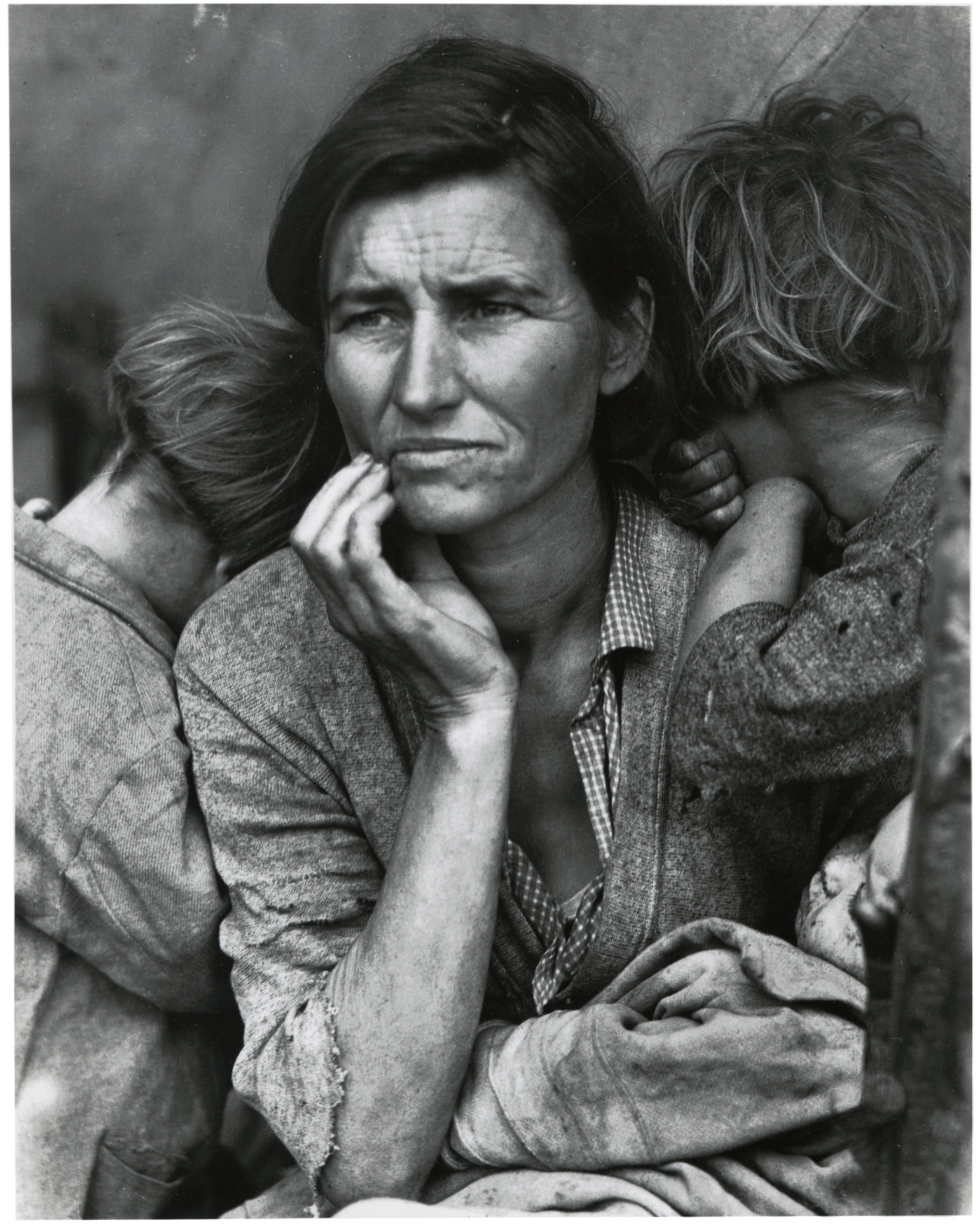
Migrant Mother is so familiar that it can start to look inevitable, as if Dorothea Lange merely arrived in front of suffering and history took care of the rest. That misses what the photograph actually does. Its force is formal before it is mythical. A mother sits at the center, two older children turn their faces away into her shoulders, an infant slips mostly out of view, and one hand holds the side of her face as if thought itself has become a physical weight. The picture does not simply show hardship. It organizes hardship into a structure the eye cannot leave.[1][4]
The context matters because the image was not born as an isolated icon. The Library of Congress's research guide places the photograph within a series Dorothea Lange made in Nipomo, California, in March 1936 while concluding a month-long trip documenting migratory farm labor for the Resettlement Administration, later the Farm Security Administration.[2] The same Library of Congress exhibition materials emphasize that the famous image is one frame from a larger encounter rather than a single miraculous shot.[5] The Smithsonian's object page adds the crucial afterlife: the photograph was first published in a San Francisco newspaper, quickly became emblematic of Depression hardship, and the once-anonymous mother was later identified as Florence Owens Thompson.[1]
That chain of facts helps clarify why the picture still works. It is not important only because it documents poverty in the 1930s. It is important because Lange found a way to turn one specific encounter into a visual grammar of worry without draining the sitter of her particular life.
Image context: the cover image uses the Smithsonian's reproduction of Migrant Mother, Nipomo, California. It matches the article exactly because the argument depends on the photograph's own structure rather than on later posters, stamps, or derivative crops.[1]
1) The children do the opposite of what portrait convention usually wants
Many famous portraits depend on reciprocal visibility. Someone meets the viewer's eye, and the drama of recognition begins there. Lange breaks that logic. In the Getty's teaching guide, the composition is described as tightly cropped and pyramidal, with the mother's face at the apex of the grouping.[4] That pyramid would feel stable or even monumental if the children looked outward. Instead, the two older children turn away. Their bodies lean inward, but their faces refuse the camera.
That refusal matters because it keeps the picture from becoming sentimental anecdote. The children are not there to perform innocence for us. They make the mother carry the full burden of legibility. She must absorb their dependence and the viewer's attention at the same time. The result is a strange dual motion: the image feels intimate because the family is compressed into one small field, but it also feels impersonal because almost no one in it is available for ordinary portrait exchange.
This is one reason the photograph can feel harsher than many overtly dramatic documentary images. Nothing is theatrically happening. No gesture begs. No facial expression is exaggerated. The children hide, and the mother thinks. That is enough. The pressure travels through posture instead of spectacle.
2) The hand and the crop turn anxiety into form
Getty's guide points to the mother's arm as a strong line leading upward toward the face, and that is exactly where the picture's emotional mechanics sit.[4] Her right hand braces her cheek, but the gesture is neither decorative nor relaxed. It looks like a support structure, something temporarily holding the head in place while thought outruns action. The photograph becomes memorable because worry is not abstract. It has weight, and the hand shows where that weight lands.
The crop intensifies that effect. Getty notes that the image is tightly framed around body language rather than the broader setting.[4] Lange could have told the same story with more tent, more camp, more surrounding objects, more documentary explanation. The famous frame withholds most of that. We get just enough environment to know this is a provisional shelter, then the background falls away. There is no horizon to relieve the eye, no social panorama to spread the responsibility outward. The scene narrows until thought, skin, cloth, and touch do nearly all the work.
That narrowing is why the picture still reads so strongly even in reproduction. The photograph does not ask the viewer to survey conditions from a safe distance. It presses the problem close to the surface. The mother's forehead, mouth, hand, and collar carry more narrative force than any amount of panoramic misery could.
3) The image gains force when you remember it is one frame from a sequence
The Library of Congress guide stresses that Migrant Mother belongs to a series of photographs Lange made of Florence Owens Thompson and her children in Nipomo.[2] The exhibition page for A Picture of Humanity pushes the point further: the famous image becomes richer when seen alongside related frames and with some knowledge of the purpose for which it was made.[5] That matters because the photograph's authority does not come from raw immediacy alone. It also comes from selection.
In other words, the iconic frame is an edit. Lange made multiple exposures, and the one that stayed in public memory is the image in which distraction has been reduced to a minimum.[2][5] The sequence reminds us that documentary force is not the absence of form. It is form under ethical pressure. Lange did not invent the family's condition, but she did decide how a viewer would meet it. The famous version removes enough surrounding incident that the image stops reading as one camp note among many and starts reading as a distilled public fact.
That is a useful corrective to the lazy split between "document" and "art." What makes the photograph powerful as documentary is inseparable from what makes it powerful as a constructed image. The series proves that the picture's emotional density was made, not merely found.
4) Why the photograph became public so quickly
The Smithsonian describes the image as one of the most famous photographs of the Depression era.[1] Britannica goes further and notes that Roy Stryker treated it as the iconic representation of the Farm Security Administration's agenda.[3] Getty's account explains why the response was immediate: within twenty-four hours of Lange making the photographs, the images were with an editor at the San Francisco News, and the resulting report helped trigger federal food aid for the migrants.[4]
That speed is part of the work's meaning. Migrant Mother lasts because it sits at the crossing point of art, journalism, and state visibility. It is a composed image, but not a private one. It is emotionally concentrated, but not inward. It gives public institutions and newspaper readers a face they can no longer keep at the level of statistics.
The danger, of course, is that an icon can flatten the person inside it. That is why the later identification of Florence Owens Thompson matters so much.[1] The picture's force depends on generalization, but its dignity depends on remembering that the generalization came from a particular woman in a particular camp in a particular month of 1936. Lange's achievement was not to erase that specificity. It was to compress it so tightly that the photograph could move far beyond the moment of exposure without losing human weight.
Sources
- Smithsonian Institution,
"Migrant Mother," by Dorothea Lange- object page with description, publication history, identification of Florence Thompson, and Smithsonian image record. - Library of Congress,
Introduction - Dorothea Lange's "Migrant Mother" Photographs in the Farm Security Administration Collection- research guide on the Nipomo series, Lange's month-long trip, and the sequence context. - Encyclopaedia Britannica,
Dorothea Lange- biography page covering the Resettlement Administration/FSA context and the photograph's iconic status within Lange's career. - J. Paul Getty Museum,
Human Erosion in California (Migrant Mother), Dorothea Lange- teaching guide on the photograph's formal structure, tight crop, pyramidal grouping, and immediate newspaper/public-aid afterlife. - Library of Congress,
A Picture of Humanity- exhibition item transcript explaining the image's status as one photograph within a larger Nipomo series and the importance of related frames.