
Jankel Adler's surviving sketchbooks are easy to misread if they are approached as rehearsal material: preparatory pages, studio leftovers, private notes that point toward more important finished paintings elsewhere. Tate's short archival film about the notebooks suggests a more demanding way to look at them.[1] These sixteen volumes, held in Tate Archive and described in the European Jewish Archives Portal as dating from 1933 to 1949, do not merely support the work. They are the work's portable condition of possibility.[1][2] When exile stripped Adler of continuity, the sketchbook kept continuity in his hands.
That matters because Adler's life was repeatedly broken by political force. Ben Uri's biography places him first in the Young Yiddish group in Lodz, then among the avant-garde circles of Germany, where friendships with Paul Klee and later Picasso mattered to the development of his style.[3] By 1933, at the height of his success in Germany, he had to flee Nazi rule; by 1937 his work had still been pulled into the notorious Entartete Kunst exhibition as an object of denunciation.[3] The broad outline is familiar in twentieth-century art history. What the sketchbooks give back is not only chronology, but pressure: how an artist keeps working when place after place becomes temporary.
The British sources sharpen the later phase of that journey. The British Council notes that Adler served with the Polish Army and was evacuated from Dunkirk, then lived in Glasgow before moving to London, where his proximity to Robert Colquhoun, Robert MacBryde, John Minton, Keith Vaughan, and Prunella Clough placed him inside a live British network rather than in passive refuge.[4] Ben Uri goes further, stressing how Adler's printmaking and pictorial intelligence fed directly into wartime and postwar British art.[3] In that setting the sketchbook becomes more than a notebook of fragments. It becomes a method for carrying form across borders fast enough that influence can survive the journey.
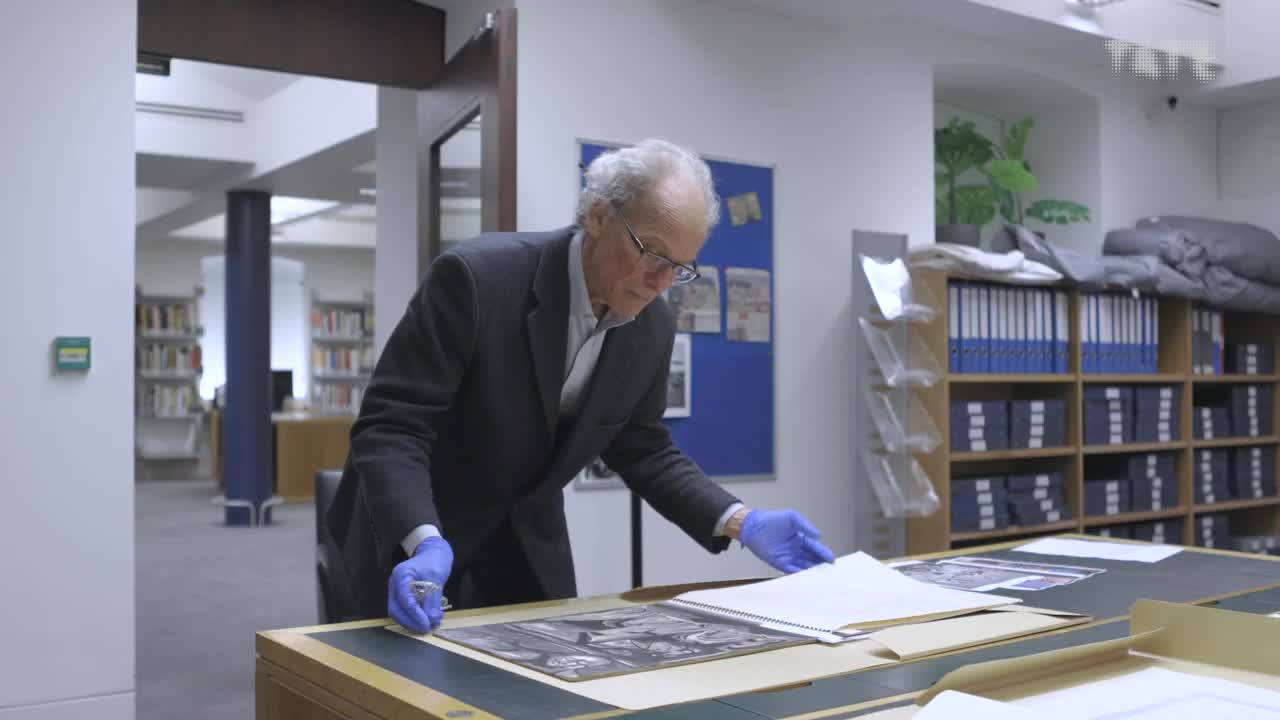
Tate's own archive framing is what makes the film especially strong. The museum's 2023 video brings together David Aukin and Glenn Sujo around the actual books, while Tate's archive and project material identifies the notebooks as part of the Emigre Art Archives Project, a digitisation and cataloguing effort designed to make exile-era holdings newly usable.[1][5] The article's image comes from that film for the same reason the video itself works: the archive is shown as a table of handling, turning, pointing, remembering, and re-reading, not as a mausoleum.[1]
Video provenance note: this embedded Tate film from 2023 presents Jankel Adler's sketchbooks in the archive reading room through commentary by David Aukin and Glenn Sujo, and forms the primary archival object discussed below.[1]
The film's first achievement is to turn biography into handling
What the video does in its opening minute is quietly exacting.[1] David Aukin starts with memory and charisma, recalling Adler not as a remote canon figure but as a person whose studio he had physically entered.[1] That personal route matters because the film refuses the clean institutional voice that often settles over archival objects. The books arrive already surrounded by friendship, inheritance, and household preservation. The archive is social before it is scholarly.
Then the film pivots toward the larger historical map. Sujo describes Adler as a figure moving between a traditional Yiddish-speaking Jewish world and the assimilative pull of modernism, while the video's own description condenses the forced route from Germany through continental movement to wartime Britain.[1] The important point is not that the sketchbooks illustrate each station like diary entries. It is that the books hold a working hand steady while nationality, language, and residence are all destabilized. Around the 1:20 mark, the film calls the notebooks a record of a "thinking life" and of Adler's movements.[1] That phrase is the key to the whole piece. Movement here is not metaphor. It is a material condition for drawing.
Around the middle, the Glasgow pages stop looking provincial and start looking transitional
The strongest passage in the video comes when the speakers move into the wartime British notebooks.[1] Aukin imagines Adler carrying such a book through evacuation from France and into Britain, while Sujo reads the first Glasgow sketchbook as an attempt to "lay down some roots" without giving up the visual habits Adler had brought with him from the Continent.[1] That is a large claim, but it is grounded by the pages on screen and by the external biographies. Ben Uri emphasizes that Adler and Josef Herman became catalytic presences in Glasgow's wartime art world, while the British Council notes Adler's later proximity to younger London painters.[3][4] The sketchbooks make those transitions visible at working scale.
That visibility matters for art history because exile is often narrated too cleanly, as if artistic identity were packed in one country and unpacked unchanged in another. The Glasgow material shown in the film points to something subtler.[1] Religious memory, figural shorthand, painterly compression, and modernist deformation keep entering the same pages together. One notebook page discussed in the film turns congregational imagery into a shimmering, unstable mass.[1] The notebook is therefore not simply preserving an older self against change. It is a place where inherited Jewish form, wartime stress, and a new British setting grind against one another until a different syntax emerges.
The late turn toward Tremblinka changes the archive's temperature
The last third of the film is what justifies the archival-spotlight mode.[1] Aukin's family recollection of preserving the studio material after Adler's death pulls the books away from abstraction and back toward contingency: somebody had to decide these pages were worth saving, portfolio them, number them, and keep them from dispersal.[1] That story of custody is part of the work's meaning now. Without it, the surviving sketchbooks would be a broken trail rather than an archive.
Even more importantly, the film moves toward Adler's late painting Tremblinka as a terminal pressure point.[1] The speakers do not present the title as a separate historical appendix. They present it as a state of mind reached through reflection at the end of Adler's life.[1] That choice changes how the earlier sketchbooks read in retrospect. The notebooks are full of studies, figures, animals, still lifes, and abstract compositions, exactly as the archive metadata says.[2] Yet the late title makes clear that portable drawing never floated free of catastrophe. The mobility that allowed Adler to keep working was created by persecution, war, and loss. The notebooks carry invention and damage at the same time.
Why these sketchbooks matter now
The value of Tate's film is that it restores proportion.[1][5] It does not inflate the sketchbooks into mystical relics, and it does not shrink them into secondary evidence. Instead it shows them as a portable studio whose modest format made a major artistic life durable across forced movement. Ben Uri's account of Adler as a central European modernist remade in Britain, and the British Council's account of his technical influence on younger artists, both become easier to believe once the books are seen in this light.[3][4] The route from Lodz to Germany, Paris, Dunkirk, Glasgow, London, and finally archive storage is not background information. It is built into the paper rhythm of the pages themselves.[1][2][3]
That is why the digitisation context also matters.[2][5] Exile archives often survive unevenly: scattered families, damaged studios, mislabeled boxes, half-remembered stories. The surviving Adler sketchbooks now let readers watch modernism moving under pressure rather than only seeing its finished results in the gallery. Tate's film earns its place because it understands that a sketchbook can be more than a notebook and less than a monument. In Adler's case, it is the compact form in which artistic continuity kept traveling when almost everything else had to be left behind.[1][2][5]
Sources
- Tate, "Jankel Adler's Sketchbooks – 'His life was one long journey'," YouTube video, February 26, 2023.
- European Jewish Archives Portal, "Sketchbooks of Jankel Adler" - metadata page for the Tate Archive collection describing 16 volumes dated 1933-1949 and their contents.
- Ben Uri, "Jankel Adler - Biography" - biography covering Young Yiddish, exile from Nazi Germany, Paris, Glasgow, London, and Adler's role in British art.
- British Council Collection, "Adler, Jankel" - artist biography on Adler's evacuation from Dunkirk, Glasgow and London years, and technical influence in Britain.
- Tate, "Tate announces the largest-ever grant to Tate Archive from the Marie-Louise von Motesiczky Charitable Trust" - press release describing the Emigre Art Archives Project that included the cataloguing and digitisation of Adler's sketchbooks.