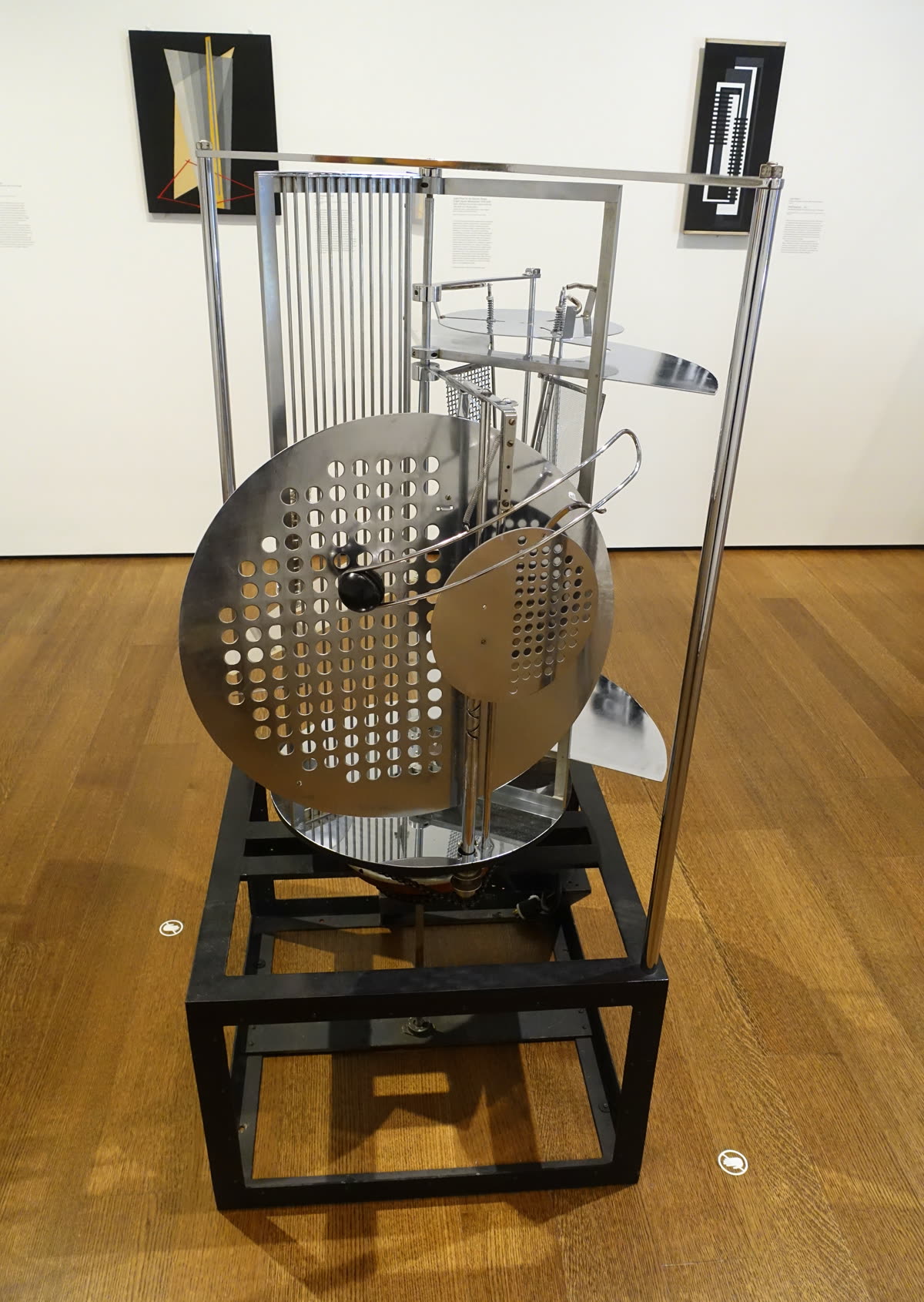
László Moholy-Nagy's Light-Space Modulator is easy to misremember as an early kinetic sculpture, a clever modernist machine that spins, glints, and earns its place in the Bauhaus legend.[1][2] The stronger reading starts one step farther out. The real work is not the object alone. It is the field of reflections, shadows, interruptions, and moving light that the object throws into the surrounding space. Moholy-Nagy did not simply build a sculpture that happens to move. He built a device that turns the room itself into the image.
That shift matters because it changes the terms of the art-tech story. If we treat the piece as a static design artifact, we admire construction, materials, and historical priority. If we treat it as a light machine, we see Moholy-Nagy pushing sculpture toward projection, stagecraft, and engineered perception.[1][2][3] The work stops behaving like a thing on a pedestal and starts behaving like an apparatus for reorganizing how vision unfolds in time.
Image context: the cover uses a real museum photograph of the sculpture in Harvard's Busch-Reisinger Museum rather than a poster, diagram, or later graphic tribute. That choice matters because the article's argument depends on actual physical parts: the perforated discs, the polished planes, the spiral element, and the framing bars that hold the machine in tension before the light even begins to move.[1][6]
The object was designed to generate effects, not just occupy space
Harvard Art Museums describes Light Prop for an Electric Stage as one of the earliest electrically powered kinetic sculptures and places it at the center of Moholy-Nagy's Bauhaus experimentation with technology, new materials, and, above all, light.[1] The phrase that matters most on the object page is his 1930 presentation of the work as a mechanism for generating "special lighting and motion effects" on a stage.[1] That wording is much more ambitious than the label kinetic sculpture by itself. It says the machine was conceived from the start as an effects engine.
Read that way, the title Light Prop for an Electric Stage becomes exact rather than quaint.[1] A prop is not a self-sufficient monument. It is a working element inside a larger perceptual event. Moholy-Nagy wanted rotating surfaces, reflective metals, and electric illumination to produce an environment in which light could be cut, scattered, and made visibly active. The sculpture's meaning therefore exceeds its silhouette. The sculpture is the hardware through which a larger optical performance becomes possible.[1][2]
That is why the Bauhaus-Archiv's object text is so useful. After Moholy-Nagy left the Bauhaus in 1928, it says, he continued investigating how space might be composed by means of light in his Berlin office.[2] The resulting device used transparent and reflective materials mounted on a circular base plate; as it rotated, more than seventy electric bulbs, some colored, cast changing patterns of light and shadow into the surrounding space.[2] The crucial sentence is not about the motor. It is about projection into the room. The machine exists to make space flicker.
Rotation turns sculpture into a time-based medium
Many sculptures ask the viewer to walk around them. Moholy-Nagy reverses that relation. The viewer can move, but the object has already begun moving on its own.[1][2] That difference is not decorative. Rotation makes time internal to the work's structure. A polished plane catches light for a moment, then drops it. A perforated disc interrupts a beam, then releases it. A spiral or rod throws a different shadow depending on the angle of the turn.[2][4] The sculpture never offers one stable appearance because appearance is being continuously manufactured.
This is where the work stops looking merely futuristic and starts looking rigorous. Moholy-Nagy did not add motion in order to animate a static form. He used motion to deny the idea that a form could be fully grasped in one fixed view. The Harvard page makes that plain when it says the rotating construction produces startling visual effects as its moving and reflective surfaces interact with a beam of light.[1] Interaction is the key word. Light is not decoration applied to form after the fact. Form and light act on each other.
The result feels closer to editing than to modeling. The work presents one fragment of a disc, then a flash, then a shadow band, then a glancing reflection. Vision has to assemble continuity from intervals. In that sense the machine already belongs to the same family as projection and film. It is sculptural in material, but cinematic in how it parcels out perception.[1][3]
The film proves that the room effect was always the real point
MoMA's note on A Lightplay: Black White Gray sharpens the issue by tying the sculpture directly to Moholy-Nagy's idea of a modern "culture of light."[3] The museum explains that his interest in objects and light moving through space led him to construct Light Prop for an Electric Stage, and that the object became the subject of his only abstract film.[3] This is a decisive clue. When an artist turns a machine into the subject of a film, he is not merely documenting an object for the archive. He is exploring what the object's optical logic becomes once the camera joins the system.
The 2007 Harvard exhibition page makes the same point from another angle. Because the original work had undergone extensive material changes and mechanical problems over time, a functioning replica was installed in a darkened gallery so viewers could experience the dramatic play of shadows, transparencies, reflections, and translucencies generated by the rotating machine's multiple surfaces.[5] The exhibition also screened Light Play: Black White Gray and described the film as a choreographed sequence of close-ups, double exposures, and special effects built from this single object.[5]
That pairing matters because it blocks a lazy distinction between original sculpture and secondary film. The film is not an afterthought. It is one of the work's native forms.[1][3][5] Moholy-Nagy uses the camera to continue the machine's project by other means. The sculpture cuts light in real space; the film cuts that altered space again into sequences, viewpoints, and superimpositions. The viewer is no longer just looking at an object that moves. The viewer is being taught how to see movement as a pattern of optical events.
Conservation history reveals that the artwork behaves like infrastructure
The work's afterlife reinforces that reading. Harvard notes that the artist and later museums made alterations over the years to keep the sculpture working, and that it remains operational today.[1] That statement is more than a conservation footnote. It tells us the work cannot be reduced to one untouched object-state without losing part of its meaning. If the point is generated light and motion effects, then maintaining motors, surfaces, alignments, and lighting conditions becomes part of preserving the art.
This is one reason the Bauhaus-Archiv reconstruction and Harvard's functioning replica are so revealing.[2][5] They show that Light-Space Modulator belongs to a category of artworks whose identity sits partly in repeatable behavior. A traditional sculpture can survive as a damaged but still legible mass. Moholy-Nagy's machine asks for activation. Its history therefore looks less like the history of a sealed object and more like the history of a technical system that must keep being made present.[1][2][5]
That makes the piece feel strikingly current. So much contemporary installation and media art depends on hardware, playback, maintenance, and calibrated environment. Moholy-Nagy was already there in 1930. He understood that the artwork of the machine age could not live entirely inside carved volume or painted surface. It would need motors, bulbs, reflectors, frames, timing, and the disciplined management of perception.[1][2][3][5]
Why the work still matters now
The durable lesson of Light-Space Modulator is that Moholy-Nagy treated light as a construction material rather than an atmospheric bonus.[1][2][3] He did not ask a viewer to admire technology for its own sake. He used technology to make vision feel unstable, sliced, and newly buildable. The room becomes active. Shadows become events. Reflection stops being secondary and becomes a primary visual fact.
That is why the sculpture still feels advanced. It does not merely predict multimedia installation in a broad historical sense. It defines a sharper proposition: the true art object may be the changing relation among machine, beam, camera, and viewer, not the metal framework alone. Once that proposition is clear, the title stops sounding technical and starts sounding exact. Moholy-Nagy did not make a static thing that represented modernity. He made a device that let modernity happen in light.[1][2][3][4][5]
Sources
- Harvard Art Museums, "Light Prop for an Electric Stage (Light-Space Modulator)" - official object page on the sculpture's 1930 presentation as a mechanism for "special lighting and motion effects," its materials, and its continuing operational status.
- Das Bauhaus-Archiv / Museum für Gestaltung, '"Lichtrequisit einer elektrischen Bühne", reconstruction of the original' - official object page on the rotating device, its transparent and reflective materials, the seventy-plus bulbs, and the projection of light and shadow into space.
- The Museum of Modern Art, "László Moholy-Nagy. Ein Lichtspiel: Schwarz weiss grau (A Lightplay: Black White Gray)" - MoMA exhibition text linking the sculpture to Moholy-Nagy's "culture of light" and to his only abstract film.
- The Metropolitan Museum of Art, "Light Prop for an Electric Stage (Light-Space Modulator)" - official object page for Moholy-Nagy's 1930 photograph of technicians installing the sculpture, noting its engineer-and-metalsmith collaboration and its startling reflective effects.
- Harvard Art Museums, "Light Display Machines: Two Works by László Moholy-Nagy" - exhibition page on the replica, the darkened-gallery installation, and the film's choreographed sequence of close-ups, double exposures, and special effects.
- Wikimedia Commons, "File: Light Prop for an Electric Stage (Light-Space Modulator) ... Busch-Reisinger Museum" - file page for the museum photograph used as the article image.
Editor’s Pick Review
This was the strongest 24-hour pick because it combines a specific artwork, a clear critical thesis, and unusually clean visual compliance. The cover is not a decorative chart or an analytical substitute; it is a real, topic-grounded museum photograph of the exact machine the article reads. The prose also earns the image: it keeps returning to perforated discs, reflective planes, rotation, projection, and the surrounding room, so the visual field and the argument reinforce each other instead of running in parallel.
The Chinese translation is a further reason to elevate it. It keeps the art-technology vocabulary legible while preserving the essay’s rhythm: “房间本身变成图像,” “效果发生器,” and “以时间为骨架的媒介” carry the source argument in natural Chinese rather than mirrored English. Among the eligible posts, this one best satisfies the updated editor-pick bar: source-grounded, visually immersive, formally distinctive, and strong in both English and Chinese.