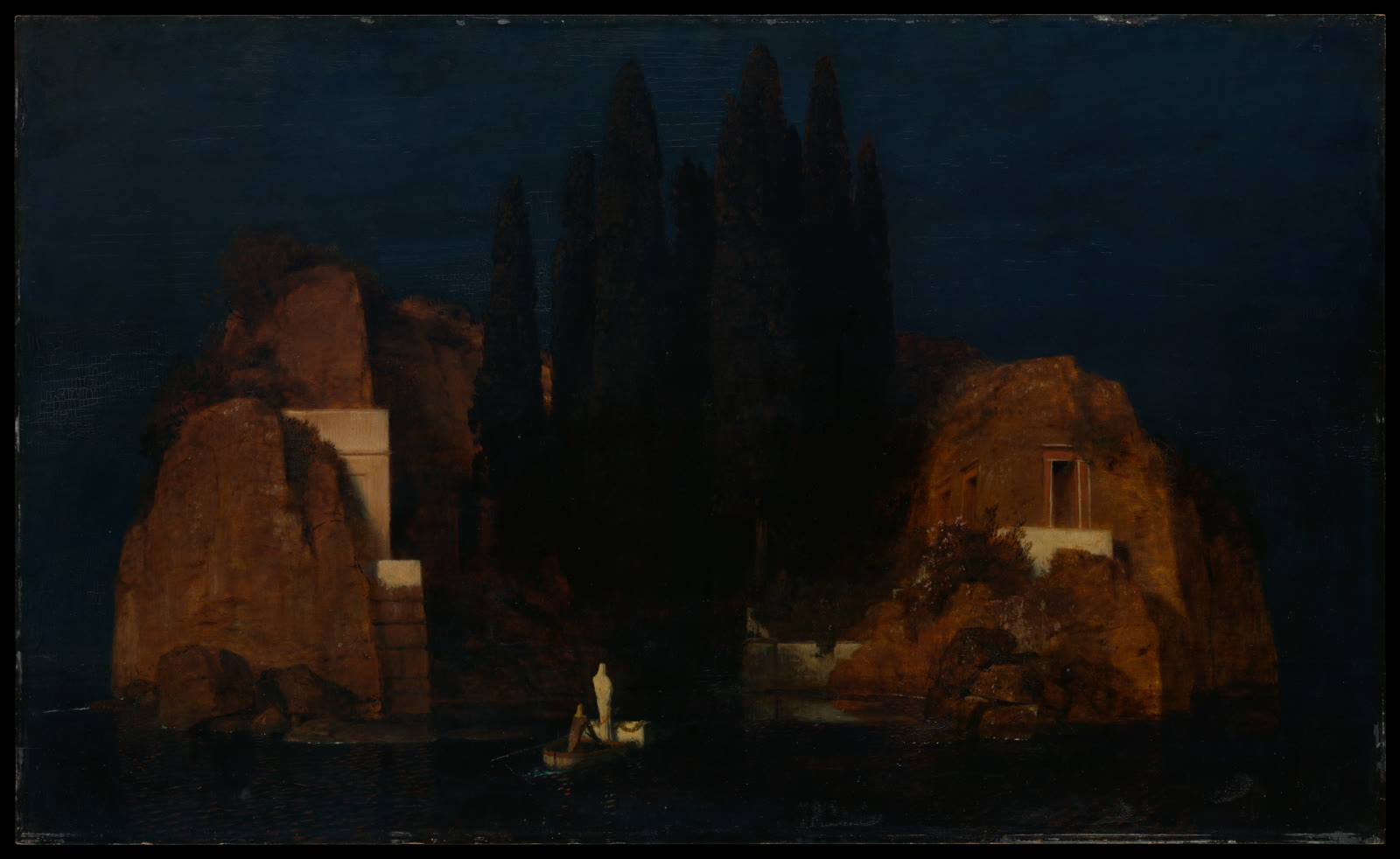
Arnold Bocklin's Island of the Dead is often remembered as a famous image of death in general, almost as if its meaning were available at first glance.[1][2][5] A boat, a coffin, a shrouded figure, dark trees, stone openings in the cliff: the iconography seems legible immediately. Yet the painting's real force comes from a more exact decision. Bocklin does not show death as an event completed. He shows approach without arrival. The rowboat has nearly reached the island, but the picture refuses the one thing that would resolve the scene: a clear landing.[1][5] Everything in the composition works to keep the passage suspended.
That suspension is not accidental. The Metropolitan Museum's object page matters here because it reminds us that the 1880 version in New York was shaped by mourning from the start: Marie Berna commissioned it as a memorial to her late husband after seeing an unfinished canvas in Bocklin's Florence studio, and at her request he added the draped coffin and upright shrouded figure to the boat.[1] Grief, then, is not simply a later interpretation imposed on a mysterious landscape. It is built into the visible structure. But Bocklin handles that grief with unusual restraint. He avoids collapse, tears, and narrative climax. Instead he gives us a choreography of hush.
Image context: the lead image uses the painting itself because the article turns on a small set of precise relationships inside the frame. A cropped detail would lose the slow pressure created by the boat in the foreground, the vertical trees beyond, and the rock face that seems to promise entry while continuing to hold it back.[1][3]
The island behaves like a wall before it behaves like a destination
The first surprise in Island of the Dead is that the island does not welcome the eye inward.[1][5] Many symbolic landscapes offer a path, a clearing, or at least a readable recession into space. Bocklin gives the opposite. The rock mass rises almost frontally, and the cypresses stand so tightly grouped that they read less like individual trees than like a dark barricade.[1][3] Their vertical rhythm is severe and nearly architectural. They turn the island into a shut interior.
That matters because the boat is already close. If the island opened generously, the picture would become a story of transport from one realm to another. Instead the destination presents itself as a threshold that withholds its own depth. The tall cypresses are crucial here. In the Met audio, curator Alison Hokanson notes the coffin, shrouded figure, tomb-like openings, and dark trees as the image's clearest allusions to mourning and the afterlife.[1] Seen compositionally, those same trees also close the picture off. They rise like a visual organ stop or a row of black blades, making the center of the painting feel compacted rather than expansive.
The rock face contributes to the same effect. Its openings resemble burial chambers or cut doorways, but they do not clarify how one enters them.[1][5] They promise a destination in symbolic terms while denying it in spatial terms. The island therefore becomes less a place than a pressure. It is there to be approached, imagined, and feared, but not comfortably occupied.
The white coffin turns motion into ritual
The second decisive element is the coffin itself. Without it, the boat might still feel solemn, but it would remain open to multiple readings: pilgrimage, visitation, exile, reverie.[1][5] Once the coffin is present, movement becomes ceremonial. The shrouded standing figure does not behave like a tourist or an active laborer. The body reads as witness, escort, or participant in a rite whose final act has not yet happened.[1]
Britannica's account is useful at this point because it gathers the older interpretive thread that links the hooded companion and coffin to Charon, the ferryman of the dead.[5] Whether or not one wants to force the image into a single mythological identification, the comparison helps explain the painting's temperature. We are not watching dramatic grief in public. We are watching transit under sacred or near-sacred conditions. The boat does not cut through violent water. It glides.
That quietness is one reason the painting stays in the mind. The scene could easily have tipped into melodrama. Bocklin chooses another register. He keeps the water almost unnaturally calm, the figures nearly silent, and the coffin startlingly pale against the darker surroundings.[1][3] The white shape becomes the picture's purest note. It carries the eye forward at the same moment that the island resists the eye's desire to arrive.
Light makes the scene theatrical without making it loud
The Met's audio description offers one of the clearest keys to the painting when it describes the cliffs and boat as dramatically spot-lit while much of the rest of the scene remains in shadow, and when it calls the composition stage-like.[1] That theatrical quality explains why the picture feels so deliberate. This is not a landscape discovered by chance. It is a set for inward projection.
Once you see the painting this way, its economy becomes more impressive. Bocklin does not crowd the frame with symbolic accessories. He arranges a few dominant shapes and lets light separate them: boat, coffin, standing figure, cliff, trees.[1] The spotlighted surfaces near the waterline push the foreground into clarity, while the darker cypresses and interior of the island refuse full disclosure. So the viewer is brought right up to the brink of explanation and then stopped there.
That brink is the painting's true subject. Hokanson says in the Met transcript that the image brings us to the edge of the mystery of passage from life into death, without showing what waits beyond the landing.[1] That description is strong precisely because it stays close to what the composition does. Bocklin has painted mourning as a scene of arrested completion. The island is close enough to define; it is still far enough away to remain closed.
Why this image became larger than one version
Part of the painting's long afterlife comes from how well this suspended structure fit Symbolist ambitions. The Met's essay on Symbolism describes the movement as one that sought to express emotion or idea rather than reproduce the natural world objectively, and it names Bocklin among the earlier artists who laid that groundwork.[2] Island of the Dead makes perfect sense in that context. It uses landscape as a carrier for psychic and spiritual conditions, while refusing a single fixed explanation.
The Basel museum materials help explain the scale of that response. Its 2020 leaflet notes that the motif's popularity became almost rapturous in the German-speaking world and that print reproductions appeared in many middle-class drawing rooms at the fin de siecle; it also traces the image's echo in Max Ernst.[3] The broader collection overview adds that Bocklin's enigmatic, evocative paintings resonated deeply with the spirit of the late nineteenth century.[4] In other words, the work spread because it offered viewers a scene that was legible enough to enter and strange enough never to finish.
That is why the painting still holds. Its effect does not depend on one doctrinal reading, one mythological key, or one biography of loss.[1][2][5] It depends on formal delay. The cypresses seal the island into a wall. The white coffin turns travel into rite. The spot-lit cliff edge offers destination without access. Grief, in this picture, is not shouted and not solved. It is held at the shore, where arrival is close enough to feel and still withheld long enough to keep dreaming.
Sources
- The Metropolitan Museum of Art, Island of the Dead - object page with commission history, artwork data, and audio transcript commentary on light, staging, and the afterlife theme.
- The Metropolitan Museum of Art, "Symbolism" - essay situating Bocklin among the artists who made landscape carry emotion, idea, and inner subjectivity rather than objective description.
- Kunstmuseum Basel, "Leaflet - Encountering Bocklin" - exhibition text on the motif's popularity, fin-de-siecle print circulation, and later echoes such as Max Ernst.
- Kunstmuseum Basel, "19th century" - collection overview on Bocklin's life, the museum's holdings, and the way his evocative paintings resonated with the late nineteenth century.
- Encyclopaedia Britannica, "Island of the Dead" - overview of the work's multiple versions, alternate titles, Charon reading, and wider cultural afterlife.