Hilma af Klint's reputation still tends to arrive through scale. She is the painter of enormous early abstractions, of spirals and diagrams and color systems that seem to outrun the usual timetable of modernism.[4] Against that backdrop, the flower sheets she made in 1919 and 1920 can look like a sidestep into something gentler and smaller. MoMA's recent exhibition and the research around it make a stronger case. The portfolio called Nature Studies does not retreat from abstraction. It shows what her abstraction was made from in the first place: repeated looking, naming, comparing, and testing relations between visible form and invisible order.[1][3][4]
That is why the flowers matter. They reduce the temperature without reducing the ambition. In the spring and summer of 1919 and 1920, af Klint drew flowers almost every day, building a portfolio of 46 works from wildflowers, weeds, and edible plants she encountered near her studio outside Stockholm.[1][2][4] The scale is intimate, the subjects often ordinary, yet the project keeps the old question alive: what lies behind appearances, and what kind of picture can register it without abandoning the world in front of the eye?[1][3]
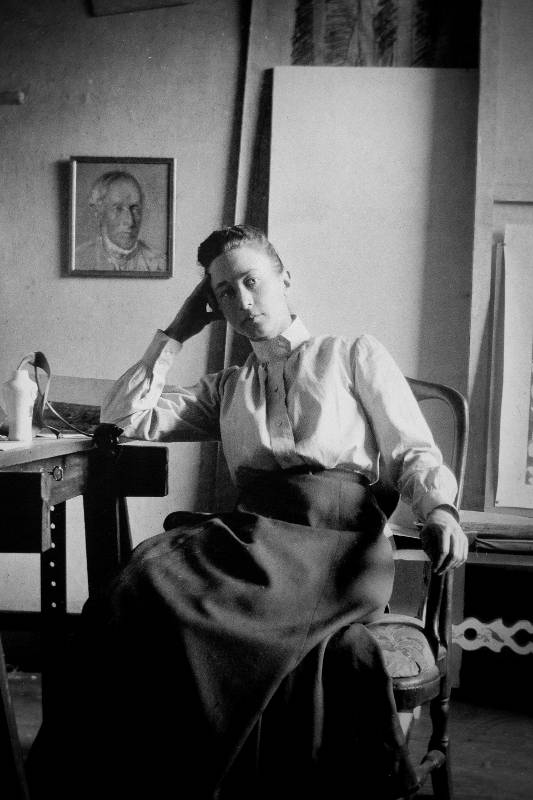
Image context: the lead image is an archival studio photograph rather than a reproduction from the portfolio itself. For this essay, that working scene is the right threshold because the argument turns on discipline and process: flower studies as a way of remaking abstraction through daily observation.[5]
The portfolio gets smaller, but the claim stays large
MoMA's exhibition description is the clearest statement of the turn.[1] Af Klint's flower studies are presented not as marginal juvenilia or private pastime, but as a sustained body of work made during "a period of intense engagement with nature," with the artist trying, in her own words, "to grasp the flowers of the earth."[1] The key phrase there is not flowers alone. It is grasp. These sheets are tactile and investigative. They slow the eye down.
That change of scale matters because af Klint had already shown she could think monumentally. Rutgers's account of the MoMA collaboration places the botanical drawings after the big abstractions for which she later became famous and notes that those oversized paintings remained hidden for decades after her death.[4] Nature Studies therefore reads neither as a beginner's exercise nor as a retreat into simple realism. It reads as a second method: how to keep metaphysical ambition alive once the artist stops speaking in mural-sized systems and starts speaking through stems, petals, roots, and seed heads.
MoMA's exhibition text pushes the same point from another direction when it describes the portfolio as an atlas, or in botanical terms a flora, that details the plants of Sweden while also mapping the natural world in spiritual terms.[1] That double identity is the real engine of the project. A flora classifies and records; a spiritual map searches for relation and inward meaning. Af Klint wants both jobs at once.
These are botanical studies, but they refuse to stay merely descriptive
The most interesting thing about the portfolio is that its observational fidelity never settles into plain illustration. MoMA notes that af Klint breaks with traditional botanical art by pairing exquisitely rendered blossoms with circles, spirals, checkerboards, and mirrored signs.[1] In other words, the plant is not only being identified. It is being translated. Representation stays in place, but another layer begins to pulse behind it.
The individual sheets reinforce that point. MoMA's object record for Primula veris (Cowslip Primrose), Cladonia spp. (Pixie Cup Lichens). Sheet 33 lists a medium richer than straightforward field notation: watercolor, pencil, ink, gouache, and metallic paint on paper from a portfolio of 46 drawings.[2] That mix tells you a lot about af Klint's procedure. The page is factual enough to name species and stable enough to belong in a portfolio, yet the materials already suggest embellishment, emphasis, and a desire to let the plant exceed neutral record.
This is why the flower studies feel so unlike academic botanical plates even when they remain careful about morphology. Af Klint is not using the plant merely as ornament, and she is not using observation as a disguise for pure symbol. She is staging the point where description becomes relation. A stem can remain a stem and begin to behave like an axis. A petal can remain a petal and begin to behave like a repeated unit in a larger visual grammar.
Science enters the room, but it does not drain the mystery
One of the best recent pieces of reporting on the portfolio comes from Rutgers, where botanist Lena Struwe described the drawings as traditional botanical studies with "an unknown and unique dimension."[4] That phrase is helpful because it keeps two things together that are often separated too quickly in writing on af Klint. The works are not anti-scientific. They are careful with species, seasons, and plant character. Yet they also insist that exact observation does not exhaust what a plant can mean.
Rutgers's account makes the ordinary quality of the chosen flora especially vivid.[4] These are not rare orchids staged for prestige. They include common plants, weeds, and familiar spring species. Struwe stresses that many of them belong deeply to Swedish cultural memory and to everyday landscapes.[4] That detail alters the spiritual argument. Af Klint is not climbing toward transcendence by fleeing the ordinary world. She is testing whether the ordinary world, examined patiently enough, already contains a surplus of structure.
MoMA's exhibition text says as much when it argues that af Klint's close observation reveals "ineffable aspects of the human condition" and records her conviction that there is a connection between the plant world and the world of the soul.[1][3] The claim sounds grand, but the form she gives it is modest. She does not make a manifesto painting to prove the point. She draws another stalk, another bloom, another branching cluster, and lets the relation accumulate.
The late lesson is not symbolism but discipline
It is tempting to treat Nature Studies as a key that decodes the grand abstractions backward, as if every spiral or blossom must resolve into a fixed esoteric message. The stronger reading is slower. The flower sheets show af Klint practicing a discipline of correspondence. They are less about hidden symbols than about training the hand and eye to move between kinds of order without snapping the link between them.
That is why these pages matter so much for her place in modern art. They show that abstraction, for af Klint, was never simply a flight from the seen world into private revelation. It was a method for reorganizing attention. The flowers keep her honest. They require contour, sequence, species, asymmetry, and growth. They make her answer to the world before she turns the world into sign.[1][2][4]
In that sense, the portfolio does something larger than add a charming botanical chapter to a famous career. It redefines the scale at which af Klint's ambition can operate. Monumental painting remains one register of her art, but these sheets prove that the same mind could work in a quieter mode, where each page becomes a small contract between botany and vision, notation and intuition, earthly form and spiritual inference.[1][3]
The flowers therefore return abstraction to fieldwork. They remind us that the visionary picture is not only born from revelation. It is also born from looking again, and then again, until a common plant starts to disclose a structure large enough for thought.
Sources
- MoMA, "Hilma af Klint: What Stands Behind the Flowers" - exhibition page on the 1919-1920 portfolio, daily flower drawing, the flora concept, and af Klint's effort to connect observation with spiritual meaning.
- MoMA, "Hilma af Klint. Primula veris (Cowslip Primrose), Cladonia spp. (Pixie Cup Lichens). Sheet 33 from the portfolio Nature Studies. May 14-19, 1920" - object page with medium details and the portfolio context.
- Jodi Hauptman, "Hilma af Klint's Flora," MoMA Magazine - exhibition-catalogue excerpt framing the flower studies through the link between the plant world and the soul.
- Rutgers SEBS News, "Rutgers Botanist Builds Bridge Between Science and Art in MoMA Exhibit on Hilma af Klint" - reporting on the MoMA research collaboration, the 46 botanical works, and Lena Struwe's assessment of their scientific and artistic dimensions.
- Wikimedia Commons, "File:Hilma-af-Klint.jpg" - archival studio photograph of Hilma af Klint used as the article image.