Suzanne Valadon is still introduced too often through the prologue instead of the work. The story is familiar and true: Montmartre model, self-taught painter, protegée of Degas, woman who crossed the studio threshold from object to maker.[1][2][3] Yet that biography can become its own soft focus. It leaves Valadon sounding exceptional because of where she stood rather than because of what she painted. Her real force lies elsewhere. She remade the painted body so that it no longer seemed arranged for somebody else's pleasure. In her hands, the nude grows heavier, more inward, more ordinary, and therefore more radical.[1][3][5]
That shift helps explain why her pictures still feel abrasive in a way that many better-known modern French paintings no longer do. The Nantes retrospective page describes her work as transgressive and uncompromising, committed to reality rather than inherited idealization.[1] The National Galleries of Scotland biography makes the same point from another angle: Valadon became known for female nudes at a moment when that subject was still unusual for women to explore publicly, and her figures stand out for their bold, confident lines.[2] Put together, those observations clarify the center of her art. Valadon did not simply add a woman's signature to existing conventions. She changed the emotional contract of the figure painting itself.[1][2]
Her career timeline matters because it shows how long and deliberate that change was. Born Marie-Clementine Valadon in 1865, she supported herself through precarious work before modeling in Paris from the 1880s into the early 1890s for artists including Renoir, Puvis de Chavannes, and Toulouse-Lautrec.[2][3] While living inside the economies of looking that fed modern painting, she taught herself to draw and paint by observation, with Edgar Degas becoming a decisive supporter and introducing her to printmaking.[2][3] By 1894 she became the first woman admitted to exhibit at the Salon de la Societe Nationale des Beaux-Arts, and by 1920 she was a full member of the Salon d'Automne.[3] Those milestones matter less as triumphal firsts than as proof that her peers recognized a distinct painter, not a curiosity promoted out of biography alone.
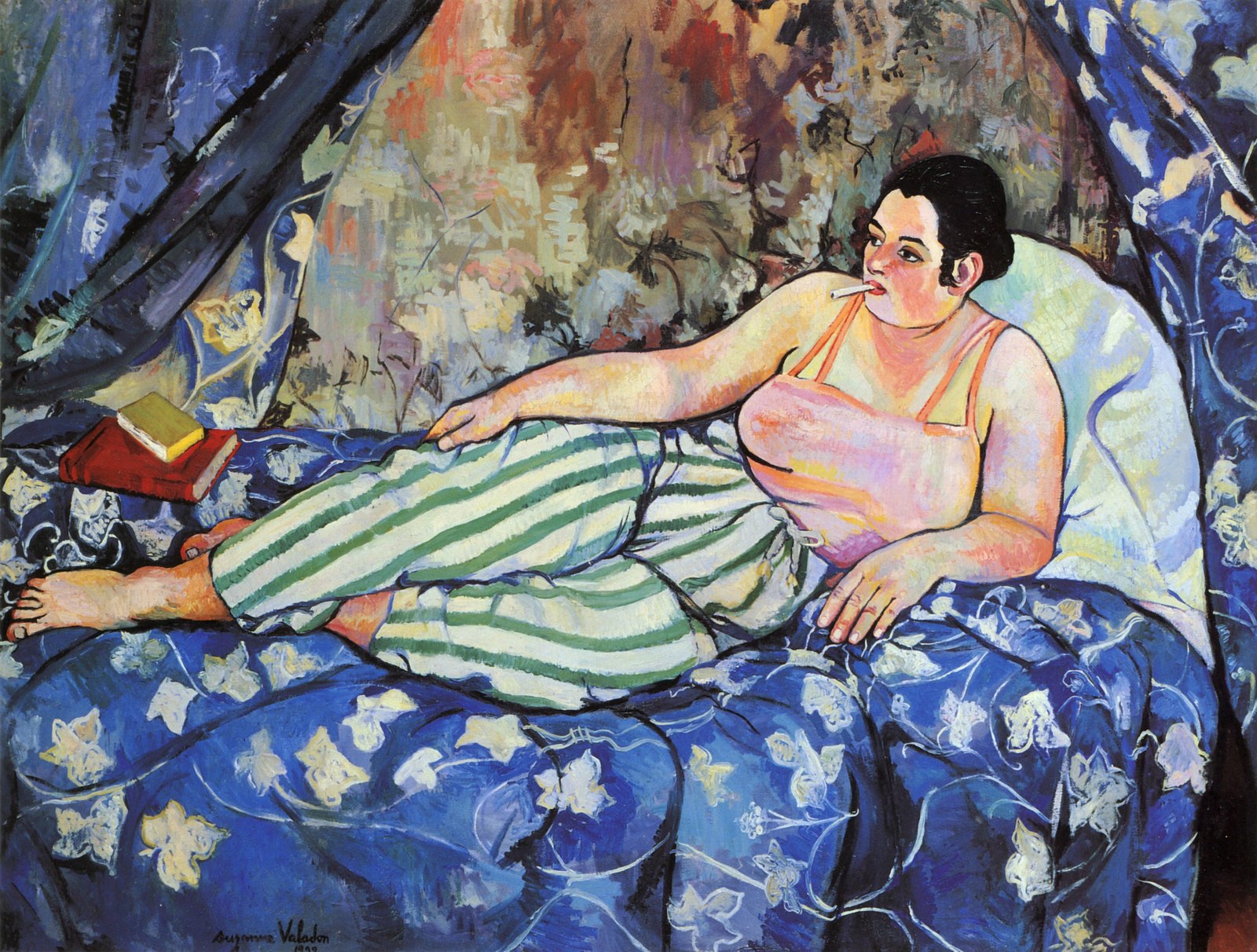
Image context: the cover uses Valadon's The Blue Room because the picture behaves like a summary of her larger achievement. The striped pajamas, the cigarette, the thick contour, the upholstered interior, and the body's unperformed sprawl all make her modernity visible at once. A portrait photograph would record the artist; this painting records the artistic argument.[3][4]
She learned the studio from the inside and painted against its habits
Valadon's early access to the studio mattered because she learned the grammar of posing before she rewrote it.[1][2][3] She knew how modern painters cropped, displayed, softened, or eroticized the female figure. That knowledge did not lead her toward revenge painting or simple inversion. It led her toward a stricter realism of relation. The women in her work remain painted, composed, stylized, and often vividly colored; they are never raw documents. But they do not float free of gravity or of lived circumstance. They sit, sprawl, dry off, smoke, stare, and withdraw as if the room belongs to them before it belongs to the viewer.[1][3][5]
The Nantes exhibition's section headings are revealing here. The curators frame Valadon's path through modeling, early drawing and printmaking, and then a "pictorial revolution through the nude," stressing that her paintings of the body arise from her own experience and break with traditional idealization.[1] That phrasing fits the work closely. Her nudes do not offer an academic improvement of nature. They keep the body's awkwardness in play: thick wrists, compressed shoulders, settled hips, knees that do not point elegantly, a pose that reads as held only because a real body is carrying it.[1][5] The achievement is not shock for its own sake. It is the restoration of bodily situation.
This is one reason the usual label of "female gaze" is useful but incomplete. Valadon certainly alters who is looking and how the looked-at figure is allowed to exist.[3][6] But the deeper change is formal. She uses contour and color to make the body remain stubbornly local. Flesh does not dissolve into atmosphere. Pattern does not become decorative escape. The figure stays materially present, and presence carries social meaning with it.
Her line keeps the body specific
The National Museum of Women in the Arts describes The Abandoned Doll from 1921 as an intimate scene built from vivid color, dark outlines, textile patterning, and simplified forms with awkward poses and deliberately unidealized anatomy.[5] That museum language is especially useful because it identifies the elements Valadon keeps returning to in mature work. Outline is not a finishing touch; it is a discipline. It stops the figure from being absorbed into painterly softness, and it gives each limb or shoulder the kind of factual edge that resists fantasy.[5]
In The Abandoned Doll, that edge sharpens the painting's emotional structure.[5] A clothed older woman towels a naked adolescent girl, while the girl turns toward a hand mirror and the abandoned toy on the floor quietly marks childhood receding from the room.[5] The subject could easily have become anecdotal or sentimental. Valadon prevents that by building the entire surface out of firmness: pattern, contour, abrupt bodily angles, and a psychological distance that keeps the scene from melting into maternal warmth.[5] The result is tenderness without prettification.
That same firmness explains why Valadon's bodies do not feel apologetic even when they are vulnerable. The Barnes Foundation's exhibition materials emphasize works such as Adam and Eve, Family Portrait, The Blue Room, and Black Venus as evidence of how directly she approached desire, domestic life, and the politics of representation.[6] Across those pictures, the body is never reduced to one register. It can be sexual, tired, comic, burdened, self-aware, familial, or solitary all at once.[5][6] Valadon does not ask the figure to become graceful before it becomes worthy of paint.
The Blue Room turns the odalisque inside out
If one painting gathers Valadon's project into a single image, it is The Blue Room from 1923.[3][4] Centre Pompidou's object page and recent essay both insist on the same fact: the work borrows the old odalisque schema only to overturn it.[3][4] A reclining woman occupies the bed, but she is dressed in striped pajamas, smoking, absorbed in her own interior weather, and markedly indifferent to the tradition that would have turned her into an available spectacle.[3][4] The room is saturated with blue pattern, yet the figure does not dissolve into ornament. She anchors it.
The museum's analysis goes further and becomes even more precise. It notes the broad loungewear, the mature hands, the body's weight, and the intense blue interior, all of which shift the image away from erotic offering toward modern self-possession.[4] Even the cigarette matters. On the object page it reads as a social signal of unruly modern femininity; on the canvas it also functions compositionally, a small hard accent that sharpens the mouth and keeps the reclining head from slipping into languor.[4] Valadon does not abolish pleasure here. She relocates it. Pleasure belongs to privacy, fabric, color, thought, and bodily ease before it belongs to display.
This is why the painting feels newer than many louder acts of modern rebellion. Its defiance is not theatrical. The woman does not confront us with a manifesto. She simply refuses to reorganize herself for our benefit.[3][4] That refusal changes everything around her. Pattern stops behaving like decorative background and starts reading as inhabited space. The reclining pose stops serving quotation and starts serving comfort. Modernity moves from slogan to posture.
Why Valadon still matters
Valadon's reputation has risen sharply because museums have become better at seeing what was always there.[1][6] The recent retrospectives described by Nantes and the Barnes Foundation both try to restore her to the place contemporaries already granted her: a central, independent painter of early twentieth-century modernity, not merely a colorful satellite of Montmartre legend.[1][6] That correction matters, but it would be too small if it ended in justice-by-inclusion. Valadon deserves attention because she solved real pictorial problems.
She found a way to paint bodies without flattering them, rooms without domestic sweetness, and desire without submitting to the old script of availability.[1][3][4][5] She used hard line to protect the figure's fact, saturated color to thicken mood, and ordinary interior life to replace exotic alibis.[3][4][5] The result is a form of modern painting that feels unusually durable in 2026. So much contemporary looking still swings between two weak poles: polished idealization on one side and confessional exposure on the other. Valadon offers a third mode. Her figures remain seen, but they stay their own.
That is why the model-to-painter anecdote, while irresistible, should finally become secondary.[1][2][3] It explains access. It does not explain achievement. The achievement is that Valadon taught painting how to keep a body present without making it perform. Her women occupy beds, baths, rooms, mirrors, fabrics, and family space with a density that changes the terms of representation itself. The pictures do not ask permission to be beautiful, and they do not ask forgiveness for being blunt. They simply hold their ground.
Sources
- Musee d'arts de Nantes, "Suzanne Valadon: A world of your own" - retrospective overview on her career from model to artist, anti-idealized bodies, and the five-part exhibition structure.
- AWARE: Archives of Women Artists, Research and Exhibitions, "Suzanne Valadon" - artist dossier covering her early work as a model, self-taught training, Degas's support, and her treatment of everyday bodies.
- Centre Pompidou, "Focus on... The Blue Room (La Chambre bleue) by Suzanne Valadon" - museum essay on the 1923 painting's subversion of the odalisque and its modern private-space logic.
- Centre Pompidou, "La Chambre bleue" - collection entry with date, medium, dimensions, and curatorial analysis of the painting's clothed odalisque structure and bodily modernity.
- National Museum of Women in the Arts, "The Abandoned Doll" - artwork entry on Valadon's mature style, psychological staging, and unidealized female bodies.
- The Barnes Foundation, "The Barnes Foundation Presents Suzanne Valadon: Model, Painter, Rebel" - exhibition press release highlighting The Blue Room, Family Portrait, Adam and Eve, Black Venus, and the artist's treatment of desire and motherhood.