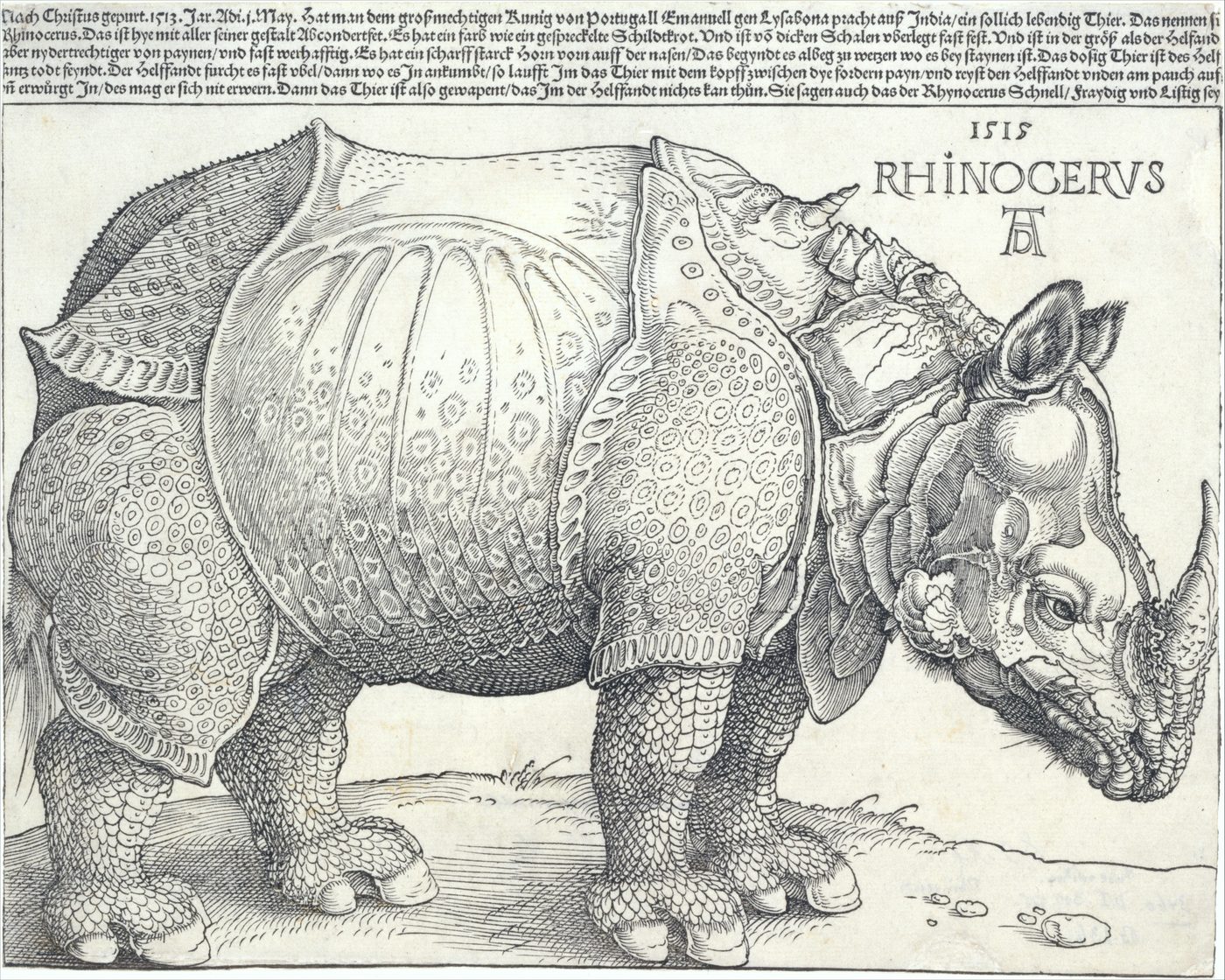
Dürer's Rhinoceros is often introduced as one of art history's great mistakes. The artist never saw the animal, the anatomy is wrong in memorable ways, and yet the image remained Europe's default rhinoceros for generations.[1][2][3] That summary is true, but it leaves out the more interesting question. Why did this wrong animal become so durable? The best answer is technical before it is zoological. Dürer's woodcut did not merely record hearsay badly. It translated secondhand description into a relief-print structure strong enough to look factual, memorable enough to survive repetition, and cheap enough to circulate far beyond the event that produced it.[1][4][5]
That is why a medium-and-technique reading fits this print better than a simple story about Renaissance curiosity. In 1515 an Indian rhinoceros reached Lisbon, causing a sensation. Dürer, working in Nuremberg, likely relied on a now-lost sketch and a Portuguese report rather than direct observation.[1][3] What he made from that distance was not a tentative reconstruction. It was a woodcut built out of decisive black-line modules: plates, scales, ridges, labels, and a block-filling profile that leaves little room for doubt.[2][4][5]
Image context: the cover uses The Met's public-domain image of the print itself because the article depends on the exact graphic behavior of Dürer's lines. A photo of a real Indian rhinoceros would clarify the zoological error, but it would miss the point. What matters here is how a woodcut turns misinformation into a persuasive surface.[2][5]
1) Woodcut favors structure that can survive pressure
The Metropolitan Museum's woodcut essay gives the necessary starting point. A woodcut is a relief process: the cutter removes everything that should not print and leaves the lines and shapes that will receive ink.[4] That sounds simple, but the consequences are severe. Thin lines can break, awkward passages can collapse under pressure, and early woodcuts often relied on thick outlines with limited shading because the block had to stay physically printable.[4] Dürer matters in that history because he pushed the medium toward far greater tonal richness and textural complexity without sacrificing legibility.[4]
That technical situation helps explain why The Rhinoceros looks the way it does. The animal is not built from soft observational transitions. It is built from durable compartments. The body is divided into large, plate-like sections; the legs carry repeated scale textures; the face and neck are packed with ridges and crackling marks; the shoulder horn rises as a clean secondary accent.[1][2] Whether or not these details are accurate to an Indian rhinoceros, they are excellent woodcut information. Each one gives the cutter a printable unit. Each one turns ambiguity into contour.
The result is that the creature feels more engineered than glimpsed. The black-and-white language of the block helps Dürer substitute articulation for uncertainty. Instead of saying, in effect, "this is approximately what witnesses described," the print says: this animal has a hide built in segments, a head armored by ridges, legs with reptilian texture, and a body compact enough to fit solidly inside a frame. Relief printing rewards that kind of certainty because certainty prints cleanly.
2) The famous errors work because they are graphic solutions
The National Gallery of Art's story on the print is especially useful because it separates features that are recognizably rhino-like from features that are plainly invented or exaggerated.[1] Dürer does capture the animal's mass, its single large nose horn, its three-toed feet, and even the fuzzy shape of the ears.[1] But he also turns folds of skin into something closer to armor plates, gives the legs a reptilian scaling, and adds a small twisted horn on the animal's back.[1][2] The question is not only why he got those parts wrong. The question is why those wrong parts look so plausible inside the image.
The answer lies in how well they solve the print's formal problems. Armor plates break the body into large readable zones. Repeated dot-and-ring textures keep those zones from becoming dead flat. Scales on the legs compress small surface variation into a familiar pattern language. The extra horn creates a secondary spike that strengthens the silhouette and points, as the National Gallery notes, toward Dürer's monogram.[1] These inventions are not observational failures alone. They are compositional devices.
This is one reason the print lasted as long as it did. Error here is not fuzzy. It is organized. A viewer may never have seen a rhinoceros, but the image offers recognizable analogies: armor, scales, plates, horn, shield. Each analogy pulls the unknown animal toward known visual systems already trusted in Europe. The woodcut does not ask the audience to imagine a new beast from scratch. It assembles the beast out of already legible graphic habits.
3) Text and image behave like a news sheet
The British Museum's drawing entry clarifies the distance between animal and artist: Dürer never saw the rhinoceros himself and likely based his image and inscription on a Portuguese newsletter sent to Nuremberg merchants, probably accompanied by sketches that no longer survive.[3] That matters because the print should not be mistaken for a private studio fantasy. It belongs to an information circuit linking imperial trade, diplomatic gift exchange, merchant correspondence, and urban print culture.[1][3]
The National Gallery goes a step further by describing the finished woodcut as functioning like a broadsheet, almost a poster or newspaper announcement for the rhino's arrival.[1] That comparison is exact enough to be useful. Five rows of German text run across the top of the sheet, framing the creature with a verbal report that explains where it came from, what it is called, and how it supposedly behaves.[2] The image does not stand alone as pure art. It arrives with its own documentary rhetoric attached.
Woodcut is ideal for that hybrid form because text and image can be organized on the same printable surface and reissued repeatedly.[1][4] The medium is not only about making a picture. It is about stabilizing a report. Once the creature's outline, textures, and explanatory inscription are locked into a block, the animal can be sent outward as a coherent packet of information. Repetition then stops looking secondary. It becomes the point.
4) Reproducibility turned confidence into authority
The National Gallery's object page states the consequence bluntly: despite its inaccuracies, Dürer's woodcut was accepted as the standard image of a rhinoceros until the eighteenth century.[2] That is an extraordinary afterlife for an image made from secondhand description. It also tells us that the print's authority did not depend on direct witness after the first moment. It depended on circulation.
Here Dürer's reputation mattered, but medium mattered just as much. The National Gallery story notes that he was among the first celebrity artists in Western art history and that prints helped him reach a broad audience quickly.[1] A singular drawing can persuade a patron; a repeatable woodcut can persuade a continent. Because the block can be inked again and again, the image gains force each time it reappears.[1][4] What began as one artist's resolved guess hardens into a visual standard.
That process also explains why the print remains more instructive than embarrassing. Dürer did not fail because he cared too little about reality. He succeeded because he understood how print could package reality claims. The woodcut takes unstable information, rebuilds it as structured black form, and then lets repetition do the rest. By the time later viewers inherited the image, they were no longer receiving one man's imaginative leap. They were receiving a familiar type.
5) The print still matters because it shows how form stabilizes belief
Seen this way, The Rhinoceros is not just a Renaissance curiosity about an exotic beast. It is a sharp lesson in how media make knowledge feel solid. The print does not persuade by hiding its construction. It persuades by making construction look orderly. Plates align across the body. Scales repeat. The inscription anchors the image in reported fact. The horn and profile press against the frame as though the animal were too real for the sheet to contain.[1][2]
That is why the work still feels alive in the museum. It shows that repeatability is never neutral. A printable image has to simplify, select, and lock decisions early. When those decisions are strong enough, they can outlive correction.[2][4][5] Dürer's rhinoceros is wrong as natural history and brilliant as image engineering. The woodcut made hearsay printable, and once it became printable, it became believable for far longer than the living animal itself survived.[1][2][3]
Sources
- National Gallery of Art, "Horns, Scales, and Armor" - story on the Lisbon rhinoceros, Dürer's use of secondhand sketches and written description, the print's broadsheet function, and the animal's accurate and inaccurate features.
- National Gallery of Art, "The Rhinoceros" - object page with visual description, translated top inscription, medium details, and note that Dürer's image remained the standard rhinoceros in Europe until the eighteenth century.
- The British Museum, "Rhinoceros" drawing entry - collection note on the elephant fight, the animal's drowning en route to Rome, Dürer's reliance on a Portuguese newsletter, and the now-lost accompanying sketches.
- The Metropolitan Museum of Art, "The Printed Image in the West: Woodcut" - Heilbrunn essay on relief printing, the physical constraints of the woodblock, and Dürer's transformation of woodcut into a richer black-and-white art.
- The Metropolitan Museum of Art, "The Rhinoceros" - object page for the 1515 woodcut used as the article image, with public-domain access, date, medium, and dimensions.