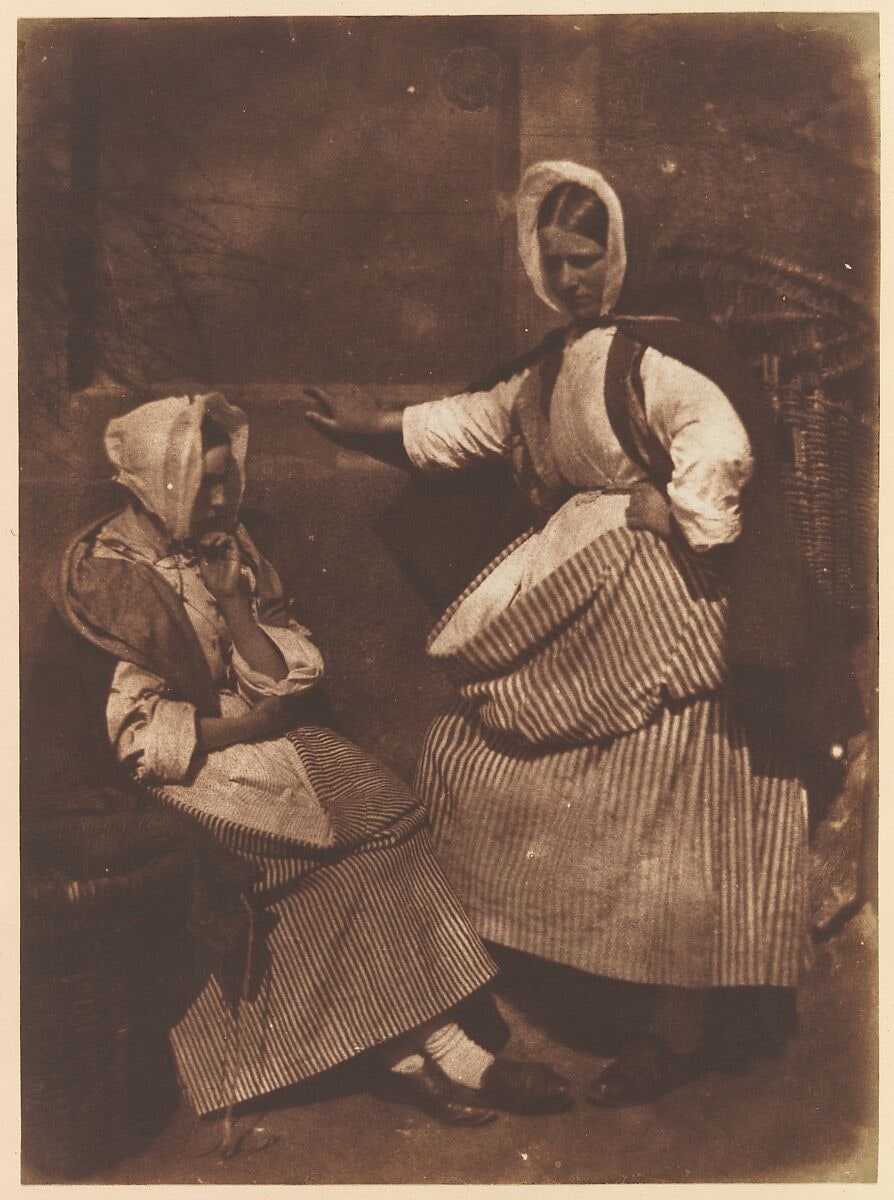
One woman sits with her hand at her chin. The other stands beside her, a basket rising behind her shoulder, an arm stretched toward the stonework. In Hill and Adamson’s Newhaven Fishwives, made around 1845, the two figures seem to have found a small interval in the working day. Their bodies settle against basket and wall. We arrive as spectators of a pause.[1]
That sense of arrival is the photograph’s quiet achievement. Early paper photography required cooperation and stillness. The apparent ease of this encounter was made through an arrangement that the women had to sustain. Looking closely means attending to both things at once: the convincing presence of working people and the composition that gives their presence a particular meaning.
Start with the difference between the poses. The seated woman’s bent arm brings the eye upward toward her face, then lets it travel down through the folds and stripes of her clothing. Beside her, the standing figure opens outward. Her extended arm connects her body to the wall; the basket behind her enlarges her silhouette. One figure gathers inward while the other reaches across the picture. Their unequal heights keep the group from hardening into a row.
The baskets are crucial. They identify an occupation, but they also help shape the encounter: a burden carried on the back, a surface close to the seated body, woven curves beside the heavier geometry of stone. Clothing supplies another rhythm. Stripes break the broad masses of the skirts into smaller movements, so that the eye remains active while the bodies remain still. The photograph makes resting look substantial. Even in a pause, these women occupy the picture with the equipment and weight of their work.
The Metropolitan Museum of Art identifies this particular object as a salted paper print from a paper negative, measuring 29.5 by 21.7 centimeters. Its catalog places the Newhaven photographs within a project that presented the fishing community through labor, tradition, and mutual support.[1] Those are useful terms to hold beside the image, provided we remember that a composition can propose solidarity more readily than it can prove the conditions of an entire community.
The women’s work extended well beyond the moment shown. They prepared fishing lines, handled and cleaned the catch, carried fish into Edinburgh, and sold it. The Met notes that the process could not follow the fishermen’s work at sea; activity on land offered subjects the camera could accommodate.[1] A technical constraint therefore helped determine which part of an economy became visible. The women occupy the foreground of this history because their labor mattered and because the photographers could make pictures of them ashore.
Even there, the camera needed time. The University of Glasgow’s account of the calotype process describes exposures ranging from seconds to many minutes, often around a minute. It does not establish an exposure time for this photograph.[3] We should therefore resist imagining an exact count. What matters to the reading is the sustained pose: an elbow needs somewhere to rest, a body needs a position it can keep, and a convincing interval of daily life has to survive the demands of the apparatus.
The picture’s softness belongs to its making, too. A calotype negative was formed on sensitized paper and developed chemically. For a salted paper print, light passed through that negative onto another prepared sheet, producing a positive image in the paper’s surface fibers. Printing took place by contact, with negative and print the same size.[3] The finished photograph carries the physical character of paper through both stages. Broad areas of light and shade can assert themselves before small details come into focus.
Hill valued that effect. In a statement reproduced by the National Galleries of Scotland, he defended the paper’s uneven texture as “the very life of it.”[4] Here, the softened surface lets clothing, faces, basket, and masonry belong to one tonal world. My reading is that this continuity helps make the women’s proximity feel like a relationship: the eye moves between them without encountering a sharp break in visual language. That is an effect of the picture, not evidence that we know what either woman felt.
Their photographers had first come together in 1843 to make portrait studies for Hill’s painting of the founding assembly of the Free Church of Scotland. By August 1844, they were planning photographic volumes on a wider range of subjects, including The Fishermen and Women of the Firth of Forth. The proposed volumes were never published.[2] The Newhaven images nevertheless show how far the partnership’s ambitions had moved beyond supplying likenesses for a painting. A working community could become a sustained photographic subject.
There is a complication in the admiration these pictures invite. The National Galleries describes the series as presenting Newhaven as an exemplary community, while leaving open whether social purpose or attraction to picturesque subjects chiefly motivated the photographers.[4] Either way, the photograph’s calm is selective. It gives us no direct measure of earnings, exhaustion, dangerous weather, or disagreement. Its beauty can make a hard life look settled.
Caroline Douglas’s study of gender and class in the Newhaven photographs sharpens that concern. She shows how nineteenth-century praise could elevate working women into classical figures, and how the fame of a portrait could coexist with neglect of the sitter’s biography.[5] Her discussion centers on other images in the series; it does not identify the two women in this print. Its challenge carries across: admiration for an artist’s achievement can become so absorbing that the photographed person recedes behind it.
Return, then, to the hand at the chin. It gives the seated woman an inwardness we can recognize without claiming to know its contents. Her companion’s extended arm supplies another bodily fact, another way of occupying the same small space. The arrangement has brought them into a persuasive relation, but neither face becomes fully available to us. After the baskets have explained the occupation and the composition has suggested a community, the women still retain that distance. The photograph gives us time to look; it leaves their thoughts with them.
Sources
- The Metropolitan Museum of Art, “Newhaven Fishwives,” ca. 1845, accession 1997.382.19 — object record, archival image, dimensions, provenance, and curatorial account of the Newhaven project.
- Malcolm Daniel, “David Octavius Hill (1802–1870) and Robert Adamson (1821–1848),” The Metropolitan Museum of Art, October 2004 — the partnership’s origins and its proposed photographic publications.
- University of Glasgow, Archives & Special Collections, “The Calotype Process” — paper negatives, exposure, contact printing, and the material structure of salted paper photographs.
- National Galleries of Scotland, “Hill & Adamson” — Hill on paper texture, the construction of apparently spontaneous portraits, and the series’ representation of Newhaven.
- Caroline Douglas, “‘Sonsy Fishwives’: Gender and Class in Early Scottish Photography,” Studies in Photography, Spring 2021 — research on the fisherwomen’s representation and biographies; author manuscript held by the Glasgow School of Art.