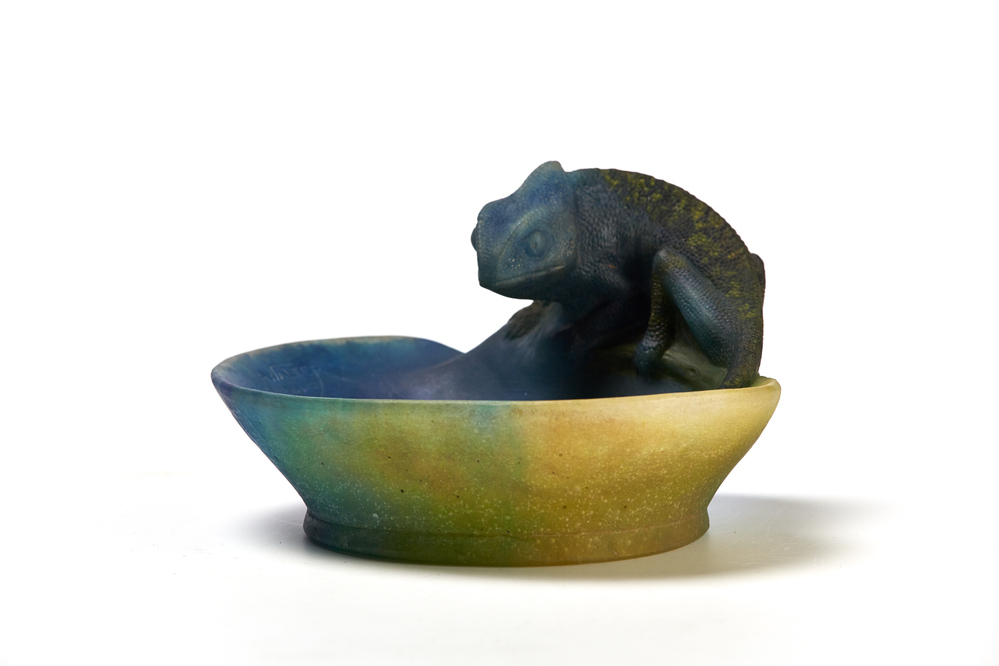
A chameleon leans over the rim of Amalric Walter’s glass dish, directing its head toward the hollow. Below it, blue meets golden yellow through a band of aqua. The Sainsbury Centre dates the dish to the 1920s.[1] It is an invitingly strange object: a vessel with a small animal apparently taking an interest in its contents.
The color deserves as much attention as the creature. Walter worked in pâte de verre, or glass paste. To understand the technique, imagine the dish before it could hold anything, while its future surface was still being assembled inside a mold. Color could already have an assigned place. The firing would fuse that arrangement into a solid glass object.
The Corning Museum of Glass describes the basic sequence: glass is ground into powder and combined with a binder to make a workable paste, with a flux helping it melt. The maker brushes or presses the mixture into a mold, dries it, and fires it until it fuses. Annealing precedes removal and finishing.[2] A phrase that sounds almost like a painter’s material therefore names a process involving both careful placement and controlled heat.
The mold supplies more than a boundary around the work. Its inside is the surface against which the glass takes shape. A maker working there has to think ahead: the recess being filled will eventually be seen from the other side. Where the material goes matters before the finished object can be picked up and turned toward the light.
The Sainsbury Centre explains that Walter’s dish required a multipart mold made from heat-resistant material.[1] The apparently casual perch depended on a carefully planned structure. Sculptural invention and the practical demands of making the glass developed together.
Heat then has a delicate task. In its discussion of terminology, the French glass training and research center Cerfav explains that, in the narrower sense of pâte de verre, firing is planned to fuse the grains while limiting their flow and mixing.[3] The maker needs cohesion without losing the arrangement established in the mold. More melting is therefore not automatically a better result.
Think of two neighboring colors. Their relationship might depend on a sharply controlled edge, a soft transition, or small variations within a larger patch. If everything moves too freely during firing, the initial placement cannot do the same work. This is the technique’s expressive tension: the glass must change enough to become an object while retaining something of the maker’s local decisions.
There is no single paste recipe behind that effect. Corning’s Rakow Research Library points readers toward studies of several binding materials, including gum arabic, and toward a published method using methylcellulose glue.[4] These are references to different working approaches, not interchangeable instructions. The practical question is how to make the glass particles behave while they are being positioned.
A binder gives the powder a manageable consistency at that stage. It should not be confused with the fired material that ultimately holds the object together: the glass itself has fused.[2][4] Separating those stages makes the name easier to understand. “Paste” describes how the maker can handle the material on its way to becoming the finished work.
Nor does the name guarantee one appearance. François-Emile Décorchemont’s 1928 Bowl at the Metropolitan Museum of Art offers a particularly substantial example. The museum records a diameter of 25.1 centimeters and a weight of 3.1 kilograms; it associates his work with strong color, dense translucency, and matte surfaces.[5] This is glass with visual and physical weight.
Those qualities shift what a viewer might ask of it. Transparency ordinarily invites us to look through an object. Dense translucency holds our attention within its thickness: light becomes part of the material’s presence. That is a way of reading Décorchemont’s work, rather than a definition of the whole technique. A matte, substantial vessel represents one artistic destination.
Diana Hobson pursued another. Corning describes her experiments, beginning in the 1970s, as an effort to make pâte de verre exceptionally thin and transparent, with closely controlled placement of color. Her 1989 commission, Copper the Color of Magic, combines the glass forms with copper and stone.[6] The contrast with Décorchemont makes the technique’s range more useful than any shorthand about cloudiness or opacity.
Hobson’s work also changes the implied scale of attention. Instead of asking how much weight glass can seem to possess, it invites a viewer to consider how little material might carry a form and its color. The shared process accommodates different ambitions. Knowing how the glass was made opens a comparison; it does not dictate the visual verdict.
Look again at the meeting of blue and yellow. The color is part of the object’s construction. Understanding pâte de verre adds the pleasure of imagining its earlier state: patient placements inside a mold, brought together by a firing that had to preserve their differences.
Sources
- Vanessa Tothill, “Dish,” Sainsbury Centre, January 2021 — Amalric Walter’s chameleon dish, accession 21152; dating, colors, mold construction, dimensions, and museum photograph.
- Corning Museum of Glass, “Pâte de verre,” Glass Dictionary — preparation, molding, firing, annealing, and finishing.
- Cerfav, “Estampage · Quid ? The pâte de verre,” June 2024 — terminology and the control of glass flow and mixing during firing; French-language source.
- Rakow Research Library, Corning Museum of Glass, “Does the library have recipes including the binder for the glass powders in pâte de verre?”, updated March 9, 2024 — published research on binding materials and working methods.
- The Metropolitan Museum of Art, François-Emile Décorchemont, “Bowl,” 1928, accession 1972.239 — dimensions, weight, and the artist’s characteristic surface and translucency.
- Corning Museum of Glass, “1989 Rakow Commission: Diana Hobson” — thinness, transparency, controlled color, and Copper the Color of Magic.