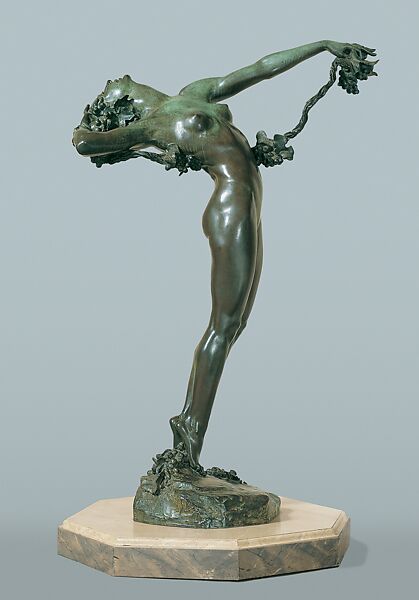
Start at the feet. The heels have lifted, the legs draw upward, and then the body seems to change its mind about the direction of travel. The torso arches back; the head follows it. One arm reaches into the space above the figure while the other folds toward the head. In Harriet Whitney Frishmuth's The Vine, a standing body becomes an extravagant curve.
The Met bronze photographed here was conceived in 1921, enlarged and revised in 1923, and cast in 1924.[1] The work began as something small enough for a tabletop. At monumental scale, its backbend takes possession of the space a viewer might otherwise occupy.
The temptation is to follow the lifted arm and forget the feet. Looking back down changes the sculpture. The apparently effortless gesture has a very definite place to stand.
Following the outline
The grapevine gives the work its name, but the body supplies its largest curling line. Foliage runs between the hands, letting the eye travel across an interval that would otherwise be empty. The plant is a delicate companion to the much heavier bronze limbs. It also gives the hands something to do: their reach belongs to an action, however elusive that action's beginning and end may be.
Read this as a relationship between outlines. The long sweep through the torso opens the figure outward; the bent arm gathers part of it inward again. The gesture occupies space unevenly. It spreads above a comparatively narrow footing, so that our attention keeps moving between the broad upper reach and the small area beneath it. Even in a still photograph, the eye has work to perform.
In the Met's audio guide, Frishmuth recalls Rodin's advice to study silhouettes. She also remembers the awkwardness of enlarging The Vine: working from a ladder, she had to model the tilted face upside down.[1]
That recollection brings the sculptor's own body into the picture. The finished bronze makes a difficult position look fluid. Its making required another person to negotiate the position from outside, moving around and above it. The silhouette that reads so readily at a distance was worked on at close quarters, feature by feature.
The dancer inside the plant
The pose came from collaboration with dancers. The Met identifies Desha Delteil of the Fokine Ballet as the model for the enlarged sculpture.[1] An earlier stage had a different participant: Christie's catalogue for a small cast names René Wilde as the model for the original statuette, conceived while Frishmuth was teaching in her Sniffen Court studio in 1921.[2] One familiar title therefore contains more than one encounter between sculptor and sitter.
Art historian Clarisse Fava-Piz, writing for the Smithsonian American Art Museum, makes the useful distinction between the figure's appearance of abandon and the bodily command needed to sustain it. She connects the vine with Bacchus and euphoria, while drawing attention to the steadiness of the dancer.[3] The sculpture lets those associations coexist. Its pleasure depends on a position demanding considerable control.
There is a visual reason the botanical comparison works. A vine can bend while remaining continuous; here, the turn of the torso carries the eye from the lower body toward the thrown-back head. Yet the figure keeps recognizable joints, muscles and extremities. Frishmuth leaves enough anatomy visible for us to sense the stretch. The transformation into a plant happens in the act of looking, without requiring the body to become unrecognizable.
I find the tucked-back head especially important. It interrupts the possibility of an ordinary face-to-face meeting. We encounter the direction of the body before we establish any exchange with its expression. Attention moves toward what the figure is doing with its whole length.
A gesture changes size
The smaller Vine had a long life of its own. The Museum of Fine Arts, Houston, holds a bronze dated 1921 in the Rienzi Collection.[4] Sotheby's catalogue, drawing on the sculpture's catalogue raisonné, records 396 small casts made between 1921 and 1966, with 317 produced by the Gorham Manufacturing Company.[5] These figures describe the statuette's edition; they should not be mistaken for the production history of the monumental bronze.
The distinction changes how one imagines looking. A statuette can be surveyed from above, its whole gesture gathered into a single glance. A figure over two meters high puts its lifted hand and tilted face into a different relationship with the viewer's head. The same sweep becomes an invitation to look up. Scale gives the composition another tempo: recognition can begin at the feet and take time to arrive at the farthest reach.
Fava-Piz places the enlargement in the National Sculpture Society's 1923 exhibition and notes that five large casts were made.[3] The Met identifies its example as number four of five.[1] The photograph thus records a specific object within a small monumental edition, alongside a much more widely circulated smaller design.
Return finally to the foliage. It offers a name for the movement, but it does not explain the entire sculpture. The pleasure lies in following how an upright figure can stretch so far beyond an upright line while remaining visibly planted. Each trip from the feet to the head makes the backbend feel extravagant; each return to the feet makes its composure newly apparent.
Sources
- The Metropolitan Museum of Art, “The Vine,” accession 27.66 — object metadata, collection photograph and audio-guide transcript containing Frishmuth's recollections.
- Christie's, “Harriet Whitney Frishmuth, The Vine,” lot 4013401 — catalogue essay identifying René Wilde, the 1921 statuette and the later enlargement.
- Clarisse Fava-Piz, “On Harriet Whitney Frishmuth's The Vine,” Smithsonian American Art Museum, September 17, 2019 — dance, the pose and the monumental edition's exhibition context.
- Museum of Fine Arts, Houston, “The Vine,” accession 94.1074 — the separate 1921 bronze in the Rienzi Collection.
- Sotheby's, “Harriet Whitney Frishmuth: The Vine,” American Art, September 17, 2019, lot 58 — small-cast edition history and catalogue raisonné reference.