Gego is often introduced through a paradox: a sculptor who made drawing leave the page. The phrase is useful, but it can make the work sound lighter than it is, as if wire simply replaced pencil and air simply replaced paper. Her real achievement was harder. She made line behave as a condition of space. In her hands, line did not describe an object from the outside; it became the object, the interval, the shadow, and the route a viewer had to negotiate.[1][2][3]
That shift explains why Gego still feels difficult to classify. The Guggenheim's 2023 retrospective framed her as a German-born Venezuelan artist trained in architecture and engineering at Stuttgart, displaced by Nazi persecution in 1939, and settled permanently in Venezuela before fully beginning her artistic career in the 1950s.[1] Those facts matter because they prevent the work from being reduced to delicacy. The wire looks fragile, but it comes from an artist trained to understand structure, load, connection, and the behavior of parts in space.[1]
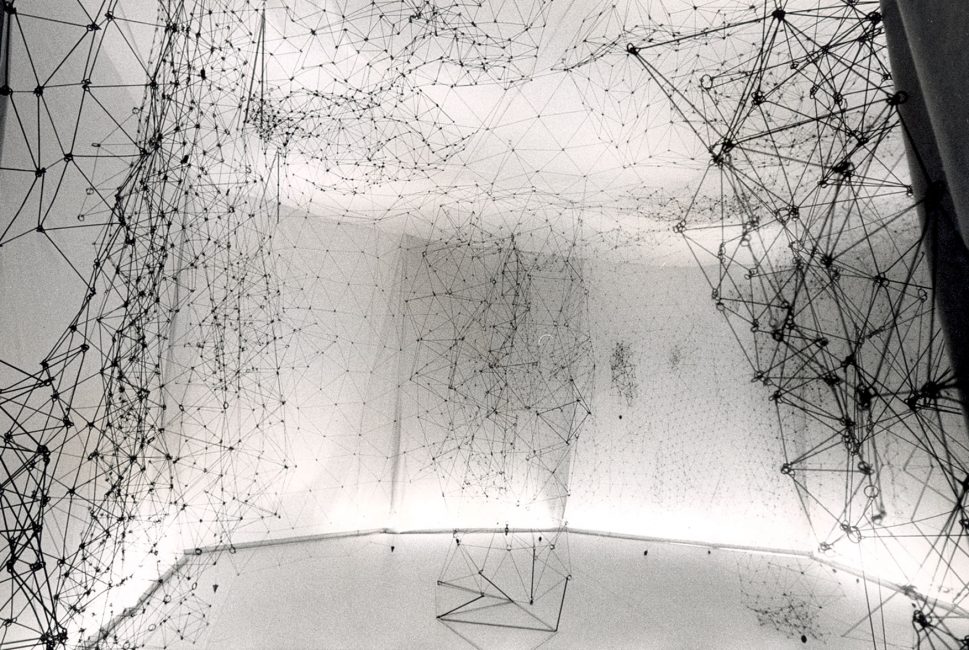
Image context: this is a real photographic image of Gego's Reticularea, not a diagram, chart, or generated visual. It belongs here because the article's argument depends on the installation's actual visual condition: fine metal links, open voids, suspended geometry, and the way the surrounding room enters the work.[4][5][6]
Caracas changed the geometry
Gego was born Gertrud Goldschmidt in Hamburg in 1912 and arrived in Caracas in 1939.[1][3] The biographical move is not just background. It helps explain why her abstraction does not behave like a European style transplanted intact to Latin America. She brought architectural discipline with her, but the mature work opens that discipline to instability: hanging, sagging, bending, irregular junctions, and the changing positions of viewers.
The Guggenheim emphasized her relation to geometric abstraction and kinetic art, but also her departures from both.[1] That distinction is crucial. Gego used geometry, yet she did not let geometry become a closed ideal. She used serial connection, yet the result rarely feels machined into certainty. Her lines often look like they are finding temporary agreement rather than enforcing a law. The grid is present, but it has been made vulnerable.
This is why Caracas matters as more than a place of residence. Postwar Venezuelan modernism had a strong public language of architecture, civic building, and geometric abstraction. Gego entered that world without becoming its obedient representative. She understood structure from within, then made structure porous. Where a hard-edged abstraction might stabilize the eye, Gego's networks keep the eye moving from node to node, unsure whether the work is expanding, loosening, or quietly repairing itself.
Reticularea made the room part of the drawing
The decisive public event was Reticularea, first presented in June 1969 at the Museo de Bellas Artes in Caracas.[5] Yale University Press's account describes it not as one fixed object but as an installation idea that kept threading through Gego's career: geometry and disruption, architecture and not-architecture, sculpture and drawing without paper, public space and private mental reconstruction all at once.[5]
That is the point. Reticularea is not a sculpture placed in a room. It is a situation that makes the room uncertain. Fine metal wires hang from ceiling and wall, crossing into constellations of triangles, polygons, and open cells.[4] The eye tries to sort foreground from background, but the installation refuses the comfort of a single front. A line close to the viewer can suddenly align with one farther away. A void can feel like a shape. A shadow can become another strand.
The Guggenheim Bilbao's exhibition materials define Reticularea as a monumental installation of vertically and horizontally suspended metal wires that create a constellation of lines and geometric figures filling space.[4] That definition sounds almost neutral, but the experience is active. The viewer does not stand before a composition; the viewer becomes one more moving variable inside it. Step sideways and the structure changes. Bend down and the density redistributes. The work is stable enough to exist, but unstable enough to make seeing feel provisional.
The line learned to cast a shadow
Gego's later Drawing without Paper series makes the same argument at a more intimate scale. The Kunstmuseum Stuttgart describes the synthesis of her findings about line and space as manifest in the Dibujos sin Papel, or Drawings without Paper.[3] The Henry Moore Foundation's catalogue page gives the broader frame: across five decades Gego explored how line could operate as an object, creating planes, volumes, and expansive nets that test perception.[2]
That double status is central to Gego's intelligence. A drawing normally asks us to accept a line as a mark on a surface. A sculpture normally asks us to accept an object as volume in space. Gego refuses the separation. Her line is physically present, but it keeps producing a graphic afterimage. Her shadow is immaterial, but it changes the structure we see. Her work turns drawing into an event between metal, wall, light, and viewer.
That makes the series more than elegant wirework. It is a practice of recombination, reduction, and spatial testing. A small element is not only a component in a finished design; it can become a new relation. A spare line is returned to the problem of line itself. This gives the work a quiet ethical force. Form is not imposed from a perfect plan. It is negotiated through available pieces.
Fragility is not weakness
The easiest mistake is to praise Gego's work as delicate and stop there. Delicacy is visible, but it is not the argument. The strongest institutional accounts keep returning to line as an active spatial agent rather than a drawn boundary.[1][2][3] Gego's lines make space active without filling it completely. They turn emptiness into a participant.
That is why fragility in her art does not read as weakness. A Reticularea can look breakable, yet it also absorbs the whole room into its logic.[4][5] A Drawing without Paper can look modest, yet it makes line, wall, shadow, and shallow depth perform together.[2][3] Gego's art keeps asking how little material is needed before space begins to organize itself around a line.
Her architectural training returns here, but changed. Architecture often promises enclosure, support, and legibility. Gego gives us support without enclosure, relation without closure, legibility without finality. She does not abandon structure; she makes structure breathe. The result is a form of abstraction that feels less like escape from the world than an unusually exact way of entering it.
Why she matters now
Gego's recent museum visibility has helped correct a familiar art-historical lag: major women artists and Latin American modernists are often treated as late discoveries by institutions that should have been looking earlier.[1] But the stronger reason to return to her is not reputational repair alone. It is that her work gives a precise answer to a contemporary problem: how can an artwork be rigorous without becoming sealed, systematic without becoming rigid, open without becoming vague?
Reticularea answers by making geometry relational.[4][5] Drawing without Paper answers by making line and shadow share authorship.[2][3] The biography answers by showing an artist who carried technical training through exile, design, teaching, and decades of experiment without letting any single category finish the work for her.[1]
Gego made line stop behaving like outline because outline was too final. Her line connects, trembles, suspends, casts, doubles, and opens. It lets structure appear while keeping the air visible. Once that is understood, the phrase "drawing without paper" becomes less a clever label than a full artistic proposition: drawing can leave the sheet, enter the room, and still remain drawing because it has kept faith with line as thought.[2][3]
Sources
- The Guggenheim Museums and Foundation, "Gego: Measuring Infinity" - retrospective overview covering Gego's biography, architectural training, migration to Venezuela, media range, and relation to geometric abstraction and kinetic art.
- Henry Moore Foundation, "Gego: Line as Object" - catalogue page on Gego's architectural studies, move to Caracas, and five-decade exploration of line as object, planes, volumes, and nets.
- Kunstmuseum Stuttgart, "Gego. Line as Object" - exhibition page on Gego's focus on line, the creative relationship between space and line, and the Dibujos sin Papel.
- Guggenheim Museum Bilbao, "Gego. Measuring Infinity" - exhibition materials defining Reticularea as suspended metal wires forming constellations of lines and geometric figures in space.
- Yale University Press, "Gego's Reticularea: Transcending Space and Time" - essay on the 1969 Caracas installation and Reticularea as geometry, disruption, architecture, sculpture, and drawing without paper.
- Wikimedia Commons, "File:Reticularea 4-969x650.jpg" - source page for the Fundacion Gego photographic image used as this article's cover.