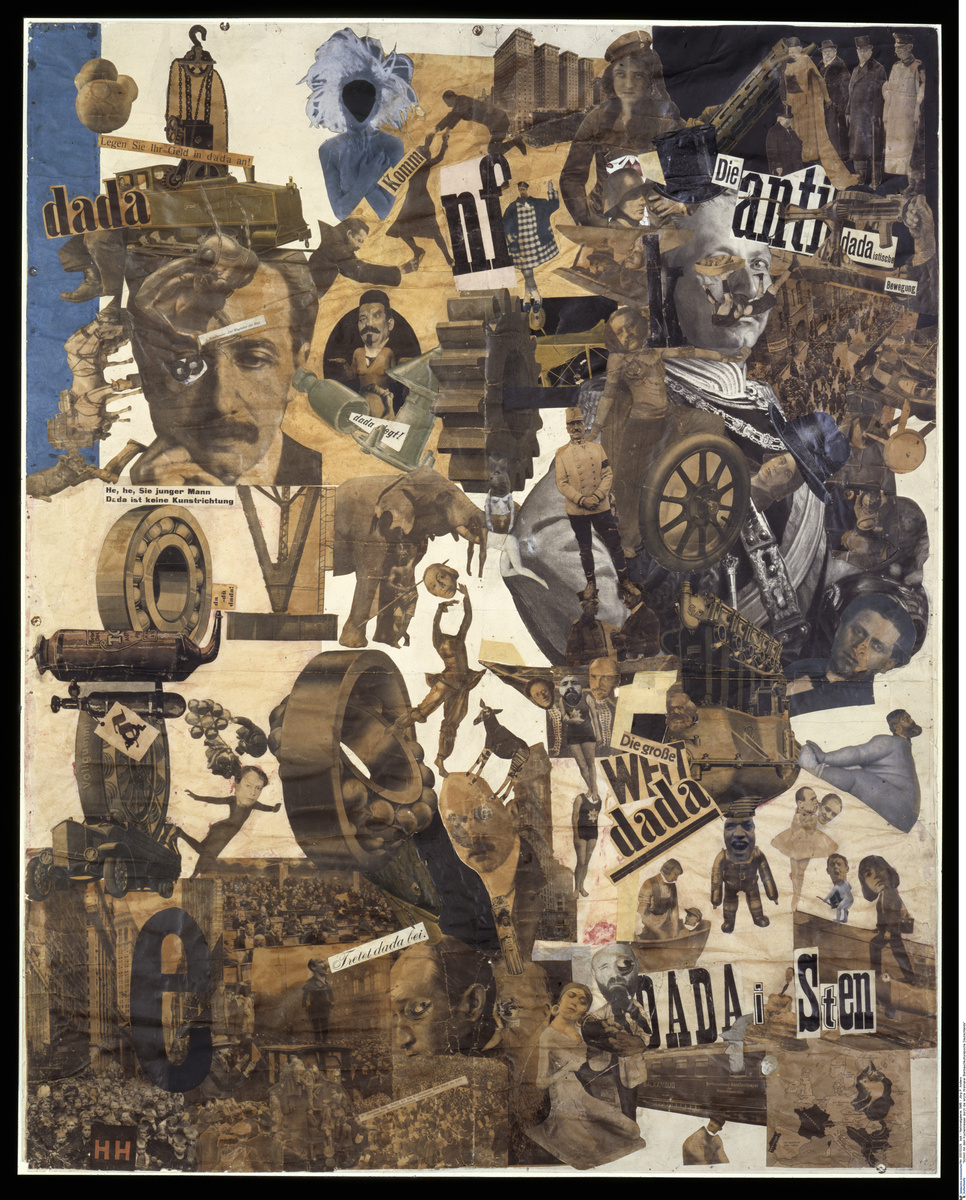
Hannah Höch's Cut with the Dada Kitchen Knife through the Last Weimar Beer-Belly Cultural Epoch in Germany is easy to describe as chaos. That is also the quickest way to stop looking. The 1919-1920 photomontage is crowded with severed heads, machine parts, dancers, athletes, politicians, type fragments, crowds, and bodies that have been recombined against their original meanings.[1][2] But the picture is not a heap. It is a controlled disorder: a work that makes Weimar Germany look as if public life had already been sliced, sorted, re-captioned, and redistributed by mass media.
That is why the kitchen knife matters. Höch was not only naming a domestic tool with ironic feminist force, though that force is real. She was also naming the operation of photomontage itself. The work was made from images cut from the Berliner Illustrirte Zeitung and other periodicals, then pasted into a new political field.[1] A newspaper photograph normally arrives with the authority of having been printed, captioned, and circulated. Höch breaks that authority. She cuts faces away from roles, bodies away from social coherence, and printed language away from official tone. The result is not anti-composition. It is a composition about what happens when the press, politics, industry, and gender all become available for cutting.
Image context: this is a real archival photographic reproduction of a 1919-1920 photomontage in the Nationalgalerie, Staatliche Museen zu Berlin, not a generated image, diagram, or chart. It belongs here because the artwork's argument is visual and material: pasted paper, photographic fragments, visible seams, machinery, and typography do the thinking.[1][2]
The title is already a weapon
The title's full length is part of the artwork. Cut with the Dada Kitchen Knife through the Last Weimar Beer-Belly Cultural Epoch in Germany sounds comic, excessive, and almost physically overstuffed, like the political culture it mocks. Britannica frames the work as a forceful commentary on gender issues in postwar Weimar Germany and notes its visibility at the First International Dada Fair.[4] The title tells the viewer that the picture will not politely represent that world. It will cut through it.
The "beer-belly" phrase is especially sharp because it turns cultural authority into a body: swollen, male-coded, self-satisfied, and vulnerable to a domestic blade. Höch's knife does not attack from outside art. It attacks from a space that modern culture often tried to demote as feminine, private, and minor. That reversal is one of the montage's structural jokes. The tool associated with kitchen labor becomes an avant-garde instrument; the supposedly serious public world of presidents, generals, and famous men becomes material for trimming.
Khan Academy's account is useful here because it stresses that the "Kitchen Knife Dada" cuts through the composition diagonally, separating Dada and anti-Dada elements.[2] In other words, the title is not merely a caption. It gives the eye a route. The viewer is invited to read cutting as both a metaphor and a formal action: a diagonal procedure that breaks one culture into incompatible zones.
Public men lose their frames
Many of the work's most recognizable figures were public men of the day: Kaiser Wilhelm II, Paul von Hindenburg, Friedrich Ebert, and other political or military actors appear among performers, crowds, and machine fragments.[1][2] Höch does not need to caricature them with a painter's line. The photograph has already made them public property. Her intervention is to remove them from the stable settings that made authority legible.
That removal matters. In an official portrait, a politician's face is supported by pose, dress, scale, and institutional background. In Höch's montage, faces drift, collide, and attach to the wrong bodies. The result is not simply ridicule. It is a lesson in how fragile public identity becomes once the press image loses its frame. Authority depends on layout. Cut the layout, and the official body starts to look improvised.
The surrounding gears and industrial forms intensify that collapse. GHDI describes the composition as populated by familiar public faces floating among gears and ball bearings of industrial production.[1] That detail prevents the work from becoming only a political cartoon. Höch is showing a society where bodies, offices, machines, entertainment, and circulation belong to the same system. Public men are not above the machinery. They are already caught in it.
The machine is not neutral
The montage's wheels, bearings, and mechanical fragments might first read as Futurist excitement: energy, speed, modernity. Höch makes them less innocent. They do not simply symbolize progress; they distribute pressure across the entire surface. A gear near a face can make that face look processed. A wheel near a body can make the body look like a part. A machine fragment near a crowd can make mass politics feel engineered rather than organic.[1][2]
This is where Höch's composition becomes more modern than a straightforward antiwar picture. She is not showing one battlefield or one cabinet meeting. She is showing a media ecology. Printed photographs have already made politics reproducible; industry has already changed the scale of bodies and labor; the illustrated press has already taught readers to move between celebrity, machinery, violence, spectacle, and advertising on the same page. Höch's montage exaggerates that page until its hidden logic becomes visible.
MoMA's exhibition catalogue on Höch's photomontages places her practice inside a longer project of cutting, recombining, and testing printed culture rather than treating montage as a single early stunt.[5] Cut with the Dada Kitchen Knife feels foundational because it exposes the method so openly. The work does not hide its seams. It lets the viewer see that modern images are assembled things, and that assembly can be redirected.
Women move differently through the picture
The women in the montage do not function as one symbol. They appear as athletes, dancers, performers, heads, limbs, and signs of a new bodily publicness.[1][2] That variety is crucial. If Höch had simply opposed dead male authority to liberated female energy, the work would be easier and weaker. Instead, she makes women's bodies move through the same media system while also disturbing it.
The dancers and athletes matter because they carry motion into a picture otherwise full of political heaviness. They twist, leap, balance, and interrupt. Some are glamorous because the press had already made them glamorous; others become strange through placement. The montage does not pretend that mass media automatically liberates women. It shows that women's new visibility can be thrilling, unstable, commodified, and politically charged at once.
The small map in the lower right sharpens the point. Khan Academy notes that it marks countries where women had the right to vote by 1920, near the place where one might expect an artist's signature.[2] That placement turns suffrage into more than a historical note. It becomes a claim about authorship. The artwork signs itself through women's political geography: not just "Höch made this," but "this is the world in which the right to appear, speak, vote, and cut is being redrawn."
Dada is a method of looking, not only a mood
Because Dada is often introduced through absurdity, Cut with the Dada Kitchen Knife can be mistaken for an image of random revolt. The Neue Nationalgalerie's collection context is a corrective: the work sits among twentieth-century art not as a novelty of disorder, but as a key object in modernism's argument over how a picture can be built.[3] Its strangeness is disciplined.
The discipline lies in how the work forces several kinds of reading at once. You scan it like a newspaper page, hunt it like a political cartoon, inspect it like a collage surface, and feel it like a machine room. No single mode is enough. If you read only the named public figures, the work becomes topical satire. If you read only the formal fragmentation, it becomes modernist pattern. If you read only gender, the machine disappears. Höch's achievement is that each reading keeps interrupting the others.
That interruption is the point. Weimar public life was not one coherent picture waiting to be represented. It was a collision of defeated empire, new republic, mass press, entertainment culture, industrial power, gender upheaval, and revolutionary possibility. Höch did not smooth that collision into allegory. She made a surface capable of holding it without reconciliation.[1][2][4]
Why the cut still feels current
The lasting force of Cut with the Dada Kitchen Knife is not that it predicted our image culture in a simple way. It did something more exact: it showed that modern public meaning is vulnerable at the level of extraction and placement. Take a face from one context, a headline from another, a machine part from another, and a body from another, then recombine them, and a new political reality appears. That is not a side effect of media. It is one of media's basic powers.
Höch understood that power early and treated it as material. The kitchen knife is funny because it is too small for the public world it attacks. It is serious because it works. Once the image has been cut, no authority returns whole. The generals, presidents, dancers, crowds, wheels, and words remain visible, but their original instructions have failed. The viewer must assemble the field again, knowing that assembly is now part of the argument.
That is why the photomontage still resists tidy museum calm. It does not ask us to admire chaos. It asks us to recognize the labor of cutting inside every supposedly stable public image. Höch's knife does not merely slice Weimar Germany apart. It teaches the viewer to see that Weimar's public image was already made of pieces.[1][2][5]
Sources
- German History in Documents and Images, "Hannah Höch, Cut with the Dada Kitchen Knife through the Last Weimar Beer-Belly Cultural Epoch in Germany (1919)" - archival image record, source note, and abstract on the work's press materials, public figures, gears, and Dada context.
- Khan Academy, "Hannah Höch, Cut with the Kitchen Knife Dada Through the Last Weimar Beer-Belly Cultural Epoch of Germany" - close-reading article on the photomontage's source materials, diagonal cut, political quadrants, Dada section, and suffrage map.
- Neue Nationalgalerie, "Collection" - museum collection overview listing Hannah Höch's Cut with the Dada Kitchen Knife among key twentieth-century works in the Nationalgalerie context.
- Encyclopaedia Britannica, "Cut with the Kitchen Knife Through the Last Weimar Beer-Belly Cultural Epoch in Germany" - reference entry connecting the work to Höch, Weimar gender politics, and the First International Dada Fair.
- The Museum of Modern Art, The Photomontages of Hannah Höch exhibition catalogue, 1997 - institutional catalogue on Höch's photomontage practice and its wider Dada and modernist context.