Photorealism is easy to dismiss if the only question is, "Why not just take a photograph?" The movement becomes much sharper when the question is reversed: what happens when painting stops pretending the camera is an enemy and decides to answer it on its own ground? In the late 1960s and 1970s, painters such as Richard Estes, Audrey Flack, Ralph Goings, Chuck Close, Robert Bechtle, and others made images that looked cool, exact, and camera-derived, but the point was not simply manual virtuosity.[1][2][4]
The stronger movement story is about pressure. Abstract Expressionism had made gesture, scale, and subjective force central to postwar painting. Minimalism and Conceptual art had pushed the object and the idea away from illusionistic picture-making. Photorealism entered that field like a technical provocation: it revived illusionism while insisting that illusion now had to pass through photography, slides, projection, grids, commercial surfaces, and the visual habits of mass media.[1][2][4]
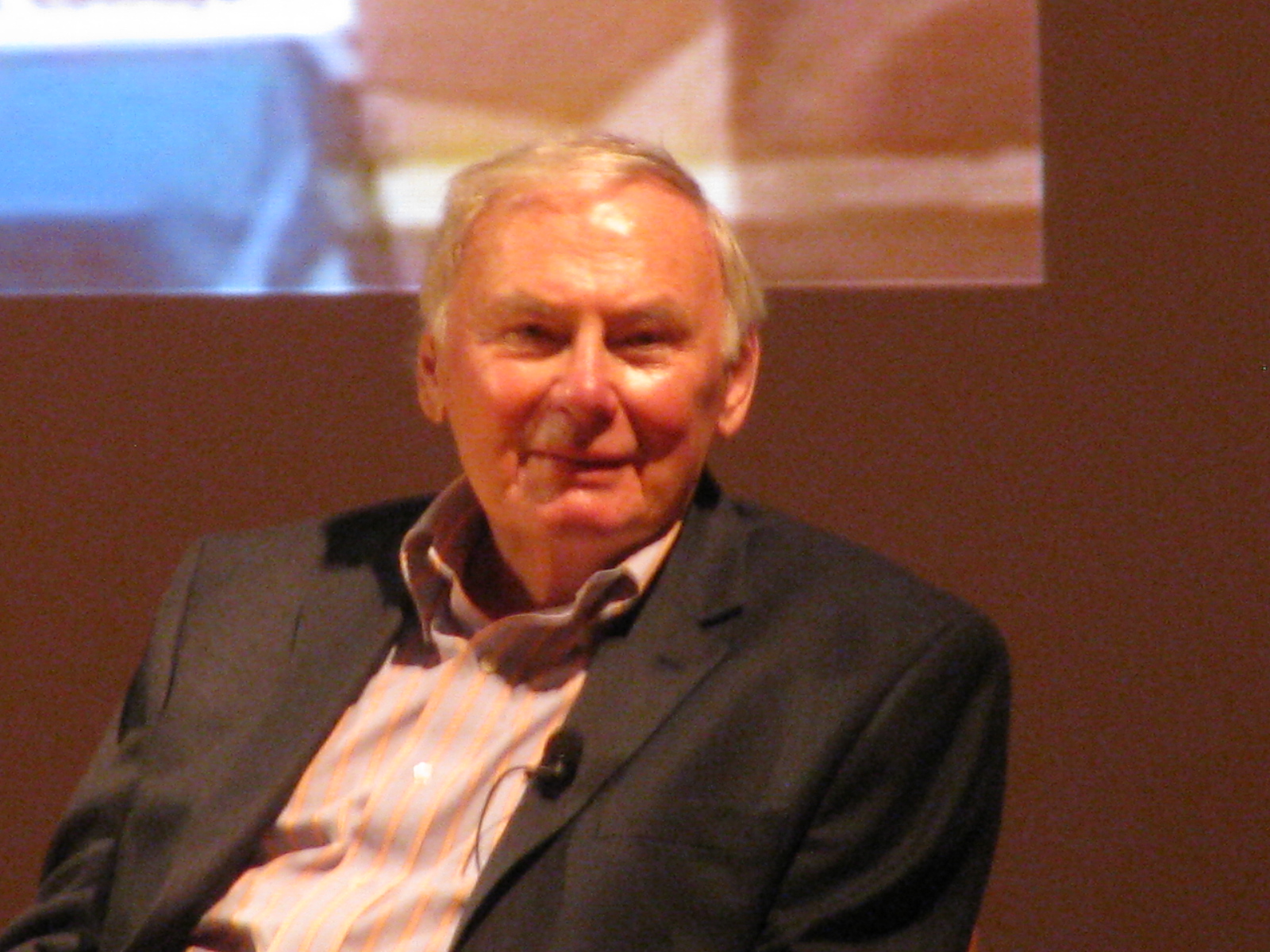
Image context: the cover uses a real 2014 photograph of Richard Estes at the Smithsonian American Art Museum, preserved on Wikimedia Commons.[6] It is not a substitute for seeing the paintings, but it anchors the essay in one of the movement's central figures and in the museum setting where Photorealism's camera-painting argument became part of contemporary art history.
The photograph was the source, but not the finish line
Britannica's compact definition gets the first mechanism right: Photo-realists used industrial or mechanical techniques, especially photography, as the foundation for painting, often producing a detached and impersonal effect that had affinities with Pop and Minimalism.[1] That foundation matters because it distinguishes Photorealism from older realism. A nineteenth-century realist could claim direct encounter with the world. A Photorealist usually begins with a mediated image and then makes that mediation visible by translating it into paint.
The Smithsonian's account of Audrey Flack's Spitfire makes the production chain concrete. Flack did not simply set up a still life and paint from it in the old studio manner. She composed an arrangement, photographed it, and then used that photograph as the source for the canvas; Photorealists commonly transferred source images with slide projection or grid systems.[2] The painting's apparent transparency is therefore built from layers of staging, lens capture, enlargement, and hand execution.
That is why the "looks just like a photo" reaction is incomplete. The painting asks viewers to notice how realism is made after photography has already trained the eye. Focus, glare, reflection, cropping, flash, surface shine, and flattened depth are not flaws to be corrected; they are part of the subject. Photorealism turns the camera's habits into painterly problems.
Coolness was a style, not a lack of decision
Photorealist paintings often feel emotionally cool because their surfaces avoid visible expressive drama. That coolness can be mistaken for neutrality. In practice, it is a decision about authority. The movement borrows the camera's promise of detached seeing, then slows it down until the viewer has to ask what detachment is doing.
Richard Estes is the clearest urban case. The Smithsonian American Art Museum's exhibition page for Richard Estes' Realism describes a career built from city subjects, including New York, London, Paris, Tokyo, Venice, Antarctica, and Maine, with paintings from the late 1960s through 2013.[3] The range matters because Estes's art is not only a trick of reflective storefronts. It is a long study of modern surfaces: glass, chrome, bus windows, diners, escalators, bridges, taxis, and spaces where the city appears as a network of reflections rather than as a stable street scene.[3]
In that context, the mechanical look becomes a social look. The city is already mediated before the painter touches it. Storefront glass turns pedestrians into layered ghosts. Buses reflect buildings while blocking them. Diners become signs, interiors, and memories of service at once. Estes does not make the city photographic because he cannot paint otherwise; he paints it as photographic because late modern urban life often reaches the eye that way.[3]
The movement was broader than storefront precision
The Rose Art Museum's 2026 exhibition framing is useful because it refuses to reduce Photorealism to one narrow genre. Its exhibition page names pioneering figures such as Richard Estes, Charles S. Bell, Audrey Flack, and Ralph Goings, and describes the movement's continued relevance across urban landscapes, psychologically charged portraits, perception, memory, and the constructed nature of realism.[4] That language is important. It keeps Photorealism from becoming only a story about shiny cars and diners.
Flack is especially good at complicating the cool-surface stereotype. The Smithsonian notes that she was one of the first female Photorealists in the original group and that her work could bring emotion and symbolism into a movement often associated with camera-like detachment.[2] In Spitfire, a fighter plane, still-life arrangement, pearls, color, and war memory press against the idea that Photorealism is automatically unemotional.[2] The photographic method does not cancel meaning. It changes the route by which meaning arrives.
Chuck Close complicates the movement from another direction. MoMA's record for his 1991 Self-Portrait explains that his early meticulous photorealism gave way to a more painterly style in the 1990s, while the underlying procedure still depended on mapping a large Polaroid image onto a grid.[5] From close range, the image breaks into abstract units; from several steps back, it resolves into a face.[5] That oscillation reveals a hidden truth about the whole movement: Photorealism is never only about resemblance. It is about the distance at which resemblance becomes believable.
Why Photorealism still matters
Photorealism can look conservative because it restores recognizable imagery after decades of modernist attacks on illusion. But the restoration is not simple regression. The movement does not return painting to a pre-camera innocence. It accepts that innocence is gone. A painted reflection, a projected photograph, or a gridded portrait can still be painting, but it now carries a record of the technologies that made seeing feel automatic.
That is the reason Photorealism remains more interesting than a display of skill. It stages a negotiation among three things: the photograph as source, the painted surface as labor, and the viewer's trust in images. When the result works, the painting first convinces the eye, then makes that conviction feel constructed.
The movement's afterlife is especially clear in a visual culture saturated by phone cameras, filters, product renders, surveillance footage, and AI image systems. Photorealism does not answer those later technologies directly, but it gives a durable grammar for thinking about them. It asks what kind of hand, system, institution, and expectation sit behind an image that claims to be merely realistic. Its best works are not saying, "This is real." They are saying, "This is what realism looks like after the camera has rewritten the conditions of proof."[1][2][4][5]
Sources
- Encyclopaedia Britannica, "Photo-realism" - overview of the movement's use of photography, mechanical technique, Pop and Minimalist affinities, and challenge to abstraction.
- Smithsonian National Air and Space Museum, "Beneath the Surface: Audrey Flack's Photorealism" - account of Flack's source-photograph process, the Speiser Photorealism Collection, and emotional-symbolic pressure inside Spitfire.
- Smithsonian American Art Museum, "Richard Estes' Realism" - exhibition page on Estes's city subjects, reflective surfaces, and career range from the late 1960s to 2013.
- Rose Art Museum, Brandeis University, "Photorealism in Focus" - 2026 exhibition page on Photorealism's late-1960s emergence, painting-photography boundary, technical precision, and continuing relevance.
- The Museum of Modern Art, "Chuck Close, Self-Portrait, 1991" - collection page explaining Close's shift from meticulous photorealism to gridded painterly construction from a Polaroid source.
- Wikimedia Commons, "File:Richard Estes 4479.JPG" - source page for the real 2014 Smithsonian American Art Museum photograph used as this article's cover image.