Gwen John is still too often introduced through diminishment. She is the quieter John sibling, the artist overshadowed by Augustus, the woman who spent years in Rodin's orbit, the painter of shy interiors and withdrawn sitters.[2] None of those facts is invented, but taken together they shrink the work before it has had a chance to act. John's real distinction lies elsewhere. She made small scale feel sovereign. A sparse room, a woman seated alone, a wall barely warmed by color, a figure bent inward rather than outward: these were not minor subjects in her hands. They became a way of giving restraint full authority.[1][2]
That authority is easiest to miss because John does not announce it through spectacle. The National Museum of Women in the Arts notes that she focused on only a few subjects, mostly three-quarter portraits of solitary women, stark interiors, and quiet still lifes, and that her style remained strikingly consistent across her career.[2] That description can sound almost narrow until one sees what she did with that narrowness. She was not short of ambition. She was cutting away options. Repetition, for John, was not fallback. It was pressure.
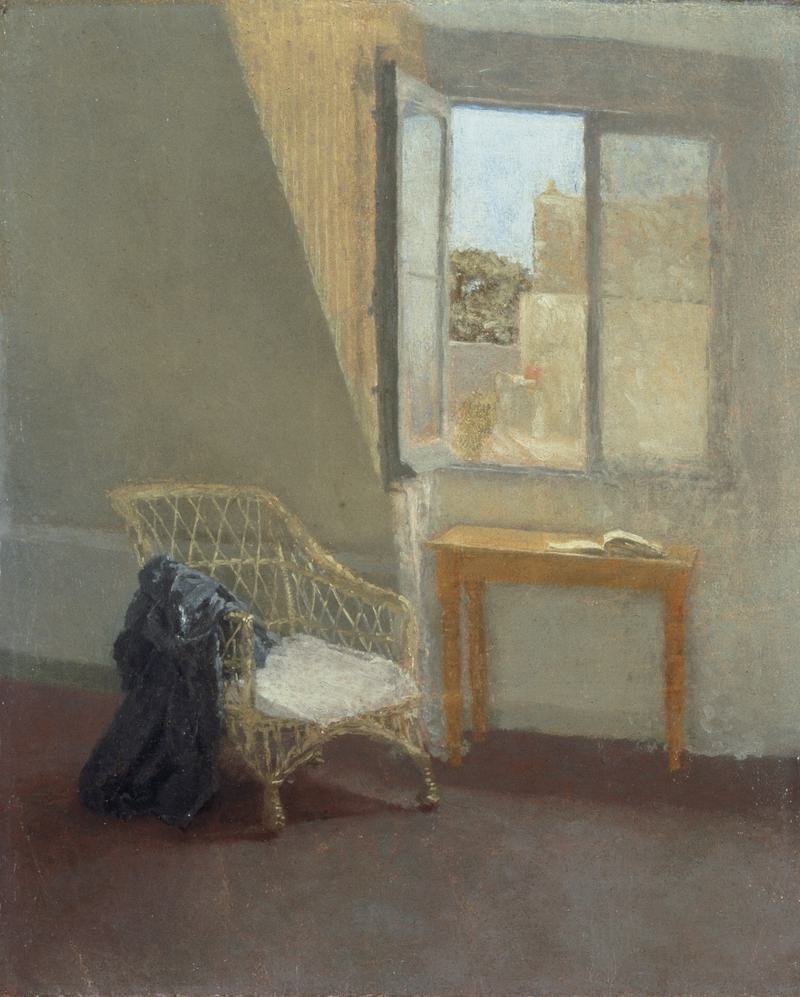
Image context: the lead image uses A corner of the artist's room in Paris because it states the article's thesis almost perfectly. The room is sparse, the chair is empty, the clothes are ordinary, and yet the whole painting feels inhabited by a will severe enough to make absence read like form.[1]
The room came first
Museum Wales's page on A corner of the artist's room in Paris is one of the clearest keys to John's art because it refuses to sentimentalize the setting.[1] John studied at the Slade, settled in Paris by the beginning of 1904, and lived in the top-floor room at 87 rue du Cherche-Midi between 1907 and 1909.[1] That room recurs in the work. The museum notes the empty chair, discarded clothes, and open book, then says the painting conveys "controlled passion," order, quiet, and absolute calm.[1] The phrase matters because it corrects a common mistake. Calm, in John, is never simple softness. It is held in place.
The room therefore behaves like more than setting. It becomes a displaced self-portrait. John does not need to stage herself theatrically inside the picture to make the space personal. The chair can carry her absence. The discarded garments can imply a body without illustrating it. The open book can suggest an inward life without turning that life into anecdote.[1] The result is why the painting remains so modern. It shows how much authority can be carried by things that remain almost stubbornly ordinary.
This is also where John's scale matters. The room is small, but the painting does not apologize for that fact or try to enlarge it into grand decor. Instead it treats scale itself as a discipline. The viewer is brought into a compressed field where a few objects must do all the work. John does not solve that problem by embellishment. She solves it by tone, spacing, and refusal.
Repetition was her method, not her limit
NMWA's artist profile makes a second important point: between 1900 and 1912, only twenty-three finished paintings have been recorded.[2] That number can sound startlingly low until it is read alongside the broader body of work. On the museum's page for Seated Woman, John is described as especially adept at rendering her subjects through the sparest means, building mood and structure with a few lines and broad subdued washes.[3] The same page notes that she produced more than 1,000 drawings and watercolors, while her roughly 200 oils were rarer and more intensely personal.[3]
Taken together, those details show a practice built around concentration rather than production volume. John did not treat drawing and painting as interchangeable outputs. Works on paper gave her speed, recurrence, and permission to circle motifs. The oils feel slower and more final, as though a subject had to survive long internal testing before it earned that density of paint.[2][3] What looks repetitive from afar starts to look exacting up close. She kept returning to the seated woman, the room, the small devotional or domestic arrangement, because return was how she sharpened judgment.
That is why even a painting like The Convalescent carries more force than its quiet subject first suggests. The National Gallery of Art's page shows a woman seated alone, looking downward, with a teacup and teapot beside her and a muted beige field behind her.[4] Nothing in the scene strains for event. Yet the whole picture is bound by containment: the body held close to the chair, the table near at hand, the palette compressed, the atmosphere stripped of surplus.[4] John's figures are often described as solitary, but solitude in her work is not social absence alone. It is compositional discipline.
Devotional attention narrowed the world and deepened it
The later work makes that discipline even clearer. NMWA's Seated Woman page places one of John's recurring series after her conversion to Catholicism in 1913, when she made images of female churchgoers, nuns, and children in Meudon outside Paris.[2][3] The same page stresses the self-contained pose as one of her favorites.[3] That phrase does a lot of work. John was not chasing psychological confession. She was building figures that keep their inwardness structurally intact.
This is one reason her art can feel devotional without becoming illustrative piety. The churchgoing women and children are not turned into moral examples, nor are they broken open into narrative. They sit, read, wait, fold inward, and occupy their chairs with an almost monastic economy.[3] John gives them dignity by not forcing them to perform legibility.
Museum Wales's 2020 blog on John adds an important archival dimension to that reading. In 1976 the museum acquired more than 900 drawings, along with sketchbooks and paintings, comprising the bulk of the material left in John's studio and almost the entirety of her later-career output.[5] That matters because it widens the profile. John was not simply the maker of a few canonical quiet oils. She sustained a long, searching practice on paper in which variation, recurrence, and inwardness remained active rather than static.[5]
Why Gwen John keeps getting larger
The durable surprise of Gwen John is that her art grows as its means shrink. She does not compete by widening the cast, brightening the palette, or escalating drama. She takes the opposite route. She narrows the field until tone, chair, wall, sleeve, bowed head, and empty space become enough. That is not modesty as a virtue signal. It is a hard artistic wager.
Seen that way, John belongs nowhere near the category of "minor quiet painter." She is one of the artists who proved that reduction can increase pressure. Small rooms can carry full presence. A woman seated alone can hold the gravity of a history painting if the structure around her is exact enough. Repetition can be the engine of seriousness rather than the sign of limitation. Gwen John made all of that visible, and she did it without ever raising her voice.[1][2][3][4][5]
Sources
- Museum Wales, "A corner of the artist's room in Paris" - collection page with John's rue du Cherche-Midi address, the room's recurrence in her work, and the museum's note on "controlled passion," order, and calm.
- National Museum of Women in the Arts, "Gwen John" - artist profile on her limited subject range, stylistic consistency, years in Paris, and the small number of finished paintings recorded between 1900 and 1912.
- National Museum of Women in the Arts, "Seated Woman" - artwork page on John's post-1913 churchgoer series, self-contained pose, spare means, and the scale of her works on paper versus oils.
- National Gallery of Art, "The Convalescent" - object page used here for work metadata and visual description of the seated figure, table, and compressed interior field.
- Museum Wales, "Gwen John: 'It's tone that matters' Part 1" - archive-based article on the 1976 acquisition of more than 900 drawings, sketchbooks, and paintings from John's studio.