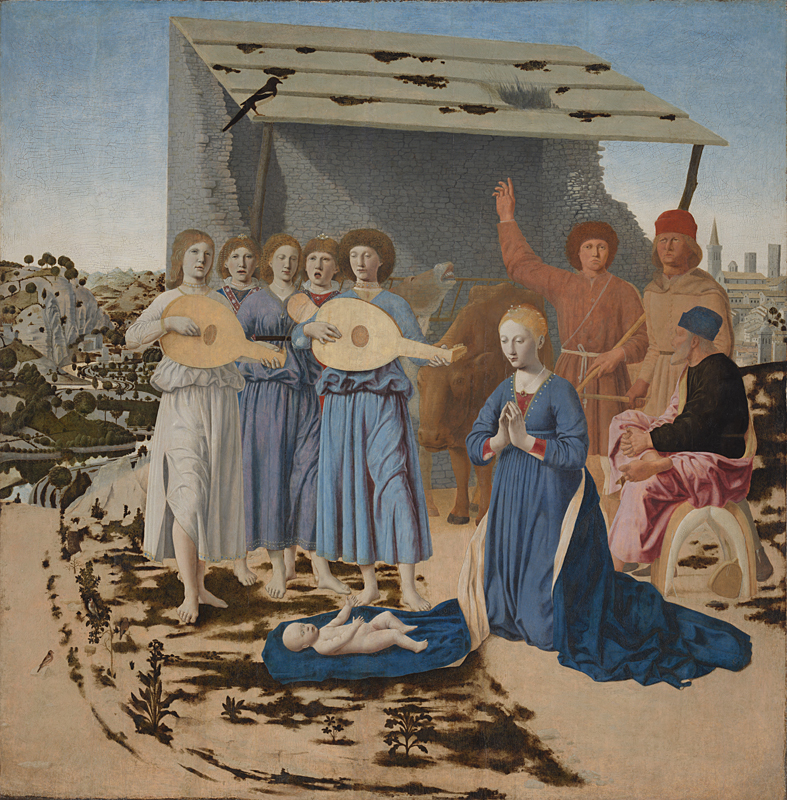
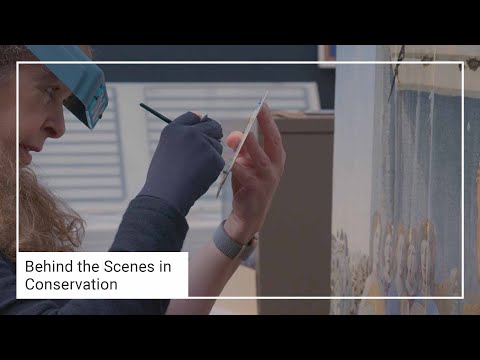
Piero della Francesca's Nativity can look almost too serene at first. The Virgin kneels, angels sing, Joseph sits quietly to the side, and the Tuscan hills open behind the shed.[1][2] Reduced to that summary, the picture becomes a beautifully cool Christmas scene, admired for calm more than for thinking. The National Gallery's conservation video is useful because it breaks that first impression without destroying the painting's stillness.[1] It argues, in effect, that the stillness had been partially hidden by damage, bad cleaning, framing assumptions, and a long habit of reading the work as if it were an unfinished altarpiece.
That shift matters because the object had suffered badly before it reached London. The National Gallery's object page and restoration pages say the panel remained in Piero's family palace in Borgo San Sepolcro until 1825, then entered the nineteenth century in poor condition, with overcleaned paint, splits in the support, and later misunderstandings about what had actually survived.[2][3][4] The short video adds a vivid material detail, candle burn marks still visible on the painting, which keeps the work anchored in lived use rather than museum abstraction.[1] This is not just a Renaissance image that floated safely into modern appreciation. It is a painting that had to pass through domestic life, mishandling, structural trouble, and a three-year conservation campaign before its logic became readable again.[1][3][4]
The strongest way to watch the film, then, is not as a pleasant restoration featurette. It is as an argument about what conservation can do for interpretation. Jill Dunkerton and Caroline Campbell are not simply cleaning grime or repairing a support.[1] They are showing that certain features long treated as defects or absences belong instead to Piero's design. The lack of shadows is not evidence of incompletion. The damaged shepherds are not proof of weakness in the original conception. The now legible patch of light on the stable wall is not decorative trivia. Each point changes how the painting should be read.[1][2][3][4]
Image context: the cover uses the National Gallery's photographed record of the restored painting rather than a cropped detail or a secondary contextual photograph. That choice fits the article because the argument depends on the picture's full surface after treatment. The stable wall, the angels' musical band, the shepherds, and the broad hilltop setting all need to remain in view together for the video's claims to make sense.[2][4][6]
Around 0:46, the work stops being an altar picture first and becomes a visionary domestic painting
The first strong turn in the video arrives when the speakers explain where the work was probably made to live.[1] For years the National Gallery displayed The Nativity in a way that encouraged viewers to imagine an altarpiece. The restoration project helped dislodge that assumption. The press release and behind-the-scenes pages state that the work is now understood instead as a grand domestic painting for the principal bedchamber of Piero's family palace, and the Gallery even reframed it in a period walnut frame to suggest that original setting more accurately.[3][4]
That matters because it changes the emotional contract of the image. A domestic painting is not less serious than an altarpiece, but it organizes attention differently. Instead of confronting a congregational liturgical object, the viewer is brought into a more private and visionary relation to the Nativity. The object page makes that relation explicit by linking the composition to Saint Bridget of Sweden's account of Christ's birth.[2] Piero does not give us a theatrical stable crowded with narrative action. He gives us a miracle materializing in a familiar Tuscan landscape, as if revelation had entered the artist's own world quietly and with exact visual discipline.[2][4]
The domestic setting makes the painting stranger, not more cozy. The principal bedchamber is a place of sleeping, waking, vulnerability, and repeated daily vision. Read in that context, the angels stretched across the foreground and the kneeling Virgin do not merely decorate a sacred subject. They stage a concentrated apparition. The Nativity happens here not as public spectacle but as meditative presence. The calm is therefore not soft. It is controlled.
Around 4:45, damage stops masquerading as unfinished painting
The middle of the video is where the article's main claim really locks in.[1] Campbell and Dunkerton explain that the work's damaged state had encouraged a persistent misunderstanding: many viewers believed the painting was unfinished.[1][2][4] The official pages now reject that reading firmly. Overcleaning, especially in the shepherds' heads and other delicate passages, had stripped away enough paint that the image looked thinner and less resolved than Piero intended.[3][4] Panel splits and other condition problems deepened that impression.[3]
Once that history is understood, the painting changes immediately. "Unfinished" suggests a failure of execution or a break in intention. "Damaged" suggests the opposite: an intention partially obscured by later handling. The distinction is fundamental. The object page says the 2022 restoration enhanced the painting's legibility and recovered much of Piero's original intention.[2] The press release sharpens the point by noting that even when the Gallery acquired the painting in 1874, Parliament questioned how much original paint remained, so unstable had the work's appearance become.[3] This is a painting whose reputation had been entangled with its wounds for generations.
The missing shadows are the clearest example of how badly form can be misread when condition takes over interpretation. The restoration pages say their absence had long been cited as evidence of incompletion.[3][4] After treatment and renewed study, the Gallery instead interprets that absence as deliberate, part of presenting the Nativity through Saint Bridget's miraculous vision rather than through ordinary optical consistency.[2][3][4] That is a far more interesting solution. Piero is not failing to finish naturalistic space. He is suspending one part of naturalism so that miracle can remain visible without noise. The painting keeps its realism in the hills, the shed, the plants, and the weathered setting, but refuses fully ordinary shadows where the visionary event would become too anchored to everyday time.
Around 6:29, restoration clarifies Piero's light rather than inventing it
The last major movement in the film is where conservation becomes a matter of pictorial intelligence rather than cosmetics.[1] Dunkerton and Campbell discuss cleaning, retouching, and panel work, but the most revealing claims concern what could be seen again afterward. The press release says retouching of abraded paint on the stable brought back a patch of light stones, while thin glazes over Piero's underdrawing helped the shepherds recede properly and made his handling of light, color, and space legible again.[3] The object page says much the same in slightly broader form, stressing that the restored work once again reveals the divine light on the stable wall and the composition's sense of space.[2]
This is why the video is better than a generic before-and-after reveal. It does not flatter restoration as magic. It shows restoration as disciplined restraint. Nothing in the treatment invents a new iconography. Instead it lets relationships become readable: the shepherd's gesture now connects more convincingly to the heavenly beam entering through the hole in the roof, the stable wall regains a harder material presence, and the figures sit more coherently inside the hillside clearing.[2][3][4] In a painting so dependent on quiet intervals and precise spacing, those recoveries matter enormously.
The painting's mood therefore changes in a subtle but decisive way. Before treatment, damage could be mistaken for vagueness. After treatment, calm looks designed again. The rustic shed feels intentionally ramshackle, not simply rubbed thin. The shepherds feel spatially placed rather than weakly sketched. The famous stillness remains, but it stops feeling passive. It becomes a consequence of control.
Why this short film is worth keeping
Many museum restoration videos are useful only while the treatment is new. This one has a longer life because it changes the terms in which the painting is seen.[1][3][4] It asks the viewer to stop treating conservation as backstage maintenance and to recognize that condition history shapes meaning. A work can become more theological, more spatially exact, and more emotionally persuasive once damage is disentangled from intention.
That is the real lesson of The Nativity in its restored state. Piero's miracle is not loud. It does not rely on crowded gestures or dramatic weather. It works through hilltop clarity, domestic stillness, musical suspension, and a selective relation to realism in which some things are made exact while others, like cast shadows, are withheld on purpose.[2][3][4][5] The conservation video matters because it returns that selective exactness to view. The picture stops looking sweetly incomplete and starts looking like what it always was: a highly planned visionary painting whose quiet depended on a much sharper structure than damaged surfaces had allowed modern viewers to see.
Sources
- The National Gallery, "Conserving Piero della Francesca's 'Nativity' | Art restoration | National Gallery," YouTube video.
- The National Gallery, "Piero della Francesca | The Nativity | NG908" - official object page with overview, in-depth interpretation, and post-2022 restoration framing.
- The National Gallery, "Following three-year restoration, Piero's 'Nativity' returns to public display for Christmas with long-standing mysteries answered" - press release on overcleaning, panel splits, the shepherds, missing shadows, and the revised domestic setting.
- The National Gallery, "Restoring Piero della Francesca's 'The Nativity'" - behind-the-scenes page on the three-year conservation treatment, damaged surface, and new framing.
- The National Gallery, "Piero della Francesca" - artist page on his cool palette, geometrical compositions, and recurring Tuscan landscape logic.
- The National Gallery IIIF manifest for "The Nativity" - image and download record for the painting used as this article's cover image.