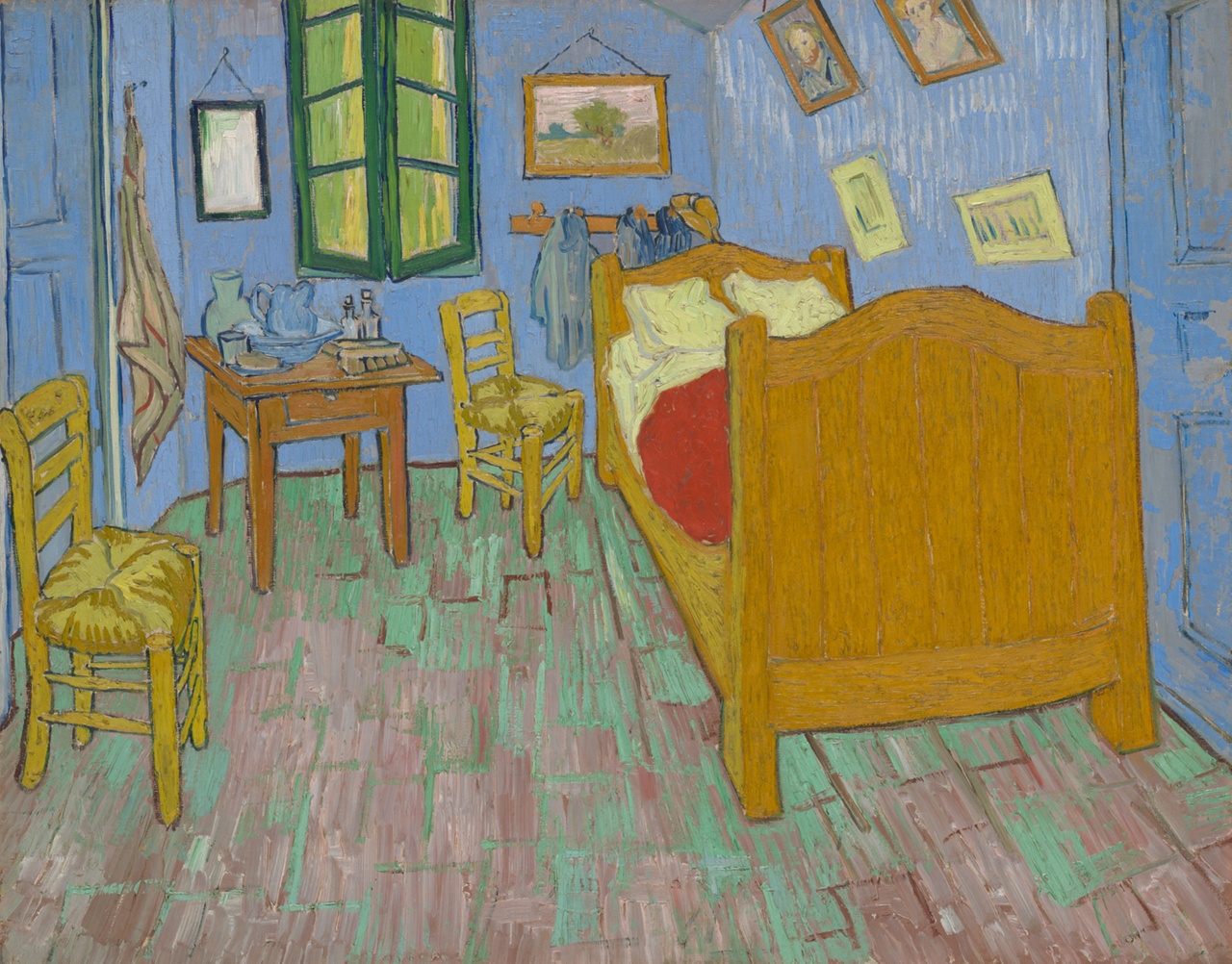
Van Gogh's The Bedroom is easy to remember as a comfort picture. The bed looks sturdy, the chairs are simple, the walls are bright, and the room seems stripped of all social noise.[1] Yet the painting only gets more interesting once it stops reading as cozy. Van Gogh said he wanted the image to suggest rest and sleep through color and simplification, to let the painting calm the mind rather than excite it.[2] What he produced, however, is not a soft refuge. It is a room that has to hold itself together by force.
That tension is the work's real subject. The Art Institute's object page notes that the bold palette, broken brushwork, and sharply receding lines can suggest nervous energy even though Van Gogh understood the painting as restful.[1] The contradiction is not a flaw in the picture. It is the picture. Rest here is not a natural condition quietly possessed by the room. It is something Van Gogh tries to construct against fatigue, loneliness, and the instability of his own seeing.[1][2]
Image context: the lead image uses the Art Institute's 1889 version because this article's argument depends on the whole space rather than on one detail. The slanted floor, compressed furniture, green shutters, mirror, towel, and wall pictures work as a single pressure system rather than as isolated symbols.[1][2]
Color does the emotional work
Van Gogh's letter to Theo from 16 October 1888 remains the clearest guide to what he thought he was doing.[2] He writes that the bedroom should rely on color, simplified form, and flat tints to suggest rest or sleep in general. He inventories the room almost item by item: pale violet walls, red floor, butter-yellow bed and chairs, lemon-green sheet and pillows, scarlet blanket, green window, orange dressing table, blue basin, and lilac doors.[2] That list matters because it shows how deliberate the painting is. The room is not brightly colored by accident or by generalized emotion. Each object has been assigned a role in a chromatic plan.
But the plan is more strenuous than tranquil. The yellow bed and chairs push forward hard against the blue walls. The red floor refuses neutrality. The green shutters and orange table keep the room from settling into a narrow harmony.[1][2] Even before one starts reading symbols or biography, the eye feels the painting as a set of emphatic placements. Van Gogh wanted color to make the room restful, but he also wanted it vivid enough to survive simplification. That double demand is why the painting still hums.
The absence of cast shadows sharpens the effect.[2] Van Gogh says directly in the same letter that the shadows have been removed and the space is colored in flat plains like Japanese prints.[2] Without shadows to cushion transitions, color boundaries and contours have to carry more weight. The room therefore looks cleaner, but also stranger. Its calm is achieved not by atmospheric softness but by reducing the space to hard relations between wall, floor, bed, chair, and window.
The furniture is solid, the room is not
Van Gogh also wrote that the solidity of the furniture should express "unshakeable repose."[2] The phrase is revealing because the furniture is indeed the most stable thing in the picture. The bed frame, chairs, and table are thickly outlined and materially insistent. They do not dissolve. They plant themselves. Yet the room around them refuses to sit still. The floor tilts upward too quickly, the back wall feels both near and remote, and the side walls seem to lean into a space too narrow for the objects they contain.[1]
This is where the close reading has to resist the old shortcut that treats the painting's odd perspective as mere technical awkwardness. The spatial compression is functional. If the room obeyed a cooler academic perspective, the furniture would recede politely and the scene would become calmer in the ordinary sense. Van Gogh wants the opposite. He wants the bed, chairs, and window to remain close enough that repose feels actively defended.[1][2] The room becomes intimate by almost becoming cramped.
That cramped intimacy also explains why the empty bed matters so much. No figure occupies the room, yet the room is saturated with bodily expectation. The bedspread has weight, the pillows keep their shape, the towel hangs ready, and the chairs imply recent or imminent use.[1][2] The body is absent, but the room keeps its outline. That is one reason the painting never feels like a neutral interior study. It behaves more like a self-portrait by furniture.
A room of one's own, and a room without company
The broader history of the three Bedroom paintings makes the image less anecdotal and more revealing. The Art Institute's exhibition page frames the series through Van Gogh's "quest for home," noting that the first Bedroom followed his move into the Yellow House, the second was made after water damage threatened the first canvas, and the third was painted as a gift for his mother and sister.[4] The room therefore mattered enough to be painted again and again. This was not a passing domestic note. It was a motif in which the ideas of home, memory, and preservation kept converging.[1][4]
At the same time, the room is not a simple documentary record. The Art Institute's essay on the pictures hanging on the wall points out that the first version differs from the later ones: in the original, the wall pictures depict Eugène Boch and Lieutenant Milliet, while the later versions replace that pair with other images.[3] That change is small in scale but large in meaning. It shows that Van Gogh was not merely copying an inventory of possessions. He was adjusting the room's social atmosphere inside the painting itself. The bedroom could be repainted as a structure of relations, not just as a place.
Kevin Salatino's Art Institute essay on solitude makes the room's emotional paradox especially clear.[5] He calls the space cramped, sparse, and yet inviting, then argues that its emptiness shares solitude with the viewer secondhand.[5] That feels exactly right. The Bedroom welcomes us in, but it does not give us company. The shutters are closed, no body enters, and the room's order is held in suspension. It is home, but a home presented through absence.
Why The Bedroom keeps its grip
What lasts in The Bedroom is not just the famous palette or the biographical aura of the Yellow House. It is the way Van Gogh turns rest into a formal problem. Color has to calm without going dull. Furniture has to look solid inside a room that will not quite stabilize. Home has to appear even though the inhabitant is missing. Solitude has to feel shared without becoming sociable.[1][2][4][5]
That is why the painting stays more alive than a familiar masterpiece has any right to be. It is not a postcard of peace. It is a hard-won image of repose built out of flat color, compressed space, and the stubborn wish that a room might hold together long enough to shelter a mind. Van Gogh wanted the picture to rest the imagination.[2] Instead, he made a painting that shows how much effort rest can require.
Sources
- The Art Institute of Chicago, "The Bedroom" - official object page with the 1889 version's metadata and the museum's note that bold color, broken brushwork, and sharply receding lines complicate the painting's restful aim.
- Vincent van Gogh, "Letter 705: To Theo van Gogh. Arles, Tuesday, 16 October 1888" - primary-source description of the room's colors, removed shadows, shut shutters, and the goal of making the painting suggest rest and sleep.
- Katie Rahn, "On the Wall of Van Gogh's Bedroom." The Art Institute of Chicago - essay on the different wall pictures across the three versions and what those changes reveal about the image's constructed interior life.
- The Art Institute of Chicago, "Van Gogh's Bedrooms" - exhibition page on the three versions, the Yellow House as Van Gogh's first felt home, the water-damage trigger for the second version, and the later gift version for his mother and sister.
- Kevin Salatino, "Van Gogh and the Nature of Solitude." The Art Institute of Chicago - essay on why the room feels inviting while also staging absence and solitude.