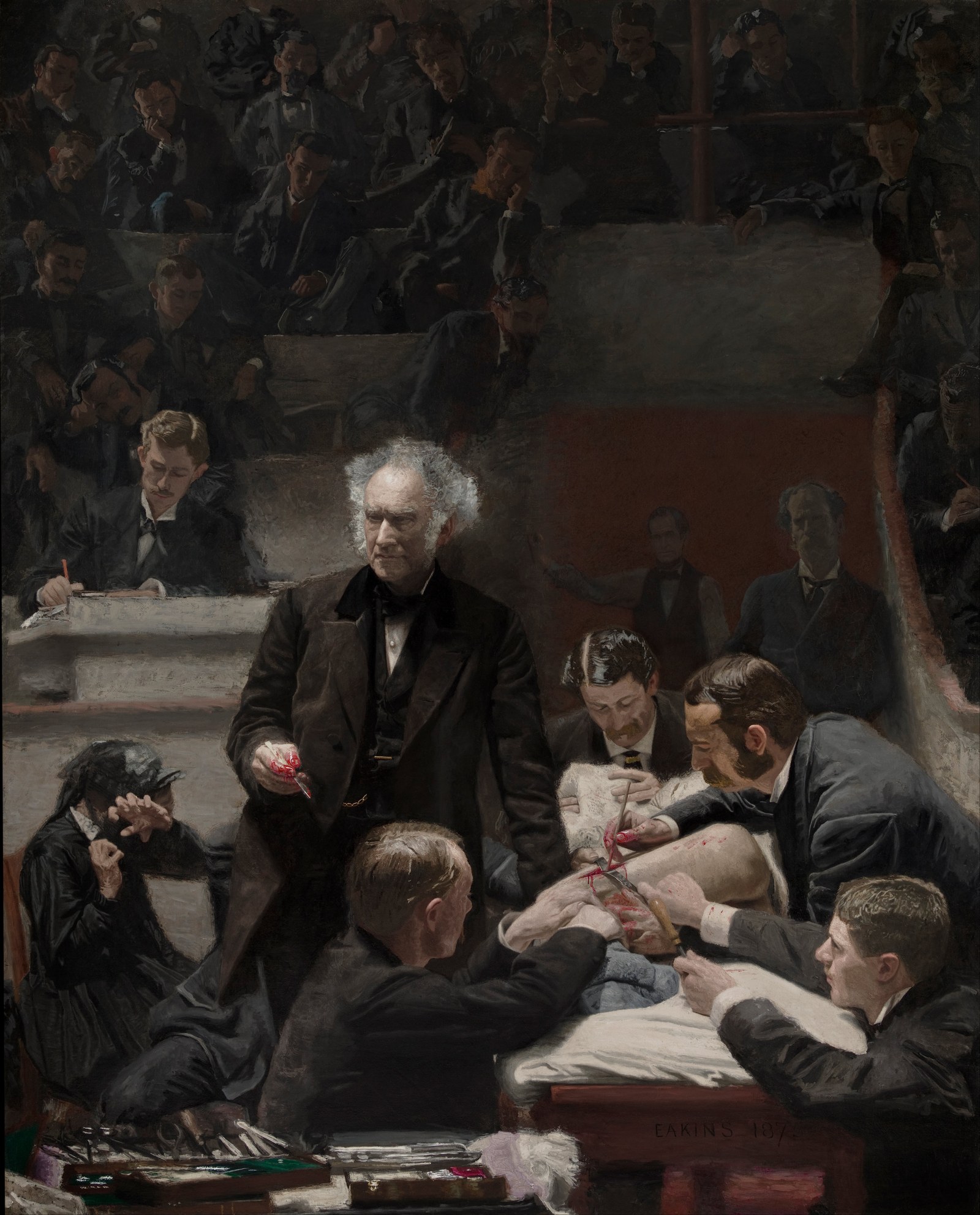
Modern viewers are used to surgery appearing as an environment of hygiene first and drama second. Masks, gloves, bright lamps, sealed surfaces, and clipped procedural language have taught us to imagine the operating room as a place where expertise suppresses spectacle. Thomas Eakins's The Gross Clinic works in the opposite direction. It makes surgery public before the room has acquired that modern visual code. Blood is visible on the surgeon's fingers and scalpel. The doctors still wear street clothes. A cloth soaked with chloroform covers the patient's face. Students crowd the tiers above. A woman at left recoils and shields her eyes.[1][2][3]
That is why the painting still has such force. It is not memorable merely because it is graphic. It is memorable because it stages a new kind of authority in full view. Dr. Samuel D. Gross is not shown as a hidden specialist working behind institutional walls. He stands in the surgical amphitheater as both operator and lecturer, turning a wounded body into a lesson before a room of witnesses.[1][2] Eakins understood that this was more than a medical scene. It was a civic scene, a picture of Philadelphia wanting to see itself as scientifically advanced, professionally serious, and modern enough to convert technical knowledge into public stature.[1][4]
Image context: the lead image uses the full painting because this essay depends on the whole arrangement rather than one cropped detail. Gross at center, the operating team below, the mother at left, the dark passage at right, and the steep rows of students above all belong to one visual argument about who can look, who cannot, and who gets to explain what is being seen.[1][2][5]
Surgery is being taught, not merely performed
The Philadelphia Museum of Art's object page states the scene plainly. Eakins made the picture for Philadelphia's 1876 Centennial Exhibition, choosing the city's famous surgeon and teacher Dr. Samuel Gross as his subject and placing him in Jefferson Medical College's surgical amphitheater, where five doctors operate on the left thigh of a patient while Gross demonstrates a relatively new procedure for treating bone infections.[1] The companion museum PDF sharpens the staging further. Gross is lit from above by the skylight, chief of clinic Dr. James Barton bends over the wound, assistants hold the leg and keep the incision open, an anesthetist presses the chloroform cloth to the patient's face, and the clinic clerk records the proceedings.[2]
These details matter because they change what the painting is actually about. The wound is real and the operation is real, but the center of the composition is not the incision alone. The center is explanation. Gross turns away from the wound and toward the students, calm enough to lecture while the surgery continues below him.[1][2] He occupies the picture as an interpreter of the body's crisis. The clinic therefore becomes a theater of translation: pain is converted into knowledge, technical labor into pedagogy, and local medical reputation into public form.
Eakins builds that hierarchy into the painting's geometry. Gross's forehead and hand catch the light with almost sculptural emphasis, while the operating group knots itself around the patient's obscured body. The action that matters most physically is taking place lower in the frame, yet the action that matters most symbolically is vertical. Gross rises. He addresses. He commands the room not by operating alone but by making operation intelligible.[1][2]
The room still belongs to the nineteenth century
One reason the picture shocked its first viewers is that it does not allow modern medicine to arrive already cleaned up for them. The museum's educational lesson on The Gross Clinic asks students to compare Eakins's scene with a photograph of modern-day surgery and immediately points out the obvious differences: the doctors wear street clothes, no gloves or face masks cover their hands and faces, the patient is anesthetized with a cloth held over the mouth, and the room is not brightly lit.[3] Those observations are simple, but they go directly to the painting's strange emotional temperature.
The room feels disciplined, though not sterile. It feels professional, though not remote from the body's mess. Eakins does not give viewers the comfort of full anatomical transparency either. The patient is largely hidden; only the left thigh, the bony buttocks, and the socked feet remain clearly legible from the audience's position.[2] The museum's object page notes that the gaping incision can be hard to read because the body's position is confusing in space.[1] In other words, the painting places the viewer in a split condition. We are close enough to feel the violence, but not positioned like surgeons. We do not get mastery for free.
That split is central to the theme. The Gross Clinic is about the emergence of professional sight, and professional sight only becomes visible when other kinds of sight fail beside it. The lay viewer sees blood, danger, and exposure. The surgeon sees procedure. The clerk sees a case worth recording. The students see a lesson. Eakins makes those modes coexist in one room without smoothing their conflict away.[1][2][3]
The mother and the artist mark the boundary of looking
The painting's most important secondary figure is the woman at left, traditionally identified as the patient's mother.[1][2] She cringes and covers her face while Gross continues his lecture and the assistants continue their work. Her function is larger than anecdotal pathos. She marks the point at which ordinary feeling reaches its limit. The operation can proceed only because the room is organized around a kind of looking she cannot sustain.
Placed against her is Eakins himself. The museum texts identify the intent figure seated at the right edge of the canvas as the artist, sketching or writing as the clinic unfolds.[1][2] That self-insertion does more than sign the scene. It aligns painting with medicine as a practice of disciplined observation. Eakins had attended anatomy classes at Jefferson Medical College, participated in dissections, and watched surgeries because he believed understanding the body's structure was essential to an artist's development.[2][3][4] His presence at the right edge says that art, too, has entered the amphitheater as a profession that wants to see without flinching.
This is where the painting becomes harder than a simple celebration of science. The mother's recoil is humanly persuasive. Eakins does not make her absurd. But he does make her structurally secondary. The room's authority belongs to those who can keep looking: Gross, the operating team, the clerk, the students, and the artist himself. The Gross Clinic therefore asks a disturbing question that still feels modern. What kind of social power gathers around the people who can turn another person's bodily crisis into expertise, instruction, and representation?[1][2][3]
Philadelphia wanted a civic masterpiece, and got an aesthetic scandal
The Met's essay on Eakins helps explain why the picture carries so much ambition. Eakins trained at the Pennsylvania Academy of the Fine Arts, attended anatomy lectures at Jefferson, studied in Paris under Jean-Leon Gerome, and returned to Philadelphia committed to the human figure as the center of serious art.[4] The same essay quotes his confidence from March 1875 that he was about to do work much better than anything he had yet made, and identifies The Gross Clinic as the likely project behind that excitement.[4] The Philadelphia Museum of Art adds the local purpose directly: Eakins intended the canvas to showcase both his own talent and the scientific achievements of his native city at the Centennial Exhibition.[1]
That civic wager collided with public taste. The museum's object page says the fair's art jury rejected the painting, perhaps finding the subject too bloody and brutal for the art building, so it appeared instead in a model U.S. Army field hospital exhibit.[1] The museum PDF preserves the mixed response that followed. One Philadelphia critic called it a great work unlike anything previously attempted in American portraiture, while another wrote that it ought never to have left the dissecting room.[2] Those two reactions expose the deeper scandal. The problem was not only that the scene was surgical. The problem was that Eakins insisted surgery, pedagogy, portraiture, and civic grandeur could occupy the same canvas.
That insistence remains the painting's enduring challenge. The Gross Clinic asks high art to admit a form of modern life that many viewers would rather keep functionally hidden. It says that the amphitheater, the wound, the lecture, and the city's professional pride belong to the same visual order. It also says that realism can do more than copy appearances. It can register how authority distributes attention inside a room: who explains, who records, who recoils, who submits, who watches, and who learns to call that arrangement progress.[1][2][4]
The painting still grips because it never settles into a single moral. It admires knowledge and shows its cost. It honors Gross and lets the mother's recoil stay valid. It records a medical advance and keeps blood in the foreground. It celebrates Philadelphia and exposes what that civic self-image required viewers to tolerate. Eakins made surgery public, and in doing so he painted one of the hardest American images of what modern professional authority looks like when it first steps fully into the light.[1][2][3][4]
Sources
- Philadelphia Museum of Art, "Portrait of Dr. Samuel D. Gross (The Gross Clinic)" - official object page on the Centennial purpose, Jefferson amphitheater setting, Gross's bone-infection procedure, the recoiling mother, Eakins at right, and the painting's rejection from the art building.
- Philadelphia Museum of Art, "Portrait of Dr. Samuel D. Gross (The Gross Clinic)" - museum education PDF identifying the surgical team, skylight, chloroform cloth, clinic clerk, mixed early reviews, and Gross's standing in American surgery.
- Philadelphia Museum of Art, "Medical Science on Canvas: The Gross Clinic" - lesson-plan PDF comparing the painting with modern surgery through street clothes, masks, gloves, chloroform, and lighting.
- H. Barbara Weinberg, "Thomas Eakins (1844-1916): Painting," The Metropolitan Museum of Art - essay on Eakins's PAFA and Jefferson training, Paris study, human-figure ambition, and the centrality of The Gross Clinic in 1875.
- Wikimedia Commons, "File:Thomas Eakins, American - Portrait of Dr. Samuel D. Gross (The Gross Clinic) - Google Art Project.jpg" - file page for the photographed reproduction used as the article image.