Martin Puryear's sculpture rarely asks to be understood in one glance. A form may arrive first as a husk, a boat, a basket, a cap, a ladder, a trap, or a shelter, then refuse to stay inside any one of those names.[1][4] That delay is central to his achievement. Puryear keeps abstraction open to use. Even when his sculptures are highly reduced, they do not become sealed-off exercises in pure shape. They remain inhabited by labor, cultural memory, and bodily association.
That is why his work feels so durable. Many postwar sculptors pursued a hard clarity in which the object would stand autonomous, cool, and self-justifying. Puryear took from modernist reduction a respect for structure and concentration, but he refused emotional quarantine. His forms stay exacting while still carrying the pressure of touch, making, travel, history, and metaphor.[1][2][4] In his hands, abstraction does not empty the world out. It condenses the world until it can be held.
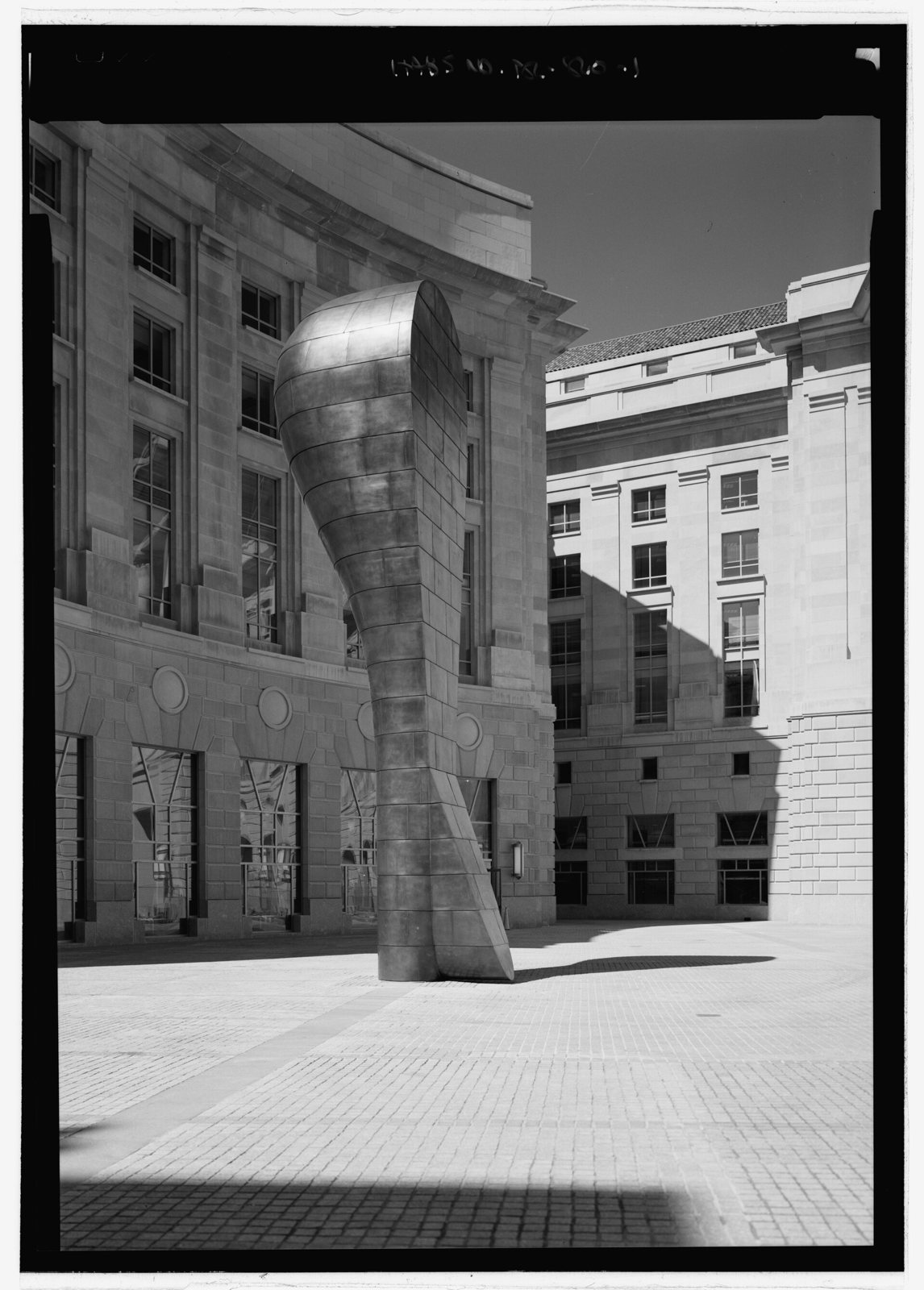
Image context: the lead image uses the Whitney's photograph of Sanctum because it states the article's thesis almost immediately. The sculpture's neck narrows like a vessel, its body swells like a hull or shelter, and its tarred skin holds evidence of work rather than polished finish. Puryear gives the viewer a form that reads as abstract and usable in the same breath.[1]
He never wanted the sealed object
The Whitney's page for Sanctum is one of the clearest entrances into Puryear because it names both sides of his sculpture at once.[1] The work, made in 1985, uses shipbuilding techniques: a wooden armature is sheathed in wire mesh and covered with tar.[1] The museum describes it as generous and embracing while also recalling a boat in dry dock or a large sea mammal hauled out of water.[1] Those comparisons matter because they explain how Puryear's forms operate. He does not choose between abstraction and reference. He lets reference hover inside abstraction without hardening into illustration.
The same Whitney text also includes one of Puryear's sharpest statements about his practice: he was never interested in "cool, distilled, pure objects."[1] That short line is a key to the whole career. It tells us that his relation to modernism was selective from the start. He valued exactness, but he did not want the object cut loose from ordinary human reactions. A sculpture should still trigger memory, analogy, and bodily recognition.
Smithsonian American Art Museum's artist page helps explain how he got there.[2] After time in Europe, Puryear encountered American minimalism at the Venice Biennale and felt the force of primary form.[2] Yet the same page stresses that his mature work combines minimalism with traditional craft and explores public and private narratives of objects, experiences, and identity.[2] In other words, reduction gave him discipline, not doctrine. He accepted the strength of spare form, then reopened it to the world.
Craft is structure, not decoration
Puryear's work is often praised for craftsmanship, but that word can become too soft if it is treated as polish or artisanal virtue. In his sculpture, craft is load-bearing. Saint Louis Art Museum's entry on The Charm of Subsistence points to one crucial source: from 1964 to 1966, while serving in the Peace Corps in Sierra Leone, Puryear encountered local building and shelter traditions that stayed with him.[3] The museum notes that he later drew from those structures in his own sculpture and describes The Charm of Subsistence itself as a work woven from heavy rattan and built up from a wooden base.[3]
This matters because Puryear never treated handwork as nostalgic retreat. Weaving, bending, carving, tar-coating, and cold molding are not decorative finishes laid onto preconceived forms. They are how the form discovers its authority.[1][3][4] A Puryear sculpture convinces through the intelligence of its making. You feel that the object has been joined, stressed, balanced, and tested into existence.
The 2025-2026 Martin Puryear: Nexus survey at the Museum of Fine Arts, Boston sharpens that reading by placing his work across a wide field of material and historical reference.[4] The exhibition frames his vocabulary through global traditions of material culture, African American history, and the natural world.[4] That triad is useful because it blocks an easy misreading. Puryear's forms are elegant, but elegance is never the end point. The work carries routes of travel, techniques learned across places, and histories that keep entering the object through title, profile, or construction logic.[2][3][4]
Hollow forms do the deepest work
One of Puryear's strongest recurring moves is to make the interior count as much as the exterior. Sanctum already shows this. Its shape suggests refuge, yet the viewer remains outside, circling a volume that feels both welcoming and withheld.[1] In the Nexus materials, this logic becomes even clearer through works like Self and Confessional.[4] The MFA describes Self as dark and monolithic while also light and hollow, enclosing a hidden interior volume, and it describes Confessional as a tar-and-wire-mesh form whose inner space is visible and obscured at the same time.[4]
That hollow center is where much of Puryear's emotional force lives. He is a sculptor of envelopes, shells, skins, and armatures. The outer body of the work matters, but so does the inaccessible space it protects, frames, or shadows.[1][4] This is why his abstraction never feels merely formal. It activates the viewer's own sense of standing outside a body, a room, a vessel, a history, or a memory that can be approached but never fully entered.
The effect is quietly radical. Many sculptures announce mass. Puryear often lets mass serve vacancy. The object becomes memorable because it gathers pressure around an unseen inside.[1][4] That structural choice gives his forms their dignity. They do not shout. They hold.
Public history enters through profile
Puryear is also unusually good at letting history enter sculpture without collapsing the work into message art. The Nexus survey highlights Big Phrygian, tied to the Phrygian cap's long afterlife as a sign of emancipation and resistance, and reminds viewers that Puryear's vocabulary is shaped by African American history as well as by formal invention.[4] The National Gallery of Art's 2008 retrospective page adds the scale of that achievement. Forty-six sculptures made between 1976 and 2007 were gathered there, including Ladder for Booker T. Washington and the monumental Ad Astra.[5] The exhibition's reach makes plain that titles, silhouettes, and material decisions in Puryear are never casual side notes. They are where historical charge enters the form.
What makes this especially strong is that Puryear does not over-explain. He does not flatten a sculpture into caption-length allegory. He lets a ladder lean toward aspiration and exclusion, a cap carry a political genealogy, a shelter hint at sanctuary and exposure, a hollow body suggest personhood without portraiture.[1][4][5] History moves through the object as contour and pressure before it arrives as argument.
Why Puryear still feels necessary
Puryear matters now because he offers a way out of a false choice that still structures a lot of contemporary looking. On one side sits pure form, scrubbed of memory and social weight. On the other sits illustration, where the object says everything too quickly. Puryear keeps another lane open. His sculpture can be abstract, rigorous, and materially precise while still carrying craft histories, political afterlives, and bodily echoes.[1][2][3][4][5]
That is the source of his authority. He makes forms that feel discovered through work rather than declared through theory. Wood, wire, tar, rattan, and mesh do not simply build the object; they keep human time inside it. Puryear's abstraction never leaves use behind. It remembers the hand, the shelter, the vessel, the burden, and the long cultural life of making something meant to hold.[1][3][4]
Sources
- Whitney Museum of American Art, "Martin Puryear | Sanctum" - official object page on shipbuilding techniques, the sculpture's sheltering and boatlike associations, and Puryear's refusal of "cool, distilled, pure objects."
- Smithsonian American Art Museum, "Martin Puryear" - artist page on his encounter with minimalism, the mix of traditional craft and modern form, and the public/private narratives carried by his sculpture.
- Saint Louis Art Museum, "The Charm of Subsistence" - collection entry on Puryear's 1964-1966 time in Sierra Leone and the way local shelter and craft traditions informed later sculpture.
- Museum of Fine Arts, Boston, "Martin Puryear: Nexus" - survey announcement on the artist's global material references, African American historical frame, natural-world motifs, and the hollow logic of works such as Self and Confessional.
- National Gallery of Art, "Martin Puryear" - exhibition page for the 2008 retrospective, including Ladder for Booker T. Washington, Ad Astra, and the scale of his sculptural vocabulary from 1976 to 2007.