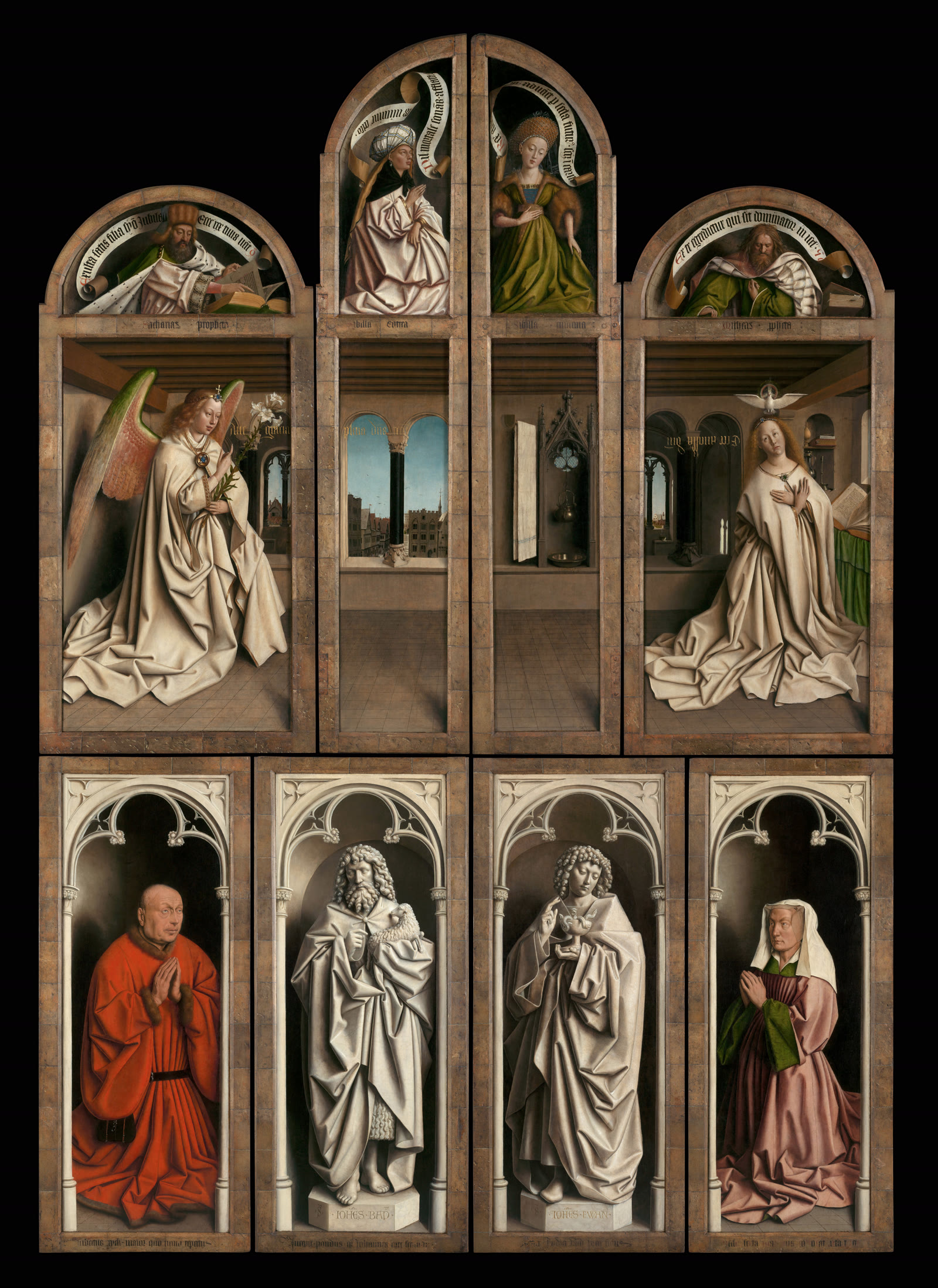
Grisaille is easy to misread as absence. At a glance it can look like the artist simply withheld color and left the work in a reduced state. The stronger reading runs in the other direction. Grisaille is a way of making tone do almost all the work: volume, weight, shadow, surface, and often the fiction that paint has crossed over into another material condition altogether.[1][4] When it succeeds, the picture stops acting like a colored window onto space and starts behaving like stone, relief, or a sculpted presence held just short of touch.
That is why grisaille mattered so much on the outer wings of Northern European altarpieces.[1][2] These objects did not present one fixed image every day. They opened and closed. Their public life depended on alternation. Grisaille gave artists a visual register suited to the shut condition: quieter, more austere, more sculptural, and more obviously tied to the architecture around it.[2][3] Monochrome here was not a deficiency. It was a staging device.
The Ghent Altarpiece remains the clearest place to feel that logic. In the closed view, the donors kneel at the far sides, while the two Saints John stand between them as simulated statues in grisaille.[2][3] The whole exterior feels compressed, measured, and devotional. Then the wings open and the work changes temperament. The interior does not merely add more imagery. It releases chromatic and spatial abundance that the exterior had deliberately held in reserve.[2][3]
Image context: the cover image stays with the closed Ghent Altarpiece rather than the open view because the article is about the medium's delaying action. Grisaille is one reason the exterior can feel complete in itself while also preparing the eye for a later transformation.[2][3][7]
Grisaille is a tonal system before it is a color choice
The National Gallery's glossary gives the base definition: grisaille is painting executed in monochrome or a very limited palette, with forms defined by tonal variation rather than by full color contrasts.[1] That sounds straightforward until you consider what it asks of the viewer. In a polychrome painting, hue often helps separate figure from ground and ornament from structure. In grisaille, that sorting has to happen through light and dark, edge control, and the handling of reflected shadow. The eye reads modeling first.
That shift is what lets paint impersonate sculpture so persuasively.[1][4] Smarthistory's late-medieval multimedia overview describes the Ghent saints as grey monochrome made to resemble unpainted stone sculpture, and uses them to show how painters were actively testing the boundary between painting and carving.[4] Grisaille does not copy sculpture only by suppressing color. It copies sculpture by forcing form to emerge through tonal pressure, as if volume had been chiseled rather than brushed.
This is why grisaille can feel unexpectedly physical even when its palette is narrow. The medium narrows chromatic distraction and enlarges attention to contour, recession, ledge, niche, and cast shadow. It tells the viewer, almost immediately, that the problem at hand is not "what color is this?" but "what kind of object is pretending to be here?"
Closed wings needed a different tempo from open ones
The closed state of an altarpiece had to be visually convincing in its own right.[2][3][6] Smarthistory's Ghent overview stresses that the work would have been closed for much of the year, with the more expansive interior reserved for feast days.[3] That liturgical fact changes the medium question. Exterior painting could not merely mark time until the "real" pictures appeared. It had to sustain devotional attention under more ordinary conditions.
Grisaille answered that need by slowing the work's pulse. On the Ghent exterior, the simulated statues of John the Baptist and John the Evangelist stand in a narrower emotional key than the open interior's teeming landscape and radiant color.[2][3] The Met's Heilbrunn essay is precise about what is at stake: the fictive statues may have functioned as a painterly challenge to the long-standing convention of sculpted retables.[2] In other words, van Eyck was not just muting the palette. He was using paint to compete with carved devotional furniture on its own terms.
The same closed-wing logic persists elsewhere. The Met's entry for Jean Bellegambe's Cellier Altarpiece notes that the exterior wings are painted in grisaille and become visible when the work is shut.[6] The point is structural, not incidental. Grisaille helped artists build an outer face for the object, one suited to intervals, thresholds, and recurring return.
Monochrome can freeze narrative into suspense
Hugo van der Goes's Portinari Altarpiece shows another reason grisaille endured. Smarthistory notes that its exterior Annunciation is painted in grisaille and that the figures feel essentially frozen in time.[5] That is an exact description of one of the medium's strongest dramatic effects. Color often encourages movement across a scene. Grisaille tends to compress action into a held moment. It can make a narrative feel suspended, as though history has paused long enough to harden into relief.
That suspended feeling matters for devotional art. The closed state of an altarpiece is not neutral storage. It is part of the work's theology of waiting, recollection, and revelation.[3][5] Grisaille supports that condition because it offers enough sculptural gravity to feel complete, while also withholding the sensory surplus of the interior. The viewer is held in a lower register of intensity that makes the eventual opening feel earned.
Seen this way, grisaille is not a backup mode for when money or pigment ran short. It is a temporal instrument. It lets a work occupy one emotional climate when closed and another when opened, without either state feeling unfinished.[2][3][5]
Why the medium still feels sharp
Grisaille remains useful because it clarifies a basic truth about painting: pictures are often strongest when they control not only what is shown but how quickly it arrives.[1][2] By reducing hue, grisaille brings forward modeling, scale, and the fiction of material substitution. By living so often on outer wings, it also teaches that image programs can be sequenced. One visual state can prepare for another.
That is the deeper intelligence visible in the closed Ghent Altarpiece. The stone illusion is not a trick added on top of the object. It is part of the object's operating system.[2][3][4] Grisaille lets the exterior act with dignity and restraint, while storing a different sensory world behind it. The medium's real power lies there: not in grayscale as style, but in monochrome as timing.
Sources
- National Gallery, London, "Grisaille" - glossary entry defining grisaille as monochrome or limited-palette painting organized by tonal variation, and noting its popularity on the outsides of Northern polyptychs.
- The Metropolitan Museum of Art, "The Ghent Altarpiece" - Heilbrunn Timeline essay on the exterior's light continuity and the grisaille Saints John as fictive statues challenging sculpted retables.
- Smarthistory, "Jan van Eyck, The Ghent Altarpiece" - overview of the closed state, the donors, and the two central saints painted in grisaille.
- Smarthistory, "Late medieval multimedia and devotion" - discussion of the Ghent Altarpiece's grisaille saints as grey monochrome rendered to appear like unpainted stone sculpture.
- Smarthistory, "Hugo van der Goes, Portinari Altarpiece" - explanation of the exterior Annunciation in grisaille and its frozen, sculptural temporality.
- The Metropolitan Museum of Art, "The Cellier Altarpiece" - object entry noting the grisaille-painted exterior wings visible when the altarpiece is closed.
- Wikimedia Commons, "File:Ghent Altarpiece (closed, after restoration).jpg" - source page for the documentary image used as the article hero.