Ben Shahn is usually filed under a broad label, social realism, and the label is not wrong.[1][2] He painted injustice, poverty, labor, war, and the dignity of ordinary people. But the stronger way to understand him is more specific. Shahn kept art close to civic speech. In his work, public life rarely appears as mute scenery waiting to be aestheticized. It arrives already argued over, written down, announced, protested, posted, and remembered. Pictures do not merely show the world; they take their place inside the world of accusation, testimony, and appeal.[1][4]
That is why his art still feels so direct. Shahn was never interested in making politics atmospheric. He wanted legibility without deadness, conviction without flattening, and design strong enough to carry moral pressure in public.[1][2] The reason that late works with script, doves, slogans, and biblical text do not feel like a separate decorative phase is that the same impulse was there from the beginning. He learned early that letters are not neutral carriers of content. They are shapes that enter public space with force.[4][5][6]
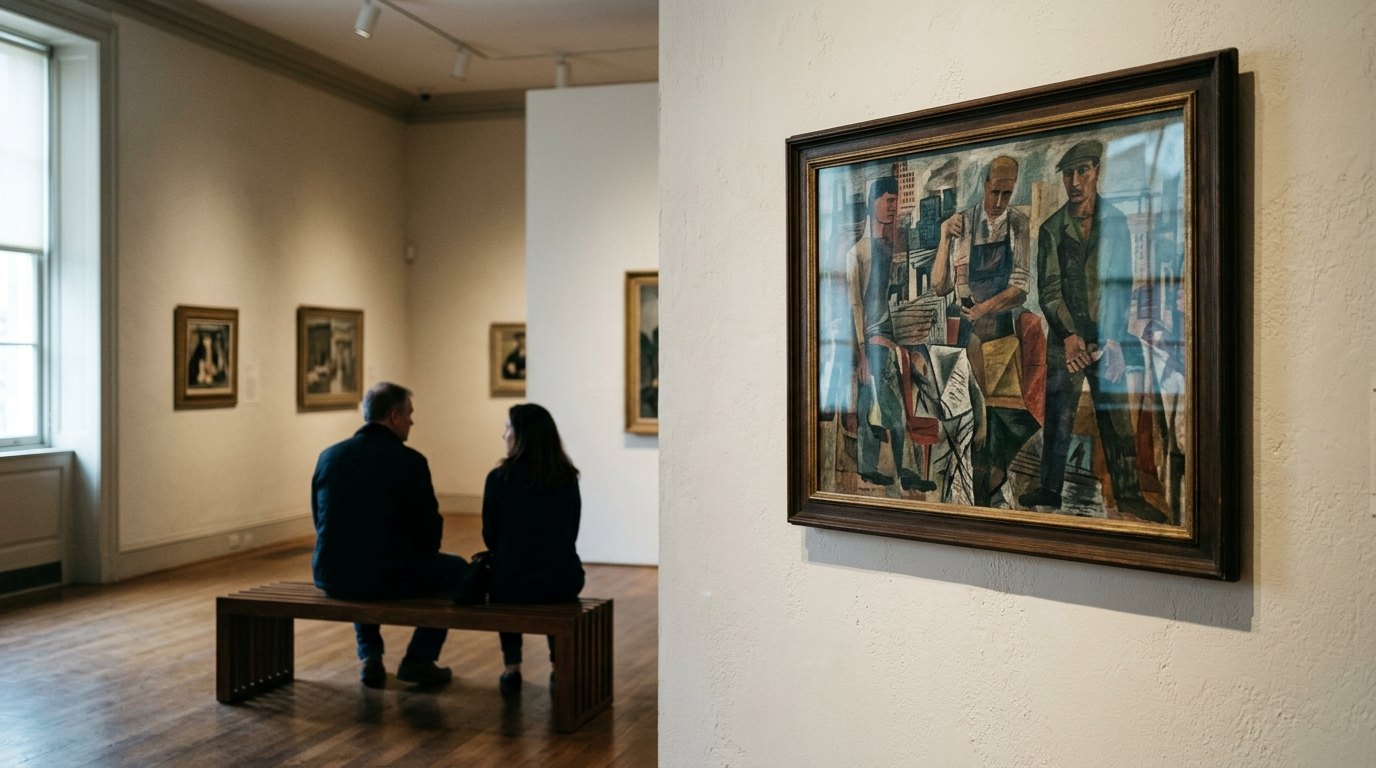
Image context: the hero image now uses an immersive gallery scene rather than a flat reproduction or text-heavy artwork crop. The article still returns to Shahn's Voting Booths as the key example: a Locke quotation hangs over an ordinary election interior, so the act of reading and the act of civic participation occupy the same picture plane.[5]
A lithographer's apprenticeship shaped his politics of form
Shahn's biography matters because it explains why writing in his art never feels tacked on. Born in Lithuania in 1898, he came to the United States in 1906 and trained first as a lithographer, not as a romantic easel painter.[1][4] The Smithsonian American Art Museum's biographies stress that before his formal art studies, he spent his early teens learning trade discipline through printing, lettering, and type, and later remembered a period of complete fascination with type itself.[4] That is more than a colorful anecdote. It gave him a practical education in how words are seen before they are interpreted.
The Whitney's artist page shows what happened next.[1] Though aware of European modernism, Shahn did not stay with its more self-contained stylistic programs. He moved toward a realist mode because it better matched his social concerns. What he carried forward from lithography was precision about visual address. Even when his figures become expressive, distorted, or emblematic, the image keeps a poster-maker's sense of public readability. Shahn wanted a picture to strike the eye the way a wall notice, placard, or printed appeal does: clearly, quickly, and with enough formal character that the message does not thin out into mere information.[1][4]
Sacco and Vanzetti taught him how to turn outrage into a picture
The breakthrough was the Sacco and Vanzetti series, first exhibited in 1932.[1][2][4] Whitney's pages on both the artist and The Passion of Sacco and Vanzetti make clear how decisive the case was for Shahn's career.[1][2] Two Italian immigrant defendants, weak evidence, a death sentence widely understood as shaped by ethnic prejudice and political hostility: the subject gave him a structure he would keep returning to for the rest of his life. Injustice here was not abstract suffering. It had names, institutions, and theatrical public rituals.
The Passion of Sacco and Vanzetti remains the clearest example.[2] Whitney describes the painting as one of twenty-three works on the case, with the commissioners standing over the coffins of the men whose sentence they upheld, lilies in hand, Judge Webster Thayer visible behind them.[2] The composition works because it behaves almost like an indictment sheet disguised as a painting. The figures are pared down, the space is legible at a glance, and the moral arrangement is unmistakable. Shahn is not reporting neutrally on a famous miscarriage of justice. He is staging responsibility so that the viewer reads power and complicity directly from the image.[1][2]
This is where the idea of civic speech becomes useful. Shahn's art does not become political only when it includes slogans. In the Sacco and Vanzetti works, the whole pictorial structure functions like public accusation. The painting speaks before any wall label does.[2]
Documentary photography widened the field but kept the same ethic
During the Depression, Shahn's public address widened from courtroom martyrdom to the ordinary pressure of American life. The Whitney notes his work for the Public Works of Art Project, the Resettlement Administration, and the Farm Security Administration, along with murals that addressed immigrant hardship, labor, and collective reform.[1] The Smithsonian's source-material overview sharpens the relation between media: as an FSA photographer, Shahn documented everyday struggle across the country, and later reused both his own photographs and those of other photographers as source material for paintings and prints.[3]
That continuity matters. Photography did not make him more factual at the expense of form, and murals did not make him more monumental at the expense of witness. Each medium solved the same problem at a different scale. Documentary work taught him how poverty, labor, waiting, and fatigue register in real bodies and environments. Murals and public commissions let him move that knowledge into civic space, where the image had to remain readable to a passerby rather than to a secluded connoisseur.[1][3][4]
The result is that Shahn's realism never becomes merely descriptive. Even when rooted in observation, it retains an addressive charge. He does not paint ordinary life to prove he has seen it. He paints it so that public life can be forced to see itself.[1][3]
In the later work, lettering stops being caption and becomes structure
The late paintings, prints, and posters make this especially clear. The Smithsonian biography says outright that Shahn's apprenticeship made him appreciate lettering and that he went on to design posters in which type "boldly predominated."[4] By the time he made Voting Booths in 1950, that lesson had matured into a full pictorial method.[5] The work's long Locke quotation is not an external explanation pasted onto an image. It is the image's architecture. The booth, the civic interior, and the political text belong to one visual field, so reading becomes part of seeing.
Whitney's Psalm 133 page shows the same logic in a different register.[6] Decorative handwritten scripture, birds, and floral framing turn text into ornament without making it passive. The words still hold the center. What changes is the emotional temperature: protest hardens into contemplation, but the belief that language can be drawn, staged, and circulated as image remains intact.[6] Likewise, the Whitney's McCarthy Peace poster from the late 1960s condenses dove, oversized letters, and protest address into a form built for distance and public repetition.[7] Shahn did not sprinkle words onto finished pictures. He let pictures and words become inseparable carriers of conscience.
That is one reason his late art avoids the split that often weakens political art. On one side sits the "serious" image; on the other, the didactic text. Shahn refuses that division. Lettering is one of his emotional materials. It can accuse, mourn, invoke, or warn without ceasing to be visually alive.[4][5][6][7]
Why he still feels current
Shahn remains contemporary not because every age rediscovers protest art in the abstract, but because he solved a harder formal problem. He found a way to make witness legible in public without draining it of complexity.[1][2][4] His pictures retain design intelligence, but they never retreat into private style. They stay answerable to immigrants, workers, defendants, voters, and viewers who meet art in the middle of social life rather than outside it.
That is why Ben Shahn kept art close to civic speech. Lithography gave him the discipline of letters, Sacco and Vanzetti gave him a model of moral accusation, documentary work gave him the pressure of actual lives, and the later prints and posters gave him a way to join text and image into one durable public form.[1][3][4][5][6][7] He made conscience graphic without making it simple, and that remains a rarer achievement than the category "social realism" can hold.
Sources
- Whitney Museum of American Art, "Ben Shahn" - artist page covering his 1906 immigration, lithography training, the Sacco and Vanzetti breakthrough, New Deal documentary work, murals, and later anti-war paintings.
- Whitney Museum of American Art, "The Passion of Sacco and Vanzetti" - official collection page on the 1931-32 painting, the twenty-three-work series, and its staging of institutional injustice.
- Archives of American Art, Smithsonian Institution, "Ben Shahn" - source-material overview on his Farm Security Administration photography and his reuse of documentary photographs in later paintings and prints.
- Smithsonian American Art Museum, "Ben Shahn" - artist biography page on immigration, lithography apprenticeship, fascination with type, government poster work, and later symbolic art.
- Smithsonian American Art Museum, "Voting Booths ... From the series Great Ideas of Western Man" - official work page for the 1950 gouache used as this article's image, including subject tags tied to civic election space.
- Whitney Museum of American Art, "Psalm 133" - official work page for Shahn's 1963 lithograph with handwritten scripture, birds, and decorative framing.
- Whitney Museum of American Art, "McCarthy Peace" - official work page for the late protest poster with dove and oversized peace lettering.