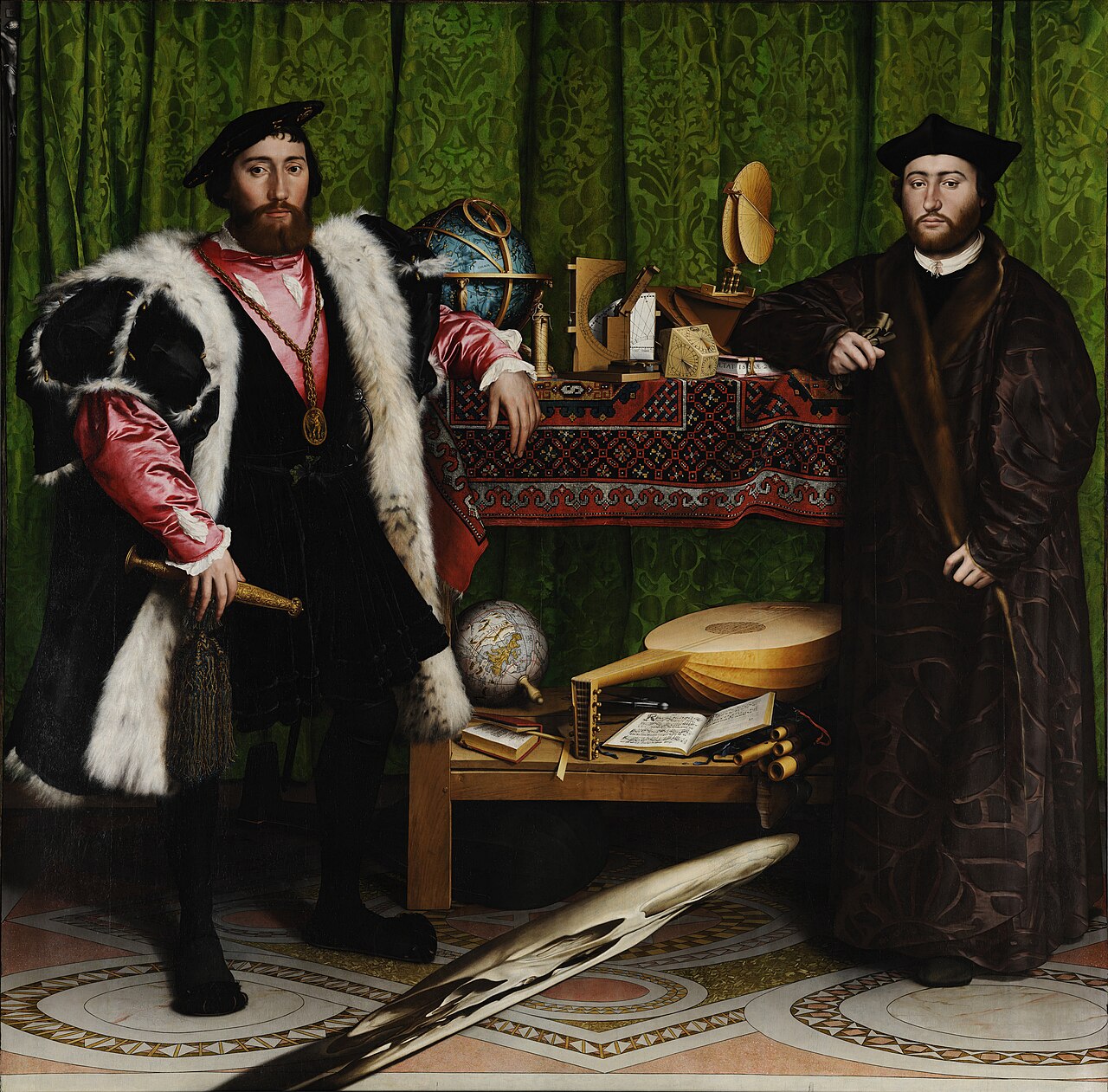
Hans Holbein's The Ambassadors is usually remembered for one spectacular trick: the long pale smear across the floor that resolves into a skull only when the painting is viewed from the side.[1][3][4] That optical shock matters, but it is not the whole work. The painting's deeper force comes from how thoroughly it organizes confidence before it unsettles it. Two young French visitors stand in silk, fur, and black cloth with extraordinary poise. Between them, a two-tier shelf displays globes, instruments, books, and music as if the sixteenth century had decided to picture knowledge itself.[1][2] Yet almost every important object carries a slight disturbance. The arithmetic book is opened to division. One lute string is broken. A flute is missing from its case. A crucifix appears only if the eye searches the upper-left margin. The skull waits for the viewer to give up a frontal position altogether.[1][3][4]
This is why the painting feels larger than a symbolic checklist. Holbein does not scatter emblems across a portrait and ask the viewer to decode them one by one. He turns the whole picture into a threshold image, a composition about what it costs to move from display to understanding. The men, the objects, the curtain, and the floor all participate in that shift.[1][2]
Image context: the article uses the painting itself rather than a crop of the skull or one sitter because the argument depends on simultaneous structure. The upper shelf's instruments, the lower shelf's music and arithmetic, the green curtain, and the diagonal skull have to remain in one field of vision before the painting's logic becomes clear.[1][2][5]
The shelf is a stage for ordered knowledge
The National Gallery's collection page and catalogue entry make clear how carefully the central shelf is organized.[1][2] The upper tier is devoted to the heavens: a celestial globe, a polyhedral dial, and other devices for measuring time, altitude, and the position of celestial bodies. The lower tier shifts downward into terrestrial and human concerns: a globe, a hymn book, an arithmetic book, flutes, and a lute.[1][2] Holbein therefore builds a vertical grammar into the painting before any symbolic interpretation begins. Above: calculation, astronomy, orientation. Below: music, trade, devotion, and lived geography.
That arrangement gives the painting its immediate authority. The ambassadors do not merely own costly things. They appear at ease within a world ordered by measurement and learning. The shelf even helps solve a portrait problem. As the National Gallery notes, it provides the men with something to lean on so that the pose feels natural rather than rigidly ceremonial.[1] But the same shelf that supports them also separates them. It runs between their bodies like a piece of furniture and a conceptual barrier at once. Friendship is commemorated here, yet companionship is mediated through things.[1][2]
This matters because the painting is often described as a double portrait with symbolic accessories. Visually, though, the center of gravity is more unstable than that label suggests. The faces are memorable, but the eye keeps returning to the shelf. Holbein makes still life compete with portraiture and lets objects carry historical pressure.
Division begins on the lower shelf
The lower shelf is where the painting starts loosening its own display of mastery. The National Gallery's in-depth text points out that the arithmetic book is opened to a page on division.[1] That detail would already be enough to sour the mood slightly in a painting made during the religious crises of 1533, when Henry VIII's break with Rome was becoming politically irreversible.[1][2] Holbein then doubles the point through music. The lute's broken string and the missing flute imply a harmony that cannot quite be completed.[1][3]
Britannica's summary compresses the issue neatly: the objects testify to culture and achievement, but several also carry the pressure of mortality and confessional rupture.[3] The National Gallery goes further by noting that the hymn book is deliberately shown on nonconsecutive pages, with songs associated with the Holy Spirit and the Ten Commandments.[1] Whether one reads that as a plea for Christian unity or as a sign that unity has already become strained, the lower shelf refuses calm. It is the zone where cultivated order starts showing cracks.
This is a major reason the painting still feels intelligent rather than merely crowded. Holbein has not filled the picture with random prestige goods. He has staged worldly accomplishment in such a way that fracture can be read inside it. Division is not an afterthought added by the skull. It is already present among the books and instruments.
The curtain opens only by a margin
Behind the men hangs a heavy green curtain, one of the painting's quiet masterstrokes.[1][2] At first it behaves like pure magnificence: a rich backdrop sealing the picture into ceremonial fullness. Then the eye notices that it parts slightly at the upper left, where a crucifix becomes faintly visible.[1][4] The effect is easy to miss, and that is exactly why it matters.
If Holbein had placed the crucifix at the compositional center, the painting would read far more directly as a moral allegory framed by luxury. Instead he lets worldly display occupy almost the entire field, then tucks the sign of redemption into a corner. The teachers' notes from the National Gallery describe the cupboard between the sitters as a display of intellectual wealth rather than monetary wealth.[4] The curtain sharpens that reading. It does not tear the worldly scene open; it merely gives the viewer a narrow glimpse beyond it.
That narrowness changes the emotional register of the painting. Salvation is present, but not easy. The cross has to be searched for, just as mortality has to be approached from an angle. Holbein turns vision into a moral discipline. Important truths are available, but they do not present themselves at the same scale or immediacy as silk, fur, polished wood, and imported carpet.[1][2][4]
The skull attacks frontal seeing
Then comes the famous skull. The National Gallery explains that the elongated shape can only be read properly from a particular angle, and the teachers' notes suggest that the picture may once have been placed near a doorway so a passerby would suddenly meet death from the side.[1][4] That possibility is more than a clever anecdote. It clarifies the painting's structure.
The skull is not simply one more emblem inserted into a rational perspective system. It attacks the system from outside. Viewed head-on, the ambassadors and their possessions appear coherent, legible, and magnificently controlled. To see death clearly, the viewer has to abandon that commanding position and move obliquely. In other words, mortality becomes readable only when frontal mastery fails.[1][3][4]
That is why the skull feels so much stronger than a conventional memento mori. It does not cap the meaning from within the picture; it changes the conditions under which the picture can be known. Even the Gallery's modern frame acknowledges this logic, since it was designed to allow a side view of the anamorphic form.[1] Holbein made a painting in which the final truth is not centered, not stable, and not available to the viewer who insists on remaining in the place of greatest control.
Why the painting stays alive
The Ambassadors lasts because it does several things at once and keeps them in tension.[1][2][3] It is a portrait of friendship, a display of Renaissance learning, a document of diplomatic anxiety, a meditation on Christian fracture, and an experiment in how looking itself can be reorganized. The painting celebrates worldly intelligence and refuses to let that intelligence imagine itself complete. Every zone of order contains a pressure point: division in arithmetic, discord in music, partial revelation in the curtain, mortality in the floor.
That is the picture's real achievement. Holbein turns display into a threshold. The viewer begins in admiration, moves through unease, and ends by discovering that the painting's most decisive statement arrives only from the side. Knowledge remains in the room. So do death and spiritual uncertainty. The work holds them together without flattening any one of them into a single slogan.[1][2][3][4]
Sources
- The National Gallery, "Hans Holbein the Younger, The Ambassadors" - official collection page with overview, in-depth discussion of the sitters, shelf objects, crucifix, skull, and material details.
- The National Gallery, "The Ambassadors" in National Gallery Catalogues: The German Paintings before 1800 - scholarly catalogue entry on dating, commission context, objects, symbolism, and provenance.
- Encyclopaedia Britannica, "The Ambassadors" - overview of the painting's commemorative context, symbolic objects, broken string, and anamorphic skull.
- The National Gallery, Primary Teachers' Notes: The Ambassadors - PDF notes on the skull's side view, the hidden crucifix, the date indicated by the instruments, and the cupboard as intellectual display.
- Wikimedia Commons, "File:Hans Holbein the Younger - The Ambassadors - Google Art Project.jpg" - source page for the faithful photographic reproduction used as this article's image.