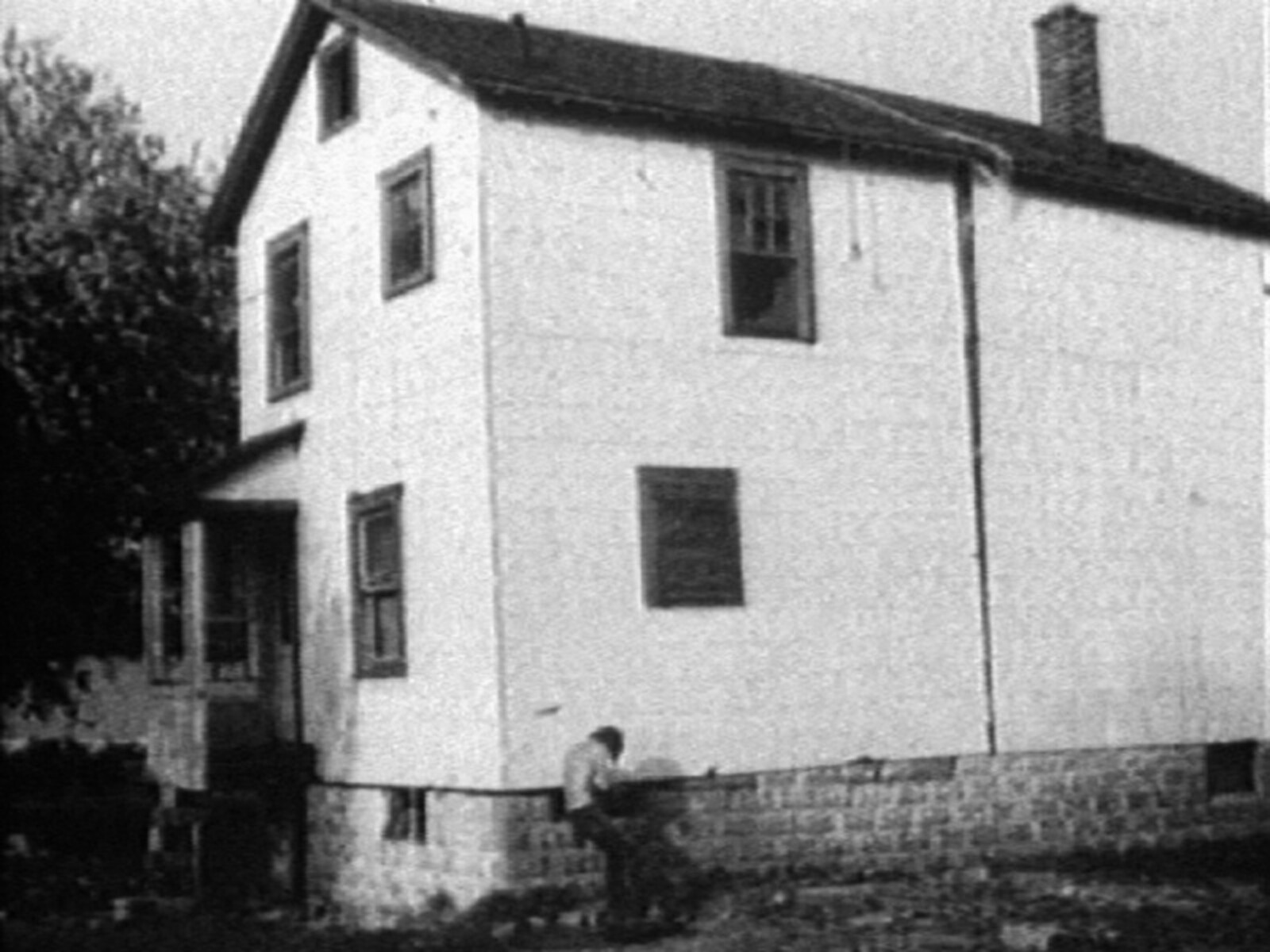
Gordon Matta-Clark's Splitting looks simple until the eye starts asking what kind of object it is. In 1974, he took a modest house in New Jersey that was already scheduled for demolition and cut it down the middle.[1][2][4] The gesture can be summarized in one sentence, but the work resists staying there. It is a building intervention, a performance of labor, a photographic sequence, a film, and an argument with architecture all at once.
That instability is the point. Splitting is not powerful because it turns a house into a theatrical ruin. It is powerful because the cut makes the house disclose the assumptions it usually hides: walls as privacy, floors as continuity, roofline as shelter, domestic space as promise. Matta-Clark did not add a sculpture to the property. He made the property become a sculpture by forcing its structure to reveal how much ideology was packed into ordinary construction.
The Whitney Museum's object record gives the essential action plainly: from March to June 1974, Matta-Clark used a chain saw to bisect the house, part of a wider practice he called "cuttings," in which he opened buildings by slicing through walls and floors.[1] Museo Reina Sofia's account adds the social tension that makes the cut sharper: the building stood in a mostly Black New Jersey neighborhood and was being demolished as part of an urban renewal project.[2] Splitting is where that pressure becomes legible in wood, daylight, gravity, and record.
The House Is Ordinary On Purpose
The house matters because it is not spectacular. A grand public building would have made the cut monumental too quickly. A rare structure would have shifted attention toward preservation. A modest suburban house, already condemned, gives Matta-Clark a tighter target. It lets him work on the default image of private American shelter at the moment when that image can no longer defend itself by function.
Museo Reina Sofia describes the building as one purchased by Holly and Horace Solomon and slated for demolition as part of urban renewal.[2] That context is not a substitute for the cut house; it is one of the ways the house's social condition enters the work. This matters because Splitting has always been an artwork with an absent body. The physical intervention was temporary, but the photographic and film records keep the cut active.
That afterlife changes how the work should be read. Matta-Clark did not merely document an action for convenience. The photographs and film are part of the work's structure because the building itself could not remain. Spencer Museum of Art holds a Splitting collage made with gelatin silver print, rubber cement, and collage technique; M+ identifies its version as a film documenting the intervention.[3][5] The work therefore travels through media that already understand fragmentation: frames, strips, collages, sequences, and edits.
Cutting Is Not The Same As Destroying
The most important distinction in Splitting is between destruction and incision. Demolition would flatten the house into debris. Matta-Clark's cut is more precise and more unnerving. It leaves the building recognizably house-like while making it impossible to trust as a house. The roof still reads as roof. The walls still read as walls. But the vertical slice interrupts the fiction that shelter is seamless.
This is why the work feels less like vandalism than surgery. The cut exposes interior thickness, the relation between surfaces, and the house's dependence on alignment. It also lets light enter where light should not enter. A normal window domesticates light by framing it. Splitting brings light through damage. The result is both beautiful and wrong: the house glows because it has been wounded.
M+ describes the film version as documentation of one of Matta-Clark's signature deconstructions, a sculptural intervention into a modest New Jersey suburban house.[5] Its account also points to a broader social reading: the slice suggests a critique of top-down architecture and planning that can split communities apart.[5] That reading is persuasive because the work's physical logic is already social. A house is never only materials. It is a contract about family, property, privacy, neighborhood, maintenance, aspiration, and exclusion.
The Cut Turns Architecture Into Evidence
Matta-Clark's architectural critique gives Splitting its bite. He understood enough about buildings to know where a cut would be legible. The work is not anti-architecture in the weak sense of disliking buildings. It is anti-complacency. It takes architecture seriously enough to treat a building as something that can be interrogated physically.
Spencer Museum's label text places Matta-Clark among 1970s artists who linked art and politics to rising property prices, poor urban planning, and unemployment.[3] MACBA's collection page sharpens the art-historical lineage: in Bronx Floors, Matta-Clark had already cut rectangular sections from abandoned Bronx buildings; in Splitting, he turned that practice toward a typical middle-class suburban house.[4] Together, those accounts help separate the piece from a purely formal exercise. The house is cut at a historical moment when urban renewal, suburban expansion, property speculation, and demolition were reshaping lived space. Matta-Clark's act does not provide a policy analysis. It does something art can do more directly: it turns the building itself into evidence that domestic form is neither neutral nor permanent.
The photographic collages sharpen this because they refuse the stable frontality of architectural photography. A conventional real-estate image would make the house whole, sellable, coherent. Matta-Clark's images make coherence provisional. They show angles, gaps, alignments, and cuts. They make the viewer reconstruct the building mentally while also accepting that reconstruction is impossible.
Why The Vanished Work Still Holds
The physical house is gone, which might seem to weaken the work. Instead, absence is one of Splitting's strongest conditions. The house's disappearance prevents the intervention from becoming a preserved attraction. What remains is a record of an action that happened to an already doomed structure, then passed into photographs, film, museum collections, and art history.
That afterlife is not clean. Museum records classify the work differently because the work exists differently in each collection: film documentation, photographic still, collage, and collection object.[1][3][4][5] Those categories do not fragment the work by accident. They mirror the work's own method. Splitting makes unity unstable, then survives as a set of partial supports.
The enduring force of the piece comes from that double pressure. Matta-Clark cut a real house, not an image of a house. But most viewers now meet the cut through images. The work therefore keeps asking how architecture is experienced, remembered, and reproduced once its physical promise has failed. A house can be demolished. A cut can keep traveling.
Seen this way, Splitting is not a dramatic prank on architecture. It is a close reading performed with a chain saw. Matta-Clark opened the house so that its ordinary authority could no longer pass as natural. The cleanest thing about the work is the severity of its question: what happens when the structure that promises shelter is made to show its wound?
Sources
- Whitney Museum of American Art, "Gordon Matta-Clark, Splitting" - collection record for the film still, chain-saw bisection, and March-June 1974 house intervention.
- Museo Reina Sofia, "Gordon Matta-Clark, Splitting" - collection record on the New Jersey building, urban-renewal demolition context, inhabited-space residue, and film as a way to view the architectural cut.
- Spencer Museum of Art, "Gordon Matta-Clark, Splitting" - collection record and label text on the collage materials and Matta-Clark's links among art, politics, property prices, planning, and unemployment.
- MACBA Museum of Contemporary Art of Barcelona, "Gordon Matta-Clark, Splitting, 1974" - collection text on the typical middle-class suburban house and relation to earlier building cuts.
- M+ Museum, "Gordon Matta-Clark, Splitting (1974)" - object record for the film and interpretation of the New Jersey house intervention as deconstruction and planning critique.