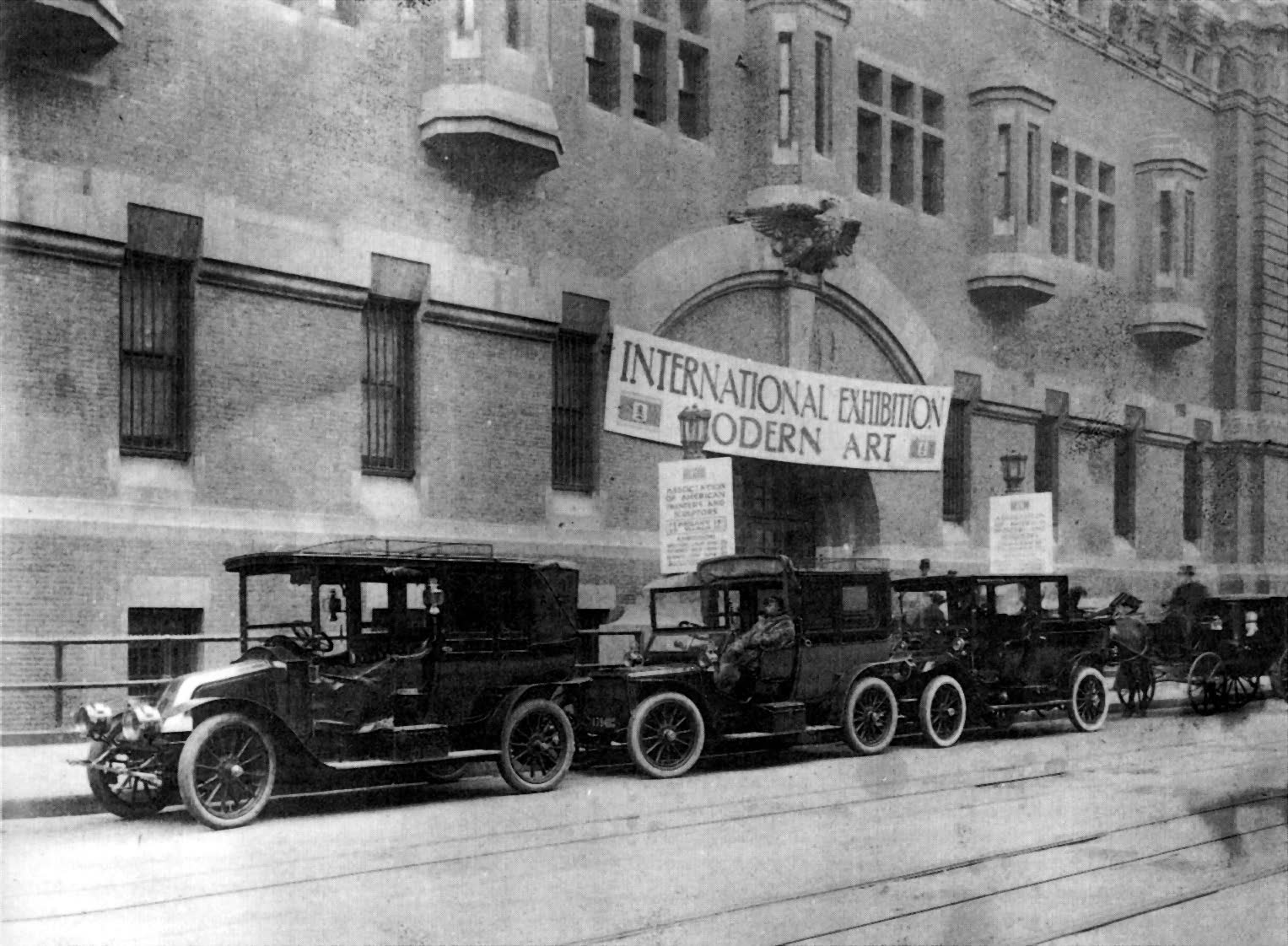
The 1913 Armory Show is usually remembered as the moment modern art shocked America. That is true, but it can make the exhibition sound like a single thunderclap: Europeans arrive, Americans gasp, Duchamp becomes a punchline, and modernism enters the story. The stronger reading is more material. The Armory Show mattered because it turned modern art into a public argument staged through architecture, publicity, sales, ridicule, and travel.[2][3]
Its formal name was the International Exhibition of Modern Art. The Archives of American Art identifies it as the first major exhibition of European modern art in the United States, organized in New York at the 69th Regiment Armory from February 17 to March 15, 1913, before traveling to the Art Institute of Chicago from March 24 to April 16.[2] The nickname stuck because the venue did more than house the show. A military armory, with its huge interior scale and civic bluntness, made modernism feel less like a salon conversation than an event one had to take a position on.
That is why the entrance photograph is such a useful image. It does not show a single famous painting. It shows the threshold. A banner announces "Modern Art" over the armory doors; cars line the street; the exhibition becomes a thing a city can notice before any visitor has learned the difference between Fauvism, Cubism, Post-Impressionism, and American realism.[1] The shock began outside the galleries.
The show changed as it was made
The exhibition did not begin as a pure modernist manifesto. Britannica notes that the Association of American Painters and Sculptors originally conceived it as a representational show centered on American artists, including figures connected to the National Academy of Design, the Ashcan School, and The Eight. Arthur B. Davies's election as association president changed that direction.[3] The final exhibition became a historical and transatlantic survey, not merely a domestic alternative to conservative academy practice.
That shift matters because the Armory Show was not just "Europe teaches America." It was an argument inside American art about what counted as seriousness, progress, and public legitimacy. The Archives of American Art emphasizes that organizers such as Davies, Walt Kuhn, and Walter Pach conceived and executed the exhibition quickly, supported by press materials, sales records, ephemera, and correspondence that reveal both professional publicity and sharply divided reception.[2] Modernism arrived through paperwork as well as paint.
The result was a deliberately crowded cultural machine. Visitors encountered older European anchors, recent French painting, American work, sculpture, prints, press claims, caricatures, and rumors. The show did not ask the public to accept one new style. It forced viewers to process incompatible tempos at once: Ingres and Goya as historical runway, Cezanne and Gauguin as pressure points, Matisse and Duchamp as provocation, Americans as participants and witnesses.[3][6]
Installation made the shock legible
The strongest modernist lesson at the Armory was not contained in any one object. It was in the arrangement. The Archives' highlight essay on the "Cubist Room" argues that a rediscovered installation photograph provides evidence for Walter Pach's role in designing the final floor plan and situates the room in relation to Parisian precedents such as La Section d'Or and La Maison Cubiste.[4] That matters because Cubism was not simply hung on walls. It was staged as a room, an environment, and a problem of viewing.
The room's polygonal logic helped modern art feel spatially strange before a visitor even solved a painting. A conventional rectangular gallery tells the eye that the wall is neutral and the work is the event. The Armory's modern rooms suggested something less stable: display itself could become part of the message. If Cubism fractured the object, the installation could fracture the visitor's movement through the exhibition.[4]
This is why the Armory Show became more than a list of imported artworks. It made style visible as a system. Fauvist color, Cubist structure, Post-Impressionist surface, and American urban realism did not merely sit beside each other; they competed for how a viewer should stand, scan, judge, and talk. The show taught people that modern art was not a new subject matter but a new public behavior.
Duchamp became the scandal because the show needed a shorthand
Marcel Duchamp's Nude Descending a Staircase (No. 2) became the exhibition's most efficient symbol because it compressed several anxieties into one title. The Philadelphia Museum of Art describes the painting as an effort to expand perception of the human body in motion, and notes that when it appeared at the Armory Show it met hostile public reaction and cemented Duchamp's reputation as a provocateur.[5] The body was still there, but it no longer behaved like a classical nude. It moved, splintered, and refused erotic legibility.
The joke response was therefore predictable. Britannica records that the painting was popularly described as resembling "an explosion in a shingle factory," while Matisse, Brancusi, and Pach were hanged in effigy by Chicago art students.[3] Those reactions were not merely anti-intellectual noise. They show how quickly modernism became legible through ridicule. A mocking phrase gave the public a way to share discomfort, and sharing discomfort helped the exhibition travel beyond the people who actually saw it.
That is the key to the scandal. The Armory Show did not succeed despite caricature and outrage. It partly succeeded through them. Public mockery made modernism memorable. It turned difficult pictorial questions into newspaper language, dinner-table jokes, student theater, and collecting opportunities. Walter Pach's sales ledger, highlighted by the Archives, records the purchase of Duchamp's Nude by Frederick C. Torrey for $324, and also shows Lillie P. Bliss buying works by artists including Cezanne, Denis, Gauguin, Redon, Renoir, and Vuillard during the show.[4] Ridicule and acquisition were not opposites. They were simultaneous public responses.
Chicago proved the show was not one New York event
The Armory Show's afterlife began almost immediately because it traveled. The Art Institute of Chicago's archive describes the Chicago presentation as smaller and more tightly focused than the New York version, installed in the museum's Beaux Arts building rather than the armory's vast drill-hall setting.[6] That change of room changed the exhibition's meaning. In New York, modernism entered through spectacular scale. In Chicago, it had to operate inside an established museum's formal galleries.
The Chicago archive notes that only a portion of the works shown in New York could travel, and that the available space was about half of what the 69th Regiment Armory had offered.[6] This made selection a new act of interpretation. William M. R. French, the Art Institute's director, asked especially for the more novel European part of the exhibition, including Matisse, Gauguin, Redon, Duchamp, Cezanne, Picasso, Van Gogh, and Rousseau, even though he personally disliked much of it.[6] That is an important institutional detail: modernism became unavoidable before it became beloved.
The Chicago installation also sharpened the point that modern art was now a curatorial problem. Which works should represent the new? How much historical runway did audiences need? Should American artists remain central, or should European shock carry the argument? Those questions did not end in 1913. They became the routine operating questions of twentieth-century museums.
The real legacy was a changed public
The Armory Show did not instantly make American art modern. It did something more durable: it changed the conditions under which modern art could be argued about. After 1913, the debate was no longer confined to artists' studios, dealers, small circles of collectors, or imported magazines. It had a public scene, a set of jokes, a set of enemies, a sales record, institutional memories, and photographs of rooms full of people trying to decide whether the future looked ridiculous or necessary.[2][4]
That is why the exhibition still matters as movement history. It did not found Cubism, Fauvism, Post-Impressionism, or American modernism. It reorganized their reception. It made style feel like a civic test: could a viewer tolerate a body broken into motion, color freed from description, surface released from finish, and exhibition design treated as an argument rather than a neutral container?[3][5]
The Armory Show's best lesson is that modernism did not enter the United States as a settled canon. It arrived as a noisy public threshold. People bought tickets, read newspaper attacks, mocked paintings, bought paintings, redesigned galleries, and carried the controversy from New York to Chicago. The shock was real, but the shock was not the whole story. The deeper event was the conversion of modern art into a public habit of dispute.[1][2][6]
Sources
- Wikimedia Commons, "File:Armory Show 1.jpg" - file page for Percy Rainford's 1913 photograph of the Armory Show entrance at the 69th Regiment Armory, including date, author, image metadata, and the downloaded cover asset.
- Archives of American Art, Smithsonian Institution, "About This Project / About the 1913 Armory Show" - overview of the digital project, organizers, dates, New York and Chicago venues, holdings, publicity, attendance, sales, and critical reception.
- Encyclopaedia Britannica, "Armory Show" - concise reference on the exhibition's dates, organizers, changed conception, reactions to Duchamp and Matisse, and importance for American art.
- Archives of American Art, Smithsonian Institution, "Highlights" - primary-source feature covering Walter Pach's sales records, the Cubist Room installation photograph, floor-plan design, and Armory Show reception materials.
- Philadelphia Museum of Art, "Marcel Duchamp, Nude Descending a Staircase (No. 2), 1912" - object record and curatorial note on motion, Cubism, the 1912 Paris rejection, and hostile public reaction at the 1913 Armory Show.
- Art Institute of Chicago, "The Show" - archival essay on the Chicago presentation, reduced scale, selection process, director William M. R. French's requests, gallery arrangement, and contrast with the New York Armory installation.