Italian Futurism is often introduced with one clean phrase: the art of speed. That is true enough to be useful and false enough to be dangerous. The movement did not merely picture fast cars, trains, factories, crowds, and electrified streets. It tried to make speed into a worldview: a way to reject inherited culture, remake the body, and treat modern force as a moral good.[2][3][5]
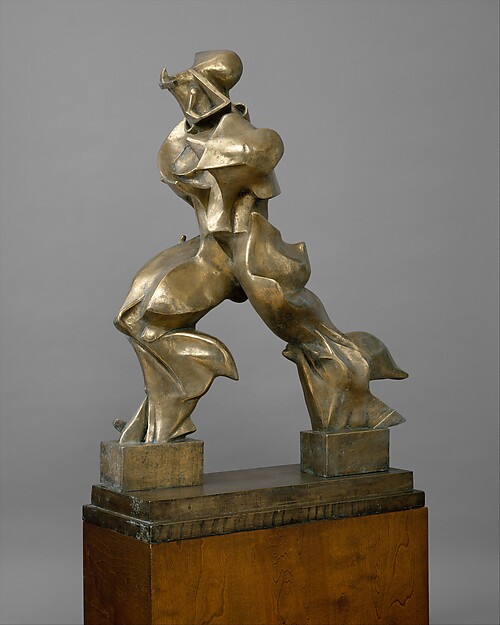
Umberto Boccioni's Unique Forms of Continuity in Space is the best single object for seeing both sides of that project. Made in 1913 and cast posthumously in bronze, the work looks like a figure walking through the future with the air peeled open around it.[1][2] It is exhilarating. It is also troubling. The sculpture makes motion heroic, but it does so inside a movement whose manifestos glorified rupture, anti-tradition, and eventually war.[3][5]
Image context: this is one real photographic image of the actual bronze sculpture in the Met's collection, not a diagram, chart, symbolic illustration, or generated visual. It belongs here because Futurism's argument is visible in the object itself: the striding torso, armless silhouette, wind-shaped planes, polished metal, and unstable boundary between body and surrounding space all need to be seen together.[1]
Speed was a cultural program
Futurism began as publicity before it became a settled visual language. Filippo Tommaso Marinetti's 1909 manifesto announced the movement with deliberate aggression, casting modernity as a break from museums, libraries, antiquarians, and the weight of Italy's past.[5] That theatrical violence was not a side effect. It was part of the strategy. Futurism wanted the new to arrive as shock.
Boccioni entered that program from Milan, the industrial city that gave him a more usable modern subject than ancient Rome could offer.[3] The Met's Heilbrunn essay tracks his path from Divisionist training and Symbolist atmosphere into Futurism's urban dynamism: street lighting, unrest, labor, crowds, and travel became materials for a new pictorial pressure.[3] The point was not simple realism. A modern crowd or machine did not need to be recorded as a clean view. It needed to be made felt as impact, vibration, force, and simultaneity.
That is why Futurism kept pushing against stable bodies. A person walking, a horse in motion, a cyclist, a train platform, or a city street could no longer be treated as isolated subject matter. The surrounding environment had to press into the figure. Motion had to leave marks on form. Boccioni called this logic plastic dynamism: the synthesis of movement relative to the environment and dynamism inherent to the object itself.[3]
The figure is not walking through space; space is walking through the figure
In ordinary sculpture, a body occupies space. Boccioni wanted something more radical: a body and its surrounding force-field fused into one shape. MoMA's object text captures the central move: Boccioni opened the silhouette of the marching figure so it could incorporate what surrounds it.[2] The Met's collection record describes the same effect more materially: the figure appears deformed by wind and speed, while its sleek metal contours allude to machinery.[1]
That is why Unique Forms still feels so strong. The sculpture is not a snapshot of a step. It is a compression of walking into one continuous body.[2] The calf, thigh, torso, and head do not read as anatomy alone. They read as pressure ridges. The body seems carved by the air it is supposedly moving through. Its stride is not represented by repeated limbs, as in some other motion studies of the period. It is built into one singular form that carries before, during, and after inside the same object.[3]
The result is almost classical and anti-classical at once. MoMA notes that the armless, triumphant stance can evoke older statuary even as the polished metal points toward new technology.[2] The ancient memory matters because it sharpens the contradiction. Futurism wanted to escape the museum, yet one of its greatest sculptures still borrows some of the authority of heroic bodies. It kills the classical statue by making it run, then discovers that the old heroic grammar is useful after all.
Bronze complicates the future
The material history of Unique Forms makes the work less straightforwardly futuristic than its shine suggests. Boccioni made the sculpture in 1913, but the bronzes now famous in major museums were cast after his death.[1][2][4] The Met's Boccioni centenary essay explains that his original plaster and related sculpture history passed through posthumous casting, exhibition, and later fame, including the work's appearance on the Italian 20-cent euro coin.[4]
That afterlife matters. Bronze gives the sculpture durability, polish, and monumentality, but Boccioni's own sculptural project was more experimental than a finished bronze icon can imply. The Met Heilbrunn essay notes that before the surviving plaster sculptures, Boccioni made mixed-media works, now destroyed, that pushed figure and environment together even more literally; later he returned to mixed media in works such as Dynamism of a Speeding Horse + Houses.[3] In other words, the clean bronze we know is only one stabilized version of a restless practice.
This is one reason the sculpture's triumph should be read carefully. Its metallic surface can make Futurism look inevitable, as if the machine age simply produced a perfect emblem of itself. The history is rougher. Futurist sculpture was fragile, polemical, partly destroyed, and repeatedly reconstructed by museums, casts, and display histories.[4] The future arrived through plaster, foundries, collectors, catalogues, and institutional memory.
The movement's violence cannot be cropped out
The hardest part of writing about Futurism is keeping the formal achievement and the ideological poison in the same frame. If the movement is reduced to fascist prehistory or macho noise, the work becomes too easy to dismiss. If the work is admired as pure dynamism, the movement's appetite for destruction gets laundered into style.
The documents leave little room for innocence. Marinetti's founding manifesto calls for cultural assault on the past and makes speed into a new beauty.[5] MoMA's label material is blunt about the later escalation: Boccioni and other Futurists embraced the coming world war as a development that would destroy remnants of the past and bind humans and machines closer together.[2] The Met object page adds the same historical edge, noting that World War I broke out the year after Boccioni created Unique Forms and that the Futurists welcomed the conflict in the belief that technological warfare would shatter Italy's classical fixation.[1]
Boccioni himself died in 1916 after volunteering for military service.[3] That biographical fact should not turn the sculpture into a prophecy, but it does change the temperature of the stride. The figure's forward thrust cannot be sealed off from a movement that confused energy with purification and rupture with renewal. Futurism's visual breakthrough came tied to a catastrophic political imagination: the dream that history could be accelerated by force.
Why it still matters
Futurism remains important because it solved a real artistic problem with dangerous clarity. Early twentieth-century life had changed the speed, noise, scale, and emotional tempo of cities. Traditional figure sculpture could not easily show that change. Boccioni found a form that could: the body no longer stands in space; it is shaped by passage, pressure, and contact with the environment.[2][3]
That invention did not stay trapped in Futurism. Any later art that treats a body as a moving relation rather than a sealed mass owes something to this problem, whether or not it wants Boccioni's politics. The sculpture also remains a warning about style's seductions. A form can be formally brilliant and morally unstable at the same time. It can teach the eye something true about modern perception while also carrying the movement's worst fantasies of cleansing speed.[1][2][5]
Seen this way, Unique Forms of Continuity in Space is not merely a beautiful machine-age icon. It is a tense artifact of modernism's wager: that art could make the present feel new enough to break the past. Boccioni made that wager visible as a walking body, all thrust and exposed surfaces. The sculpture's force is still real. So is the question it leaves behind: when art turns speed into beauty, what else is being accelerated?[1][3]
Sources
- The Metropolitan Museum of Art, "Unique Forms of Continuity in Space" - object record for the cover image, date, medium, dimensions, collection status, public-domain image, and curatorial note on dynamism, wind, machinery, war, and Boccioni's death.
- The Museum of Modern Art, "Umberto Boccioni. Unique Forms of Continuity in Space. 1913 (cast 1931 or 1934)" - object page and label text on the opened silhouette, striding figure, machine-age dynamism, classical echo, and Futurist rejection of the past.
- Rosalind McKever, "Umberto Boccioni (1882-1916)," The Metropolitan Museum of Art, Heilbrunn Timeline of Art History (August 2016) - biography, Milan context, Futurist manifestos, force-lines, plastic dynamism, sculpture sequence, and wartime death.
- Leonard A. Lauder Research Center for Modern Art, "Boccioni 100: A Future Cast in Bronze," The Metropolitan Museum of Art (August 17, 2016) - centenary essay on Boccioni's sculpture, posthumous bronze casting history, museum afterlife, and 20-cent euro coin circulation.
- F. T. Marinetti, "Manifesto of Futurism" - English translation hosted as a Britannica primary-source document, with publication context and manifesto text.