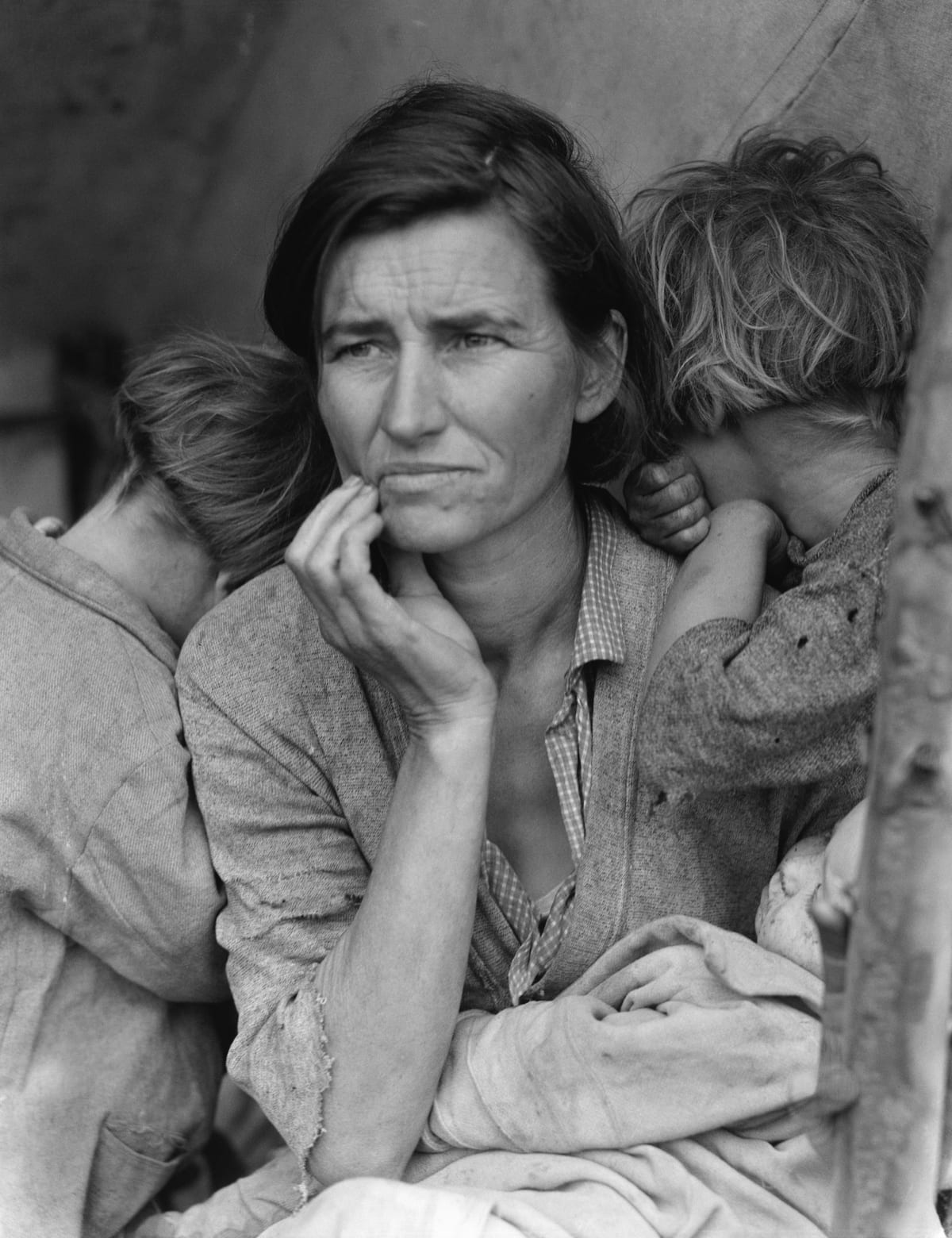
Dorothea Lange's Migrant Mother is so familiar that it can almost disappear into its own fame. The face has become shorthand for the Great Depression, rural poverty, maternal endurance, and the promise that a photograph can make suffering publicly legible. That shorthand is useful, but it is also the easiest way to stop looking.
The stronger way into the image is to treat it as a contract under pressure. Lange made the photograph in March 1936 at Nipomo, California, while working for the federal Resettlement Administration, in the project that became the Farm Security Administration's vast documentary record.[1][3] The picture asks viewers to believe that photographic evidence can carry public obligation. At the same time, its own history keeps complicating that belief: the caption is blunt, the composition is controlled, the negative was retouched, the image circulated as advocacy, and Florence Owens Thompson later challenged parts of Lange's remembered account.[1][2]
Image context: this post uses one real archival photographic artwork, not a diagram, chart, illustration, or generated visual. The photograph itself is the subject. Its power depends on real visible facts: Thompson's furrowed face, the children whose faces are hidden, the infant low in the frame, and the tight triangular pressure that turns one family scene into a public emblem.[1][2][5]
The image works by withholding almost everything
The Library of Congress title is descriptive to the point of severity: "Destitute pea pickers in California. Mother of seven children. Age thirty-two. Nipomo, California."[1] The record identifies the photograph as showing Florence Thompson with three of her children, and notes that the digital file was made from the original nitrate negative for Migrant Mother, call number LC-USF34-009058-C.[1] Those catalog facts matter because they keep the picture attached to an administrative world of negatives, caption cards, call numbers, agencies, and public use.
But the image itself does not feel administrative. It feels compressed. MoMA's object text is useful here because it explains how Lange's "taut composition excludes all but the most essential information."[2] We do not see the camp, the road, the pea field, the car, the weather, the government office, or the photographer. We see a mother, two older children turned inward, and an infant partly visible below. The lack of surrounding evidence does not weaken the picture. It makes the face carry nearly all of the social burden.
That is the first part of the documentary contract. Lange gives viewers enough specificity to trust the scene, then removes enough context to make the scene portable. Thompson's face is particular: lined, beautiful, tense, exhausted, calculating. The children's hidden faces make the family more anonymous and more symbolic at once.[2] The photograph does not merely say, here is one woman. It says, here is one woman made to stand where a society should be visible.
Persuasion was built into the assignment
The Farm Security Administration/Office of War Information collection was not a neutral family album of American hardship. The Library of Congress overview describes a government photography project headed for most of its existence by Roy E. Stryker through the Resettlement Administration, Farm Security Administration, and Office of War Information, producing a broad pictorial record of American life between 1935 and 1944.[3] The collection's black-and-white portion includes about 175,000 film negatives.[3]
That scale changes how Migrant Mother should be read. The photograph belongs to an archive, but it also belongs to a campaign. The Library's chapter on migrant workers says Lange's photographs were intended to bolster support for migrant camps in the area, and quotes her writing to Stryker that her negatives were "loaded with ammunition."[4] That phrase is easy to overheat, but it clarifies the stakes. These photographs were meant to move opinion, funds, policy, and sympathy.
MoMA frames the same public function in art terms: the FSA commissioned photographs like this to promote New Deal social programs, and Migrant Mother became a touchstone for photographers who believed their work should record social conditions and also persuade people to improve them.[2] The photograph's artistic power and its governmental purpose are not separable. Its formal compression is what made its public argument travel.
This is why the picture remains stronger than a generic image of suffering. It does not ask only for pity. It stages the viewer's obligation. The mother looks away from us rather than pleading into the camera. The children turn away from us rather than performing need. The infant is present but not displayed as a sentimental centerpiece. Lange lets the viewer feel the pressure of looking without converting the family into theatrical supplicants.
Maternal iconography makes the image legible, and risky
MoMA's 2022 gallery label makes a pointed claim: Lange's photograph emulated well-known Christian iconography of Mary and the infant Jesus to compel 1930s viewers toward religious compassion for rural families experiencing famine.[2] That reading explains why the image was so quickly legible to broad audiences. A worried mother, clustered children, a body under pressure, an infant at the center of need: the composition knows the visual language of compassion.
The risk is that iconography can flatten a person into a role. Once Thompson becomes "Migrant Mother," her name and later objections can recede behind the emblem. The Library of Congress exhibition page notes that Florence Owens Thompson was Native American and calls the photograph among the Library's most requested images; it also says artists in later decades copied the mother and children while changing ethnic features, universalizing the burden.[5] That afterlife is powerful, but it also shows how easily one woman becomes a template.
The photograph's greatness therefore has to be held together with discomfort. It made public compassion easier by giving it a face. It also made a private family scene available for endless reproduction, interpretation, and institutional display. Documentary photography often lives in that contradiction. Its subjects are not actors, but the resulting images enter public life with a force that can exceed the subject's control.
The evidence is real, but not simple
The most important detail in the Library of Congress record may be its note on retouching. The digital file was made from the original nitrate negative, but that negative was retouched in the 1930s to erase a thumb holding a tent pole in the lower right corner; the unretouched file print can be seen separately.[1] This is not a scandal that destroys the image. It is a useful warning against treating documentary photographs as transparent windows.
The retouched thumb matters because it shows the boundary between evidence and composition. Lange did not invent Thompson, the children, the camp, or the Depression. The photograph is not fictional. Yet the final public image was selected, framed, captioned, printed, circulated, and cleaned. Its truth is photographic, social, and editorial at the same time.
MoMA adds another important complication: Thompson later contested Lange's account from memory, saying in a 1970s interview that she and Lange did not speak to each other and denying the story that she had sold the car's tires to buy food.[2] That disagreement does not make the photograph empty. It makes it more ethically demanding. The picture can be true about distress, migration, motherhood, and public neglect while still being uncertain or embellished in some narrative details.
This is the article's central point: Migrant Mother endures because it never settles into one kind of truth. It is an artwork of composition. It is a federal document. It is an advocacy image. It is a portrait of Florence Owens Thompson. It is a record of one family and a symbol imposed on many families. It is evidence, but evidence made persuasive.
Why the contract still holds
The photograph still matters because it keeps asking what viewers owe to photographed suffering. If a documentary image is too aesthetically weak, it may fail to move anyone. If it is too aesthetically successful, it may become an icon that people admire instead of answering. Migrant Mother sits exactly on that line.
Lange's achievement was not simply that she found a heartbreaking subject. It was that she made the viewer feel how public policy, family survival, and visual form can converge in a single face.[2][4] The children's hidden faces keep the scene from becoming a set of individual portraits. The mother's far look keeps it from becoming direct appeal. The close crop keeps the outside world from relieving us with scenery. The image holds us in the tight space where documentation becomes obligation.
That obligation is not sentimental. It includes skepticism. We should know the caption, the agency, the archive, the circulation, the retouching, and Thompson's later challenge.[1][2][3][5] Knowing those things does not diminish the photograph. It restores its full difficulty.
The public contract of Migrant Mother is therefore not "believe every caption." It is sharper: look closely, ask who made the image, ask how it moved, ask what it made possible, ask what it simplified, and then do not use complexity as an excuse to look away. Lange's photograph remains great because it can survive that scrutiny. Its beauty is not a release from politics. Its beauty is the form politics took when one camera, one mother, one federal archive, and one anxious public met in a tent at Nipomo.[1][2][4]
Sources
- Library of Congress, "Destitute pea pickers in California. Mother of seven children. Age thirty-two. Nipomo, California" - object record for Migrant Mother, including title, date, nitrate negative, digital IDs, retouching note, subjects, rights status, and source collection.
- The Museum of Modern Art, "Dorothea Lange. Migrant Mother, Nipomo, California. March 1936" - object page and label text on the FSA context, composition, circulation, maternal iconography, Thompson's later challenge, and documentary photography's social-engagement claim.
- Library of Congress, "Farm Security Administration/Office of War Information Black-and-White Negatives" - collection overview on the federal photography project, Roy Stryker, agency sequence, dates, and approximately 175,000 black-and-white negatives.
- Library of Congress, "Documenting America: Migrant Workers" - contextual chapter on Dorothea Lange's California migrant-worker photographs, field method, support for migrant camps, distribution, and her "loaded with ammunition" letter to Stryker.
- Wikimedia Commons, "File:Lange-MigrantMother02.jpg" - image source page for the archival photographic file used as the article cover, linked back to Library of Congress digital ID fsa.8b29516 and related metadata.