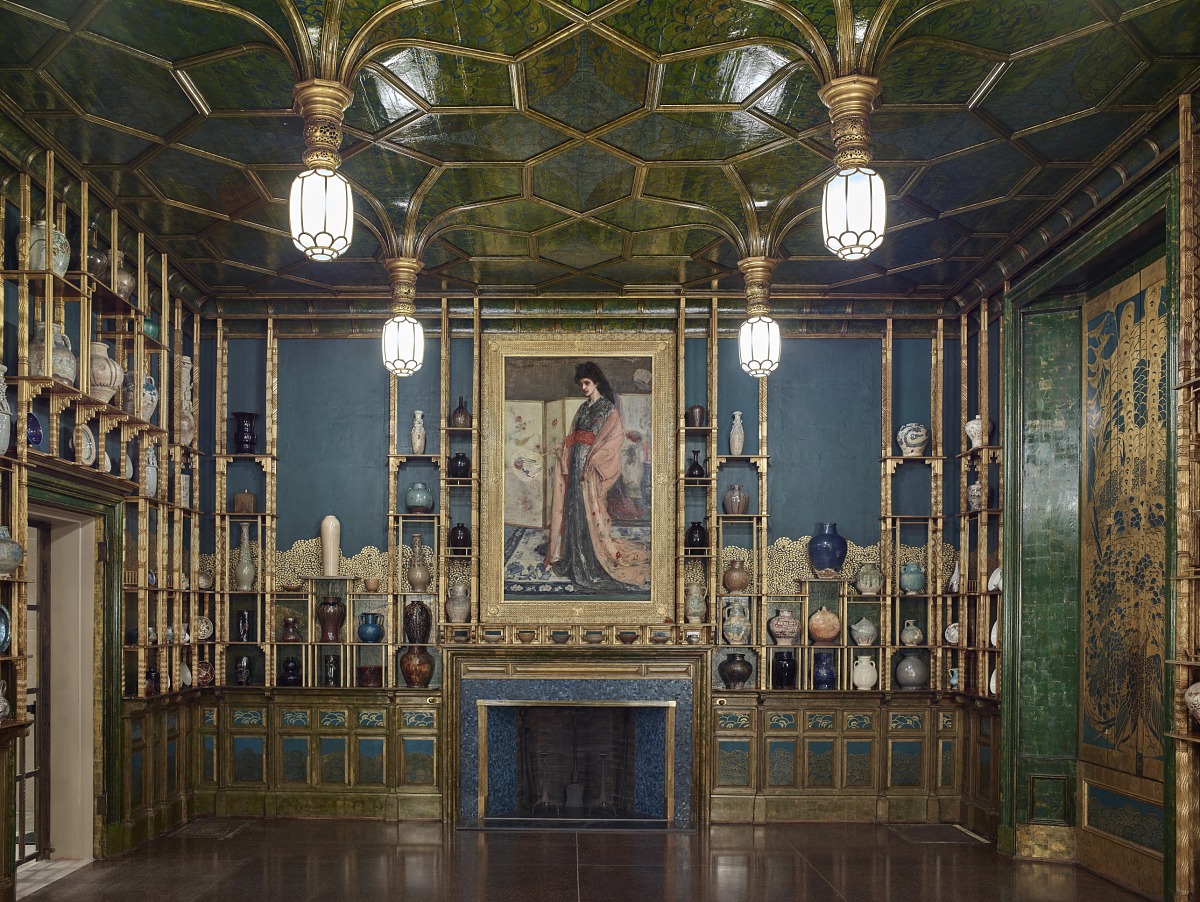
James McNeill Whistler's Harmony in Blue and Gold: The Peacock Room is easy to admire too quickly. Stand in front of a photograph and the room first reads as luxury: blue-green walls, gilded lattice shelves, Chinese porcelain, gleaming ceiling panels, and Whistler's Rose and Silver: The Princess from the Land of Porcelain enthroned above the fireplace.[1] But the room is not only beautiful. It is an argument about who controls beauty once it enters a patron's house.
That argument begins with a dining room, not a museum gallery. The room was originally built inside Frederick Leyland's London home at 49 Prince's Gate. Thomas Jeckyll designed the architectural framework, including the elaborate shelving meant to display Leyland's blue-and-white Chinese porcelain, while antique gilt leather covered the walls and Whistler's Princess held the place of honor.[1] Whistler entered the project as an artist already connected to Leyland, then transformed a coordinated interior into something more radical: a room-sized painting in which color, object, light, and ownership all became unstable.
Image context: this is one real photographic installation image of the actual Smithsonian room, not a diagram, chart, symbolic illustration, or generated visual. It belongs here because the Peacock Room is not legible from a single painted panel. Its meaning comes from the whole environment: the porcelain display, gold shelving, peacock-pattern ceiling, blue-green paint, fireplace painting, and side-wall conflict all have to be seen as one object.[1]
A Dining Room Becomes a Painting
The crucial shift is scale. Whistler did not merely improve Jeckyll's interior. He changed what kind of thing the room was. The Smithsonian object record describes the medium as oil paint and gold leaf on canvas, leather, mosaic tile, glass, and wood, and gives the whole work the dimensions of a room rather than a framed canvas.[1] That material list matters because it refuses the tidy boundary between fine art and decoration. Paint spreads onto leather. Gold turns structural shelving into pictorial rhythm. Porcelain becomes both displayed collection and color instrument.
Whistler's title announces the move. Calling the room Harmony in Blue and Gold makes the dining room sound less like domestic architecture and more like one of his tonal compositions. The Smithsonian notes that he regarded the decoration as a three-dimensional painting, acquired a blue rug for the floor, signed the room several times with his butterfly emblem, and gave the completed environment its color-keyed title.[1] The title is not a decorative afterthought. It is Whistler's claim of authorship over a space that had begun as a patron's display room.
That claim is visible in the photograph. The shelves do not simply hold ceramics; they frame patches of blue, white, green, and gold until the vessels participate in a larger color field. The ceiling panels repeat the shimmer of feathers without becoming literal birds. The room makes the viewer look laterally, upward, and across the mantel rather than straight at one painting. It turns dining into immersion.
Porcelain Is the Engine, Not the Accessory
The porcelain is often treated as the room's furnishing, but the room depends on it more deeply than that. Leyland had collected Chinese blue-and-white porcelain, much of it connected to Qing-dynasty Kangxi taste, and Jeckyll's shelving was built to make that collection visible.[1] The Smithsonian's National Museum of Asian Art explains that Whistler took cues from Chinese ceramics and Japanese textiles, with peacock forms and half-moon feather-eye shapes extending across shutters, paneling, and ceiling.[2]
That is why the blue-and-gold scheme feels so forceful. The ceramics are not neutral objects placed in front of a painted wall. They are the color source that Whistler amplifies, abstracts, and absorbs. The white porcelain surfaces keep the blue field from becoming heavy. The gold lattice prevents the shelves from disappearing into cabinetry. The room makes collecting look like painting and painting look like collecting.
The result is seductive, but not innocent. A contemporary museum reading has to keep the room's East Asian references in view. The Smithsonian's Whistler-at-the-Freer material frames the room in relation to Victorian "Chinamania," Leyland's blue-and-white collection, Whistler's aesthetic vision, and the museum's later effort to display Chinese porcelain in ways that make that history visible rather than mute.[3] The Peacock Room is therefore not just an American masterpiece of interior design. It is also a Western room built from fascination with Asian objects, surfaces, and prestige. Its beauty is inseparable from that collecting culture.
The Wall Where Patronage Breaks
The Peacock Room's drama sharpens because Whistler exceeded the assignment. The Smithsonian record says Leyland initially accepted limited changes: retouching roses on the leather hangings and adding a wave pattern to cornice and wainscoting. While Leyland was away, Whistler covered the ceiling with metallic squares and peacock feather patterning, gilded the shelves, painted peacocks on the shutters, and eventually coated expensive leather with Prussian blue.[1] What began as adjustment became takeover.
The south wall makes that takeover explicit. After a bitter quarrel over Whistler's revisions, public behavior in Leyland's home, and payment, Whistler painted two fighting peacocks on the wall opposite The Princess.[1] The Smithsonian identifies the birds as coded versions of the patron and the artist: Leyland's peacock carries silver throat feathers tied to his white ruffled shirts, while Whistler's bird has a silver crest recalling the artist's distinctive white lock of hair.[1][2] In other words, the room does not hide the conflict that produced it. It decorates the conflict until it becomes part of the work.
This is the point at which the Peacock Room stops being merely harmonious. The color harmony remains, but the social harmony has failed. Whistler's composition converts a patron dispute into ornamental theater. The peacocks glitter because they are angry. The wall is beautiful because it is accusatory. A room designed to display Leyland's taste ends up displaying Leyland's loss of control.
Conservation Reveals the Object's Oddness
The room's later museum life makes its category problem even clearer. It was sold after Leyland's death, purchased by Charles Lang Freer, dismantled in 1904, moved to Freer's Detroit house, and eventually reinstalled at the Freer Gallery of Art after Freer's death; the gallery opened to the public in 1923.[1] Wayne State University's digital Peacock Room project, produced with Smithsonian context, describes the room's history as a two-part story centered on Whistler and his two major patrons: Leyland in London and Freer in the United States.[4]
That relocation matters because it changed the room without erasing it. In London, the Peacock Room was a dining room built around Leyland's porcelain and Whistler's Princess. In Detroit, Freer used it to display his own ceramic collection. In Washington, it became a museum object whose shelves could be staged to interpret different collecting histories.[1][3][4] Each installation asks the same question in a new key: is the room an artwork, an architectural element, a display system, a collection frame, or a history of patronage?
The best answer is that it is all of those at once. Smithsonian Magazine's 2022 restoration account makes this materially vivid: conservators had to treat historic painted walls, leather, wood, canvas, gilding, and paint as parts of one unusually complex object.[5] The room's conservation difficulty is not incidental. It proves the work's central idea. Whistler made a painting that cannot be removed from architecture without becoming something else.
Why the Room Still Feels Modern
The Peacock Room still feels current because it exposes a problem that has not disappeared: the conflict between patronage and artistic authority. Leyland owned the room, the house, the porcelain, and the money. Whistler claimed the visual field. The result was not a polite commission but a battle over whether beauty belongs to the person who pays, the person who arranges, or the objects whose histories both men were using.
That tension is why the room's luxury has bite. The gold leaf, porcelain, and peacock patterning are not merely expensive surfaces. They are tools of control. Jeckyll's shelving controls the collection. Leyland's patronage controls the domestic setting. Whistler's paint controls the eye. Freer's later acquisition controls the afterlife. The museum controls the current staging. The room looks unified because every power struggle has been forced into the same palette.
Seen this way, the Peacock Room is not a retreat into aestheticism. It is aestheticism under pressure. Whistler believed that color harmony could reorganize a room, but the room remembers the cost of that reorganization. The fighting peacocks keep the social contract visible. The porcelain keeps the collecting culture visible. The repeated butterfly signatures keep Whistler's authorship visible. The museum installation keeps the object's movement from London to Detroit to Washington visible.[1][3][4]
The photograph catches the room at its most composed: lamps glowing, shelves orderly, porcelain evenly spaced, The Princess centered above the mantel. But the composition is calm only because it has absorbed a quarrel. That is the Peacock Room's lasting force. It turns decoration into a power struggle without giving up beauty, and it turns beauty into evidence that power was there all along.[1][5]
Sources
- Smithsonian Institution, "Harmony in Blue and Gold: The Peacock Room" - object record for F1904.61, including the Smithsonian Open Access image used as the cover, object history, medium, Leyland/Whistler conflict, relocation, and current display.
- Smithsonian National Museum of Asian Art, "Harmony in Blue and Gold: The Peacock Room" - interactive object note on the peacock motif, Chinese ceramics, Japanese textile influence, Whistler and Leyland as dueling peacocks, and the room's dimensions and materials.
- Smithsonian National Museum of Asian Art, "Whistler at the Freer" - museum context for Whistler, Leyland's Kangxi porcelain display, Victorian Chinamania, the room as an icon of American art, and recent blue-and-white porcelain interpretation.
- Wayne State University and Smithsonian Institution, "The Peacock Room" - digital project framing the room's journey from London to Detroit to Washington and its history through Whistler, Frederick Leyland, and Charles Lang Freer.
- Roger Catlin, "Whistler's 'Peacock Room' Open After Weeks of Restoration," Smithsonian Magazine (September 29, 2022) - restoration report on the room's painted walls, leather, wood, canvas, gilding, conservation work, and patronage dispute.