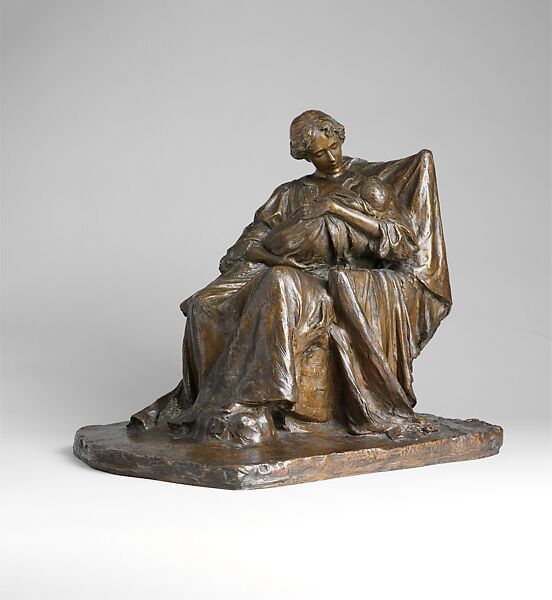
The baby lies across a broad lap; the mother's head bends toward it. In Bessie Potter Vonnoh's A Young Mother, the folds of a skirt spread beneath the pair, giving their quiet contact a substantial base. The composition gathers attention inward. Even in a photograph, the bronze seems to ask us to come closer.
Vonnoh modeled the work in 1896. The Metropolitan Museum's example, cast by Roman Bronze Works around 1906, stands just fourteen inches high. Its smallness is part of the encounter: we can take in the whole group while still wanting to study the tilt of the head and the shelter made by the arms.[1]
Such gestures sustained a substantial career. To follow Vonnoh from her Chicago studio to New York's public gardens is to watch intimacy acquire an audience—and to discover how much deliberate construction lies behind an appearance of ease.
A studio of her own
Born in St. Louis in 1872 and raised in Chicago, Vonnoh studied with Lorado Taft at the School of the Art Institute of Chicago. She joined the women assistants known as his “White Rabbits,” helping with sculpture for the World's Columbian Exposition of 1893. Work on a vast public spectacle preceded the small figures for which she became known.[2]
Her own studio followed. There she modeled delicate, tinted plaster portraits of friends. According to the National Museum of Women in the Arts, their popularity helped finance her first European journey in 1895. In Paris she met Auguste Rodin.[2]
This is an unusually tangible connection between an artistic choice and professional independence. A little portrait could earn the money for travel; travel could widen the sculptor's experience. The intimate scale already belonged to an outward-moving career.
How a touch survives casting
A second Young Mother, at the Huntington, makes the labor behind the tenderness easier to understand. This version is plaster, preserved from Roman Bronze Works. The museum explains the sequence: a sculptor's clay model was cast in plaster, which then served in producing the bronze. Careful finishing of that intermediate object mattered because its details would carry into the metal.[4]
The Huntington's plaster bears a protective shellac coating applied at the foundry. Its warm surface is therefore also evidence of use. An object that looks complete to a museum visitor could remain a working part of the sculpture's production.[4]
This changes how we look at Vonnoh's softness. A loosely suggested fold or gently modeled face had to survive a sequence of materials. What feels fleeting in the finished bronze was made durable through decisions about the surface. The appearance of an unguarded moment could be prepared, preserved, and cast again.
A figure can stand still while its surface moves
Motherhood became central to Vonnoh's reputation, but another figure shows the range within her small sculptures. The Fan, dated 1910, is silvered bronze. A standing woman turns her head while holding a fan at her side. The long dress gathers into narrow, descending folds.[5]
The National Museum of Women in the Arts draws attention to the way those folds do two jobs. They give the figure the stability of a column, while their ridges and recesses make light flicker over the surface. The pose can remain reserved as the material produces a livelier rhythm.[5]
I read that tension as one of Vonnoh's particular pleasures. The figure offers enough stillness for close attention, then gives the eye something to follow. Her subjects need no dramatic incident to hold us. A turn, a drape, or a slight change of emphasis can organize the whole sculpture.
The audience around the statuette
The Met's curator Thayer Tolles places Vonnoh within a revival of small bronze sculpture in America. Her contemporary women, initially dressed in fashionable clothing, eventually shared her repertoire with dancers in generalized, Greek-inspired drapery. Domestic life and classical reference could occupy the same modest scale.[3]
That world had boundaries. Tolles describes the refined social milieu represented by the early figures; these works cannot stand for every woman's experience. Their calm is a selected vision of life. Looking closely means appreciating its formal intelligence while recognizing the selection.
Exhibitions carried that vision beyond the room imagined inside each sculpture. Vonnoh had a significant solo show at the Corcoran Gallery in 1910, another at the Brooklyn Institute of Arts and Sciences in 1913, and became a full academician of the National Academy in 1921. Large editions, chiefly from Roman Bronze Works, helped her compositions circulate.[3]
The small bronze was therefore a public proposition about what deserved attention. A subject associated with home could travel through foundries, exhibitions, collections, and critical discussion.
A garden becomes the room
The later Burnett Fountain brings that proposition outdoors. Honoring the children's author Frances Hodgson Burnett, it pairs a reclining, flute-playing boy with a standing girl beside a water-lily pool. The Central Park Conservancy describes the figures as reminiscent of Mary and Dickon from The Secret Garden.[6]
Its setting was not inevitable. A committee formed in 1927 commissioned Vonnoh for a proposed children's garden and storytelling area elsewhere in the park. Those plans failed to materialize, and the fountain went into storage. When the Conservatory Garden opened in 1937, administrators found a place for it in the English-style southern garden.[6]
The memorial honors a writer through the imaginative company of children. That choice extends the attentiveness of the statuettes into a place visitors can enter. The room around the figures has become a garden; the possibility of quiet absorption remains.
Return to the mother with the infant, and the smallness looks purposeful. Vonnoh understood how a gesture could gather a viewer's attention. Across a tabletop or beside a pool, she gave that attention somewhere to settle.
Sources
- The Metropolitan Museum of Art, “A Young Mother” — model and cast dates, dimensions, foundry, accession 06.306, and the photograph reproduced here.
- National Museum of Women in the Arts, “Bessie Potter Vonnoh” — Chicago training, World's Columbian Exposition work, early studio, and the first European journey.
- Thayer Tolles, “Bessie Potter Vonnoh (1872–1955),” The Metropolitan Museum of Art, April 2012 — stylistic development, exhibitions, bronze editions, and professional recognition.
- The Huntington, “Young Mother,” accession 2007.9 — the plaster from Roman Bronze Works, its shellac coating, and its role in casting.
- National Museum of Women in the Arts, “The Fan” — the 1910 silvered bronze and the relationship between pose, drapery, and surface.
- Central Park Conservancy, “Burnett Fountain” — the memorial's subject, unrealized garden scheme, storage, and eventual setting.