
Frank Bowling is easy to flatten in two opposite directions.[1][2][3][4] One version makes him into a late-honored elder of abstraction, a painter of luminous surfaces whose biography can be safely detached from the work. The other keeps biography so close that the paintings become illustrations of migration, race, or Atlantic history. Tate's short interview is valuable because it refuses both shortcuts.[1] Bowling describes a path from youthful attention to tragic human behavior toward a harder trust in color and geometry, yet the shift does not evacuate lived experience. It changes the register in which experience stays present.[1][2][3]
That matters because Bowling's New York years sit at the center of the question.[2][3][4] The Frank Bowling Studio biography marks 1966 as a major reorientation: he moved from London to New York, entered a scene split by formalism and politics, argued for abstraction in his criticism, and by 1971 had fused surface, color, and personal memory in the Map Paintings.[2] The Museum of Fine Arts, Boston, sharpens the same period by calling it the artist's transformative American decade, when abstract painting, Black cultural debate, teaching, criticism, and exhibition making all pressed on his work at once.[3] What the Tate video adds is a first-person account of how that pressure became painterly method.[1]
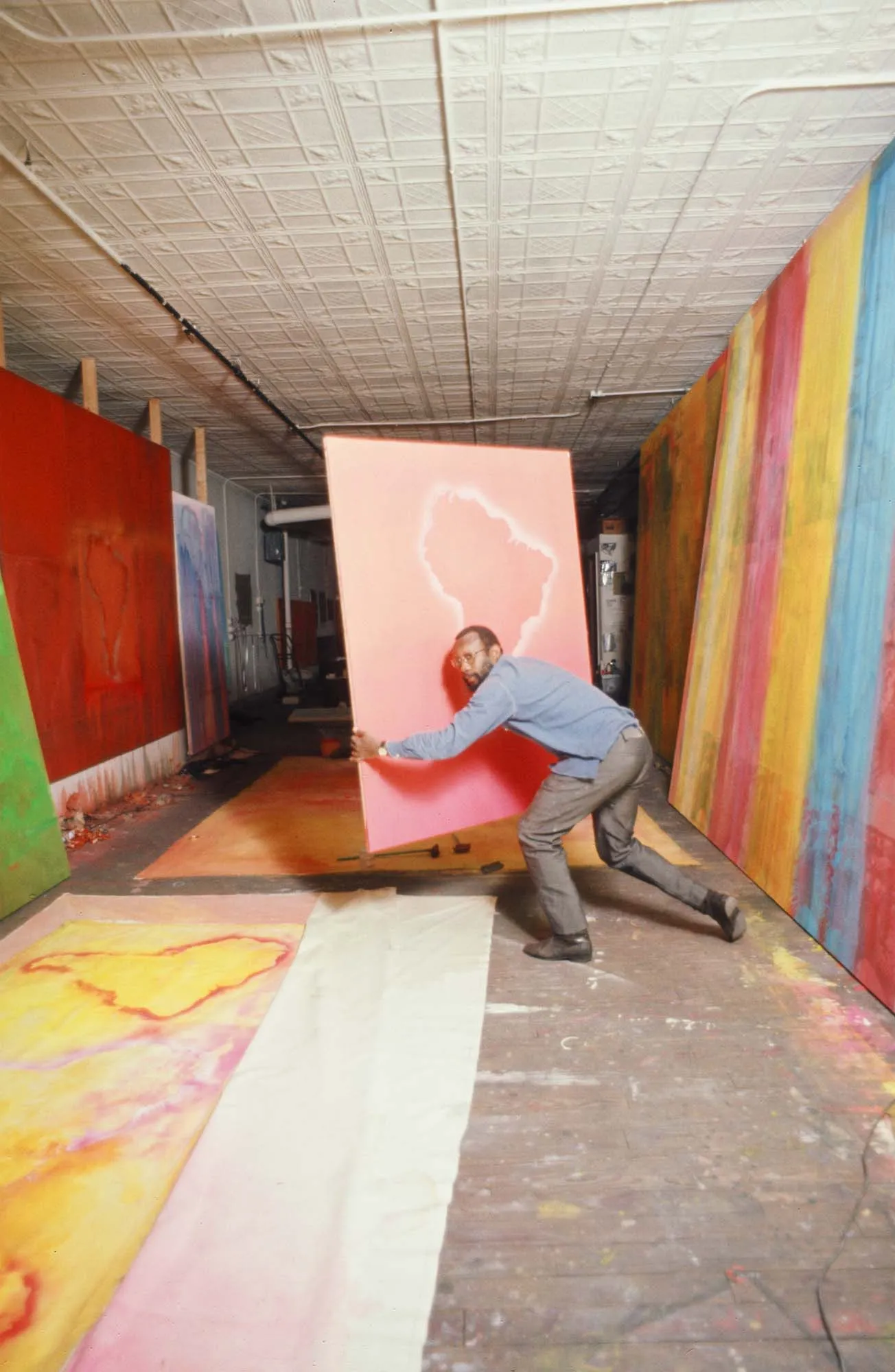
Image context: the cover uses the Frank Bowling Studio archive photograph labeled "Frank Bowling in his Broadway studio, 1971." It belongs here because the article's central claim is not merely that Bowling painted maps. The stronger point is that the studio image catches the exact hinge described in the video: a Guyana-born painter in New York, standing with map works that have already turned geography into a formal and autobiographical device.[2]
Around 0:13 to 0:40, abstraction arrives as a place of pressure rather than escape
The first useful surprise in the clip is tonal.[1] Bowling says that in his youth he tended to look at the tragic side of human behavior and tried to reflect that in his work, then adds that the deeper he moved into painting, the more he realized that color and geometry were where he felt most at home.[1] This is not the language of retreat. He does not describe abstraction as a cleansing away of history or conflict. He describes it as the zone in which painting could carry weight without being trapped inside narrative depiction.[1][4]
Whitney's artist page helps explain why that distinction matters.[4] It notes that Bowling's late-1950s and early-1960s work in London was figurative and socially charged, but that after moving to New York in 1966 he "broke loose" into colorful abstraction shaped by saturated color and stain-like surfaces.[4] The Tate video makes that move sound less like a conversion story than a change in artistic leverage.[1] Tragedy does not disappear. It gets displaced into the behavior of paint, edge, shape, and interval. Bowling's abstraction should therefore be read as intensified handling, not as biography scrubbed clean.
Around 0:52 to 1:44, New York deepens color and the map becomes a motive
The video's middle minute gives the article its backbone.[1] Bowling says that after going to live in New York, his concerns with color deepened, and that the city's energy and drive made him feel this was where things were happening.[1] Then comes the crucial sequence: by chance, map shapes appeared while he was staying at the Hotel Chelsea; he began painting maps of South America and Guyana; then he decided to use the flat map as a motive to work with because its shapes and graphic suggestions were so engaging.[1]
That sequence matters because it blocks a common misreading of the Map Paintings.[1][2][3] They are not simple emblems of origin pasted onto otherwise abstract canvases. The official biography states that by 1971 Bowling had fused abstraction with personal memories, producing the iconic Map Paintings with stenciled landmasses of South America, Africa, and Australia.[2] MFA Boston situates the same work inside the years when Bowling was writing for art magazines, curating the 1969 exhibition 5+1, and working through the terms on which a Black abstract painter would or would not be categorized.[3] Put beside the interview, the maps read as a device with two jobs at once. They are graphically useful shapes inside a painting problem, and they are also a way to keep geography, migration, and self-location inside abstraction without turning the canvas into a poster.
That double function is why the word "motive" matters so much in the video.[1] Bowling does not present the map as a fixed symbol with one stable meaning. He presents it as something workable: a shape that can be moved, stenciled, submerged, and made to carry both visual force and autobiographical voltage. In that sense, the map is less an illustration than a pressure point.
Around 1:39 to 2:33, the poured paintings turn process into event
From the map works, the clip slides naturally toward Bowling's later process language.[1] He describes moving toward a kind of geometrical color-field painting, then speaks about New York as the place where pouring, spilling, dripping, and brushing were all happening.[1] His account of method is especially strong because it remains physical all the way through: the canvas is grounded all over, stacked against the wall, worked by pouring, throwing, spilling, and dripping, then allowed to settle before being pulled back up so it can dry.[1] He emphasizes that the process is extemporary and not preplanned.[1]
That description lines up exactly with the official biography's account of the Poured Paintings from 1973 to 1978.[2] There Bowling is said to have experimented with chance and "controlled accidents," pouring paint from a two-meter height to create an expansion from color-field painting.[2] The value of the Tate clip is that it keeps the word "accident" from sounding casual. Bowling's method is structured, bodily, and procedural. Material is released, gravity is allowed to do work, but the painter still manages ground, angle, drying time, and return.[1][2] What looks atmospheric from a distance turns out to be a choreography between control and release.
This is where Bowling's abstraction feels most transatlantic.[2][3][4] The paintings absorb London training, New York speed, memories of Guyana and South America, and the language of American color-field painting without becoming secondary to any of them.[2][4] The pour is not a decorative flourish laid on top of identity. It is the mechanism by which many locations and histories are made to move through one surface.
Around 2:46 to the end, titles keep the paintings near lived time
The final passage of the video is quieter and, in some ways, more revealing.[1] Bowling says that naming his works is like keeping a diary. The titles remind him of life lived intensely, and even if they do not let him relive an experience, they preserve what he calls the tremor of knowing that the experience existed.[1] This short explanation changes the whole relation between abstraction and memory. It suggests that memory in Bowling is not only stored in mapped landmasses or in chromatic atmosphere. It also survives in the naming system that runs alongside the image.
That claim clarifies why Bowling's paintings can feel so full without becoming descriptive.[1][2] The title does not decode the picture once and for all. It keeps a register of pressure beside it, a trace of event or relation that the surface will not narrate directly. This is also why the article's main claim about the Tate video is narrower than a generic artist-profile lesson. The clip does not simply tell us that Bowling moved from figuration to abstraction.[1] It shows that he found a way to make abstraction hospitable to biography without asking painting to give up its own terms. Color carries feeling, maps carry positional memory, pours carry event, and titles carry the aftershock.[1][2][3][4]
That is the real achievement on view. Bowling's abstraction is not pure in the sense of being emptied out. It is pure only in the stricter painterly sense that the medium itself does the remembering.[1][2]
Sources
- Tate, "Frank Bowling - From Figuration to Abstraction | Artist Interview | TateShots," YouTube video, published April 19, 2012.
- Frank Bowling Studio, "Biography" - official artist biography covering the 1966 move to New York, the Map Paintings, the Poured Paintings, and the 1971 Broadway-studio photograph used here.
- Museum of Fine Arts, Boston, "Frank Bowling's Americas" - exhibition page on Bowling's New York years, 1966-1975, including his criticism, teaching, 5+1, and the transformative role of the American decade.
- Whitney Museum of American Art, "Frank Bowling" - artist page describing the move from London figuration to New York abstraction and Bowling's use of saturated color-field surfaces.