Dorothea Lange's photographs are easy to remember and easy to flatten. A few pictures have become so canonical that they risk turning into pure emblem: poverty, migration, the Depression, wartime injustice.[1][2][3] The deeper achievement is harder and more valuable. Lange kept building documentary images that refuse anonymity. Even when she worked inside a state survey, a magazine commission, or a national emergency, she looked for the point where a public crisis became legible in one person's posture, one family grouping, one fragment of speech, one carefully written caption.[1][3][5] That is why her pictures still feel close. They were made as encounters before they were absorbed into history.
The distinction matters because Lange's art sits at an unstable border. It is never only portraiture and never only evidence. The National Gallery of Art's recent publication frames her career as a long investigation into how photography could register "core values" and a sense of self while still functioning as documentary practice.[3] The Oakland Museum of California, which holds her archive, makes the process visible from the other side: more than 40,000 negatives, 6,000 vintage prints, and the field notes, correspondence, proof sheets, and audio that show how much work went into turning witness into form.[1] If you want the shortest description of Lange's art, it is this: she did not photograph social problems as abstractions. She photographed social pressure as something carried by bodies, voices, and arrangements in space.
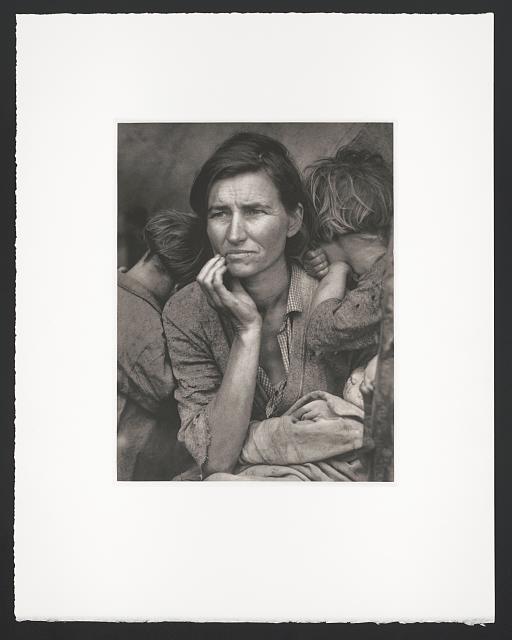
Image context: the cover uses the Library of Congress photogravure of Migrant Mother, made from an original 1936 print in the Oakland Museum collection.[2] That choice fits the essay because the image is both the best-known Lange photograph and the one most likely to be reduced to a generic symbol of suffering. The article's real claim is that Lange's strength lies in how she kept such pictures tethered to relation, sequence, and documentary attention.
1) The documentary photographer began as a portrait specialist
Lange's later authority depended on training that arrived before the Depression. The Smithsonian American Art Museum biography notes that she apprenticed in New York studios, including Arnold Genthe's, and then established herself as a portrait photographer in San Francisco after being stranded there in 1919.[5] That origin matters. She learned early that a face is not raw material; it is a negotiation between sitter, camera, and the person standing behind it. The discipline of studio portraiture stayed with her even after she left the studio. Her documentary work never treats people as background texture.
That helps explain the abrupt power of the early street pictures from San Francisco. When Lange began noticing the "new poor" outside her Montgomery Street studio during the early 1930s, she did not simply pivot from art to social conscience.[5][6] She carried portrait intelligence into public space. SFMOMA's notes on White Angel Breadline emphasize that the picture emerged from the economic collapse visible near her studio, but the image works because it is not a crowd panorama.[6] One man is turned away from us, hemmed in by hats and shoulders, his hands wrapped around a tin cup. The photograph makes a social system visible by refusing to dissolve him into that system. That move would become one of Lange's signatures.
2) Her real medium was the photograph-plus-caption encounter
The standard version of Lange's career often treats the image as the entire artwork. OMCA's archive description suggests a better reading.[1] The field notes and related materials matter because Lange's documentary practice was built from more than shutter timing. She listened, wrote, sequenced, and captioned. She used language not as decoration after the fact, but as part of the ethical frame around the picture.[1][3] The result is that her photographs keep individual lives from being swallowed by category labels such as "migrant," "relief client," or "evacuee."
That is also why so many Lange pictures feel unusually direct without becoming sensational. The NGA publication stresses that she wanted pictures that were "important and useful," and links that goal to questions of identity, inequality, and documentary meaning.[3] Usefulness here does not mean propaganda in the crude sense. It means a picture had to travel into public argument without sacrificing the subject's presence. Lange's strongest images do this by making social structure readable through relation: between parent and child, worker and road, body and temporary shelter, citizen and hostile state.
Once you see that method, the famous captions stop looking secondary. They are part of how the image keeps its human scale. A documentary photograph can make a suffering population visible and still erase the people inside it. Lange kept pushing against that erasure. She attached speech fragments, locations, occupations, and immediate conditions so that the viewer met a situation rather than a myth.[1][3]
3) Migrant Mother matters because it is an encounter before it is an icon
No Dorothea Lange profile can avoid Migrant Mother, but the point is to avoid being trapped by its afterlife. The Library of Congress record identifies the now-familiar image as a later photogravure made from an original 1936 print in Oakland's collection, and the National Gallery's process essay helps place that image inside a longer history of editing, circulation, and repeated reuse.[2][4] By the time most viewers meet the image now, it has already become "the Depression" in one frame. That shorthand is powerful, but it also narrows Lange.
What keeps the picture alive is not its iconic status by itself. It is the compositional intelligence with which Lange turns hardship into relation. The turned-away children, the mother's furrowed face, the infant in her lap, and the cramped shelter do not produce pity by excess. They organize attention. The image does not ask the viewer to admire suffering. It asks the viewer to inhabit a specific pressure system long enough to understand labor insecurity as family experience.[2][3] That is a very different artistic achievement from simply finding an unforgettable face.
It is also why Lange's art cannot be reduced to a morality tale about compassion. Compassion is part of the work, but structure is what gives it force. The NGA's framing of her career through portraiture is useful here: she kept treating public history as something that had to pass through a relation between photographer and subject, not through anonymous spectacle.[3] Even Migrant Mother, the most over-reproduced of her images, still depends on that relation to resist becoming dead symbol.
4) The later work proves the method was broader than Depression iconography
OMCA's overview is especially helpful because it refuses to let Lange stop in the 1930s.[1] It places the migrant-farmworker pictures beside urban homelessness, Japanese American incarceration during World War II, later projects on displacement, criminal justice, and rural life abroad. That range matters. It shows that the governing question in her work was not "How do I photograph poverty?" but "How do I photograph the human face of power?"[1][3]
The wartime photographs make this especially clear. When Lange photographed the forced removal and incarceration of Japanese Americans, she was still using the same method of concrete encounter, but under a sharper political strain.[1][3] Bureaucratic violence appears in signs, waiting lines, tags, luggage, and the careful composure of people required to submit to the state. The pictures are documentary in the strict sense, yet they are also formal judgments about what a democracy looks like when it organizes exclusion. Lange's art grows larger there, not smaller.
Seen from 2026, that is why her archive keeps reopening. We are surrounded by images that travel instantly and detach just as fast from the lives they claim to show. Lange offers another model. The picture can move widely, enter public argument, and still remain answerable to a real encounter. That is the social force of her work. She never made hardship anonymous. She made it legible without letting it stop being someone's life.[1][3][5]
Sources
- Oakland Museum of California, "About Dorothea Lange" - overview of Lange's career and the OMCA archive holding 40,000+ negatives, 6,000 vintage prints, and related field notes and correspondence.
- Library of Congress Prints & Photographs Online Catalog, "Migrant mother, Nipomo, California, 1936" - item record for the Library's photogravure made from an original 1936 print in the Oakland Museum collection.
- National Gallery of Art, Dorothea Lange: Seeing People - publication overview describing Lange's aim to make photographs that were "important and useful" and framing her work through portraiture, identity, and inequality.
- National Gallery of Art, "Outside the Frame: How Dorothea Lange Created Her Iconic Photographs" - essay on Lange's process, contact sheets, and the making and later lives of major images.
- Smithsonian American Art Museum, "Dorothea Lange" - artist biography covering studio training, San Francisco portrait practice, and the move toward documenting breadlines and migrant labor.
- Smithsonian American Art Museum, "White Angel Breadline" - artwork page for Lange's 1933 photograph, with object details and Depression-era subject indexing.