
Eva Hesse is often introduced through fragility, as if the main thing to know is that latex darkens, fiberglass shifts, and a brilliant career was cut short.[3][4][5] Those facts matter, but by themselves they can make her sculpture sound like a cautionary tale about impermanence. The stronger reading is harder and more interesting. Hesse did not simply make objects that later became difficult to preserve. She built works whose meaning already depended on sag, interval, repetition, awkward support, and the possibility that a piece would never look exactly the same twice.[1][2][3][4]
That is why these two videos belong together. The Guggenheim documentary on Expanded Expansion shows what happens when a museum tries to keep a materially unstable work in public life without pretending it can be returned to some untouched origin.[1][3] The Whitney installation film on No title shows the other half of the problem: some of Hesse's sculpture was meant from the outset to be variable, dependent on hanging decisions and the behavior of materials in space.[2][4] Watched in sequence, the videos make a precise argument about Hesse's late art. Its real challenge to Minimalism was not only softer matter or more bodily form. It was a different theory of sculptural time.[1][2][4][5]
The Oberlin archive helps explain why that theory arrived so quickly and with such force.[5] Hesse's mature career lasted only a few years, but the late 1960s were dense with invention: after the early reliefs and rope works of the mid-decade, she moved into fiberglass and other unstable materials from 1968 onward, while still keeping the drawing-like logic, the sense that form could hang, droop, and partly determine itself.[5] In that context, conservation and installation are not secondary technical issues. They are ways of meeting the work on its own terms.
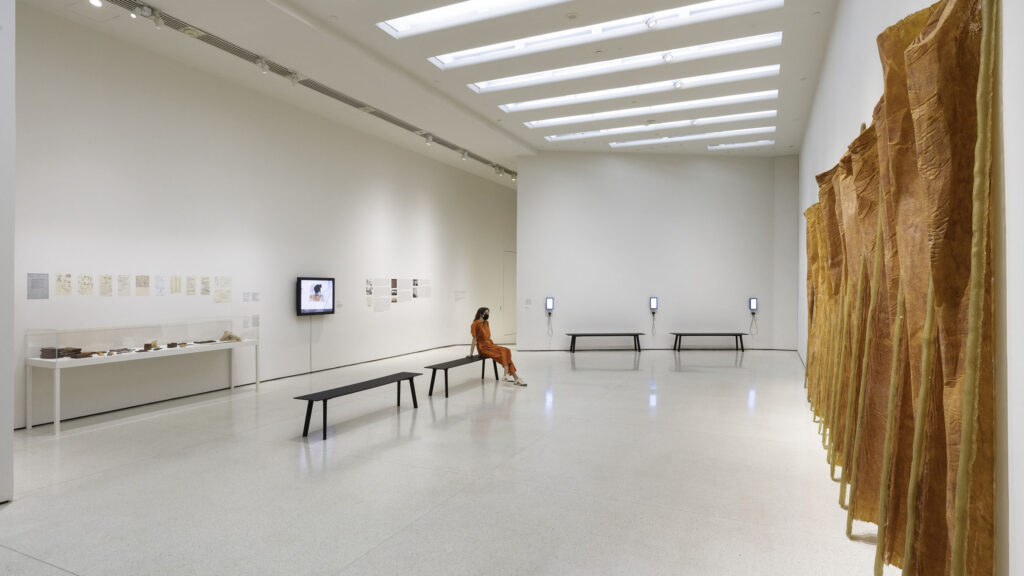
Image context: the cover uses Guggenheim's installation photograph of Expanded Expansion because this article is about sculpture that never fully settles. The work reads as a sequence of units, but each unit still leans, hangs, and depends on how the room receives it. The image is not just illustration. It shows Hesse's basic proposition that serial form can remain bodily, precarious, and alive to change.[3]
Video 1: the Guggenheim film shows conservation as negotiated continuation rather than rescue
The first video in the collection focuses on one object, but it opens outward onto Hesse's whole late method.[1][3] The Guggenheim exhibition page describes Expanded Expansion (1969) as a monumental work made from soft, draping panels of rubberized cheesecloth combined with rigid fiberglass and polyester resin poles that function like legs.[3] The piece repeats, leans against the wall, and can expand or contract according to how it is installed.[3] That combination already tells you why Hesse sits uneasily inside the colder versions of Minimalism. Seriality is present, but it is not clean. Structure exists, but it keeps brushing up against slackness, humor, and something close to bodily vulnerability.[3][5]
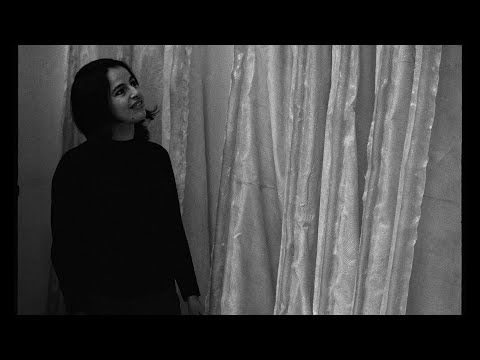
The documentary's title, "The Afterlife of Eva Hesse's Expanded Expansion," is exactly right because the film is not about restoring youthful freshness to dead matter.[1] It is about research, debate, and treatment carried out after the work had been in storage for nearly thirty-five years.[1][3] The Guggenheim page says the presentation brought the sculpture back into public view while foregrounding "the temporalities of exhibition and interpretation" and the stewardship required to keep such a work legible over time.[3] That language matters. The museum is not claiming perfect recovery. It is admitting that exhibition itself becomes historical when the materials were fragile from the start.[3]
What makes the film so useful is that it keeps conservation close to interpretation.[1][3] The Guggenheim's own description says the documentary covers "extensive research, dialogue, and complex conservation treatment."[1] That middle term, dialogue, is the key. A Hesse work like this does not ask a conservator only how to stabilize matter. It asks what counts as the work when flex, spacing, droop, and material change were built into the original experience.[1][3] If the panels are too stiff, too even, or too cosmetically refreshed, the result may preserve substance while flattening the sculpture's emotional and formal risk.
The exhibition page sharpens that problem by pairing the restored installation with smaller experimental works and with archival video and audio of Hesse in her studio.[3] That curatorial choice implies that no single moment of the object can be treated as fully self-sufficient. Expanded Expansion belongs to a larger field of testing, handling, and looking. It is one reason Hesse remains so contemporary. Her art makes museums admit that conservation is not neutral maintenance performed after meaning has already been fixed. In her case, conservation helps decide how much variability, fatigue, and contradiction a work can continue to show in public.[1][3]
Video 2: the Whitney installation film reveals that No title was designed to keep moving
If the Guggenheim video is about afterlife, the Whitney film is about original intention.[2][4] No title (1969-70) looks at first like a tangle of latex-coated rope suspended through the gallery, but the Whitney collection page makes its logic unusually explicit. Hesse dipped two separate pieces of knotted rope into liquid latex; the work attaches to the ceiling and walls at thirteen points; and the exact placements remain flexible from installation to installation.[4] The museum even cites her note that the piece should be hung irregularly, "letting it go as it will" and allowing it to determine more of the way it completes itself.[4] That is not a side instruction. It is the work's central ethic.
The short installation video is therefore more revealing than its running time suggests.[2] Rather than treating the sculpture as a fixed treasure that must be slotted back into one correct position, the Whitney staff has to negotiate how the ropes arc, knot, descend, and occupy the room.[2][4] This is where Hesse's departure from Minimalism becomes especially vivid. Minimalist objects often insist on stable relation, clear edge, and deliberate perceptual control. Hesse keeps relation, but she loosens control. She lets gravity, thickness, drying latex, and the decisions of later handlers become part of what the sculpture is.[2][4][5]
The Whitney page's visual description helps explain why this matters beyond logistics.[4] It describes No title as a web-like form with graceful arcs and dense snarls, monumental in scale but variable in footprint, its latex both apparently supple and actually brittle as it ages.[4] The sculpture can be read as a drawing in three dimensions, built from line, weight, and the accumulation of crossings rather than from sealed mass.[4] Once that is clear, installation is no longer an external museum task. It is the process by which drawing becomes environment.
This is also why the work still feels emotionally charged instead of merely procedural.[2][4] The piece is unstable, but not in a vague romantic way. Its instability is organized. Thirteen points hold it; two rope lengths structure it; drying rubber records gravity; the final form emerges through hanging rather than through one permanently bounded contour.[4] The Whitney video makes you see that Hesse's sculpture does not only sit in space. It is composed through the act of being placed there.[2] That distinction matters if we want to understand what later artists inherited from her. The lesson was not just "use vulnerable materials." It was that sculpture could remain serial, abstract, and anti-monumental while still admitting contingency as part of form itself.[2][4]
What the two videos reveal together
Placed together, the Guggenheim and Whitney films show that Hesse's late sculpture asks two related questions at once.[1][2][3][4] First: how can an artwork remain powerful when its materials are known to age, darken, stiffen, or become more fragile? Second: how can a sculpture preserve identity when its installation is intentionally variable? The first question leads to conservation; the second leads to reinstallation. In Hesse, those are not separate museum departments. They are two versions of the same philosophical problem.
That is why the phrase "after permanence" fits these videos better than the looser phrase "fragility." Fragility can sound passive, as though the work merely suffers time.[1][3][4] Hesse's sculpture is more active than that. Expanded Expansion stages repetition and bodily slack across a wall, then forces later stewards to decide how that relation can continue.[1][3] No title turns a rope drawing into a variable room-sized event, then hands part of the compositional burden to the next installer.[2][4] The result is art that neither worships permanence nor celebrates decay for its own sake. It makes change thinkable inside abstraction.
The Oberlin archive offers the broader historical frame for that achievement.[5] Hesse's mature work emerged from a compressed but extraordinarily fertile stretch in the mid-to-late 1960s, and the archive remains indispensable because it preserves not just finished objects but notebooks, photographs, and evidence of working process.[5] Read beside the two videos, that archive suggests a final point. Hesse's importance does not lie in biography alone, or in tragedy alone, or in materials alone. It lies in the way she turned handling, hanging, repetition, and deterioration into sculptural intelligence. These videos are worth watching together because they show that intelligence still working, decades after the objects first entered the world.[1][2][3][4][5]
Sources
- Guggenheim Museum, "The Afterlife of Eva Hesse's Expanded Expansion," YouTube video, published July 20, 2022.
- Whitney Museum of American Art, "Installing Eva Hesse's No Title, 1969," YouTube video, published June 25, 2015.
- Guggenheim Museum, "Eva Hesse: Expanded Expansion" - exhibition page on the 1969 work, its materials, archival studio footage, and the conservation project behind its 2022 display.
- Whitney Museum of American Art, "Eva Hesse | No title" - collection page describing the 1970 rope-and-latex work, its thirteen installation points, and its variable hanging logic.
- Allen Memorial Art Museum, Oberlin College, "Eva Hesse Archive" - archive overview covering Hesse's biography, late-1960s material shift, and the Bowery studio photograph used for contextual research.