Fluxus is easiest to misunderstand when it is treated as a style. There is no single Fluxus look in the way there is a Cubist fracture, a De Stijl grid, or a Color Field stain. Its real grammar is procedural: write a score, mail a box, stage a small action, invite an ordinary object to misbehave, and let the viewer discover that the border between art and life was never as solid as the museum made it seem.[1]
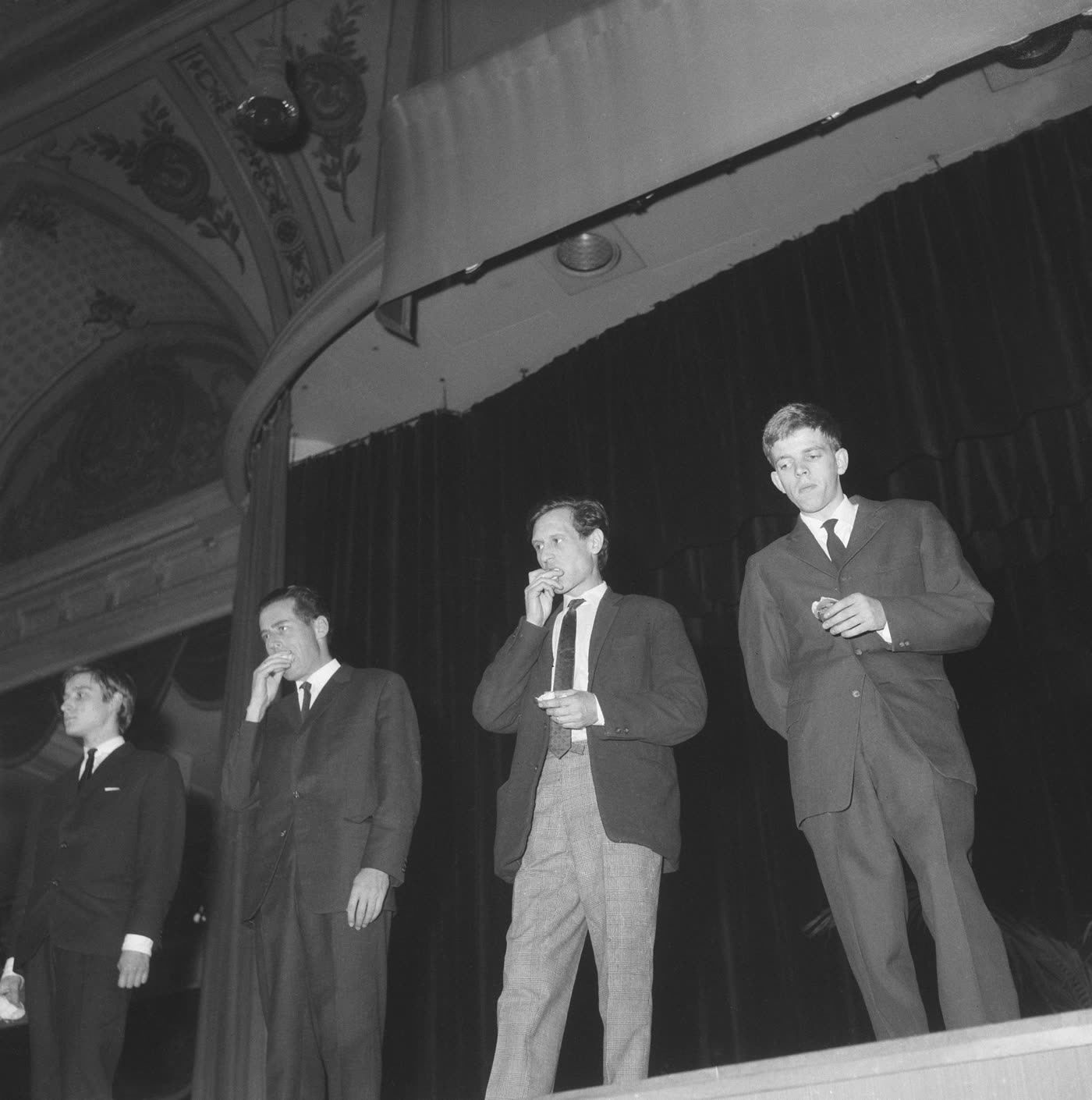
That is why a black-and-white photograph of men eating sandwiches on a stage can carry the movement better than a polished installation shot. The 1964 image used here records a Fluxus manifestation at Kurhaus Scheveningen, identified by Wikimedia Commons from the Dutch National Archives as Concert for submarine sandwiches, photographed by Hugo van Gelderen of ANEFO.[5] Nothing in the image announces grandeur. The performers wear suits. The stage curtain is dark. The action is comically plain. But the plainness is the point. Fluxus did not always ask art to look more spectacular. It often asked whether a small instruction, action, or distribution format could make spectacle unnecessary.
A Movement Without A House Style
The archive for In the Spirit of Fluxus describes Fluxus as an international group of artists, writers, composers, film directors, and actors who made non-conventional, multidisciplinary, often interactive works.[1] That phrase matters because it avoids making the group too tidy. Fluxus was not a school unified by brushwork or one manifesto obeyed by all members. It was closer to a network: George Maciunas gave it a name, a graphic identity, editions, shops, and polemical force, but the work spilled across music, performance, poetry, mail, film, games, boxes, food, instruction cards, and video.[1]
The movement's style therefore sits in its handling of situations. A Fluxus work might be small, funny, cheap, portable, incomplete, or re-performable. It might refuse the heroic scale that Abstract Expressionism had made available to postwar art. It might also refuse the increasingly expensive art object by appearing as a printed card, a box of multiples, or a task anyone could attempt. The question was not "What does Fluxus look like?" The better question was "What does Fluxus permit to count as art?"
The answer changed the viewer's job. In a conventional painting, the viewer arrives after the work is finished. In many Fluxus formats, the viewer or performer completes the work by acting on an instruction, interpreting a score, opening a box, handling a multiple, or simply noticing an everyday situation as framed. That shift is small in material terms and large in authority. It moves art away from a finished object guarded by aura and toward a situation that can be reactivated.
The Event Score Made Brevity Powerful
George Brecht's event scores are one of the cleanest ways to see the movement's method. Getty's account of Drip Music (Drip Event) explains that Brecht began developing text-based performance instructions in 1959 after moving from abstract expressionist painting toward John Cage's experimental composition world.[2] The score became a major Fluxus genre because it could move across disciplines without needing the usual apparatus of painting, theater, or music.[2]
That portability is the breakthrough. An event score is often so brief that it can look like almost nothing. But its brevity is not emptiness. It is a compact machine for producing attention. Getty notes that Drip Music was performed during the first Fluxus concert tour in Europe in 1962 and 1963, and that a convention developed in which a performer poured water from a height into a vessel below.[2] The work could keep changing because the score did not freeze one ideal version. It created a structure loose enough for realization and precise enough to remain identifiable.
This is why Fluxus humor should not be mistaken for triviality. A drip, a sandwich, a chair, a lunch, a small card, or a repeated habit can sound like a joke until the form of the joke is understood. The joke is aimed at the old contract that art must prove itself through difficulty, expense, virtuosity, or monumentality. Fluxus does not abolish difficulty. It relocates difficulty into attention: can you notice the event, accept its modesty, and follow the consequences of calling it art?
The Box Replaced The Monument
Fluxus also changed style through distribution. ZKM's account of Brecht's Water-Yam describes a cardboard box of cards printed with instructions, events, and single thoughts; the cards are not organized by hierarchy, and visitors or performers are free to interpret and realize them in different ways.[3] The object is modest, but the publishing logic is radical. A box of cards can circulate differently from a unique painting. It can be handled, stored, mailed, reissued, performed, and misunderstood in productive ways.
ZKM also notes that boxes and suitcases became important Fluxus formats because they offered alternative means of distribution, and that inexpensive editions and multiples countered high culture.[3]
That is the movement's object lesson. Fluxus did not simply attack the art object from outside. It invented different objects for a different social behavior. A Fluxkit or score box is still material, still designed, still collected, and now often museum-preserved. But its original force comes from refusing to behave like a singular treasure. It is an art object that keeps pointing away from objecthood, toward use.
The paradox is useful. Fluxus wanted art to enter daily life, but many Fluxus artifacts now sit in archives and museum vitrines. The New York Public Library's Fluxus guide makes the archival situation plain by introducing Fluxus materials spread across its collections.[4] That does not defeat the movement. It sharpens the historical question. What happens when works designed for handling, performance, and cheap movement become conservation objects? A good Fluxus display has to hold both truths: the archive preserves the evidence, and the evidence keeps telling us not to confuse preservation with completion.
Everyday Life Was Not A Soft Escape
The strongest Fluxus works make ordinary life harder to dismiss. The 1994-95 In the Spirit of Fluxus exhibition text at Museu Tapies describes the movement as a way of understanding art and life that was critical to performance, video, Minimalism, and Conceptual Art.[1] It also stresses that Fluxus artists did not advocate one particular style; instead, they shared an alternative approach to creation, culture, and life across visual, musical, theatrical, video, and literary forms.[1]
That formulation keeps the movement from becoming a bag of antics. The everyday in Fluxus is not cozy. It is disruptive because it denies the viewer a clean separation between aesthetic attention and ordinary behavior. Eating can become a concert action. A drip can become music. A printed card can become theater. A box can become an exhibition system. A viewer can become a performer without costume, training, or permission.
This was also an institutional critique, though often a playful one. If art can be a short instruction, then the museum is no longer the only place where art happens. If an action can be repeated by different people in different rooms, then authorship becomes less stable. If a multiple can be cheap and portable, then scarcity becomes a choice rather than a destiny. Fluxus did not solve those problems permanently. It made them visible in formats small enough to travel.
Why Fluxus Still Feels Current
Fluxus remains current because so much contemporary culture now behaves like a field of instructions. Recipes, prompts, open scores, participatory performances, social-media challenges, software scripts, museum activations, and mail-art descendants all ask people to complete a form by doing something. Not all of that is Fluxus, and calling every participatory gesture Fluxus would flatten the history. But the movement gave later art a durable permission structure: art can be a rule, a prompt, a distributable format, or a situation activated by use.[2][3]
Its best lesson is not that anything can be art. That slogan is too lazy. Fluxus asks for a stricter thought: under what framing, with what attention, through which action, and in whose hands does an ordinary thing become artistically charged? The answer is never automatic. A sandwich on a plate is lunch. A sandwich eaten on a concert stage under a Fluxus frame can become a test of what an audience expects from performance, taste, discipline, and seriousness.[5]
That is why Fluxus has aged better than many movements built around a single look. A look can become period style. A procedure can keep restarting. Fluxus made art behave like an instruction instead of a monument, and that instruction is still active: do less, notice more, move the work into life, and let the ordinary event answer back.
Sources
- Museu Tapies, "In the Spirit of Fluxus" - exhibition archive on the 1994-95 show, Fluxus's interdisciplinary reach, peak years, artists, and art-life approach.
- Getty Research Institute, "George Brecht: Drip Music (Drip Event) (1959-62), from Water Yam (1963)" - commentary on event scores, Cage's influence, Fluxus performance tours, and open realization.
- ZKM Center for Art and Media Karlsruhe, "Water-Yam" - object page explaining Water-Yam cards, interpretive freedom, boxes as Fluxus distribution formats, and inexpensive multiples as a counter to high culture.
- The New York Public Library, "Fluxus Materials at The New York Public Library" - research guide introducing Fluxus materials across NYPL collections.
- Wikimedia Commons, "File:Fluxus1964.jpg" - archival photograph of the 13 November 1964 Fluxus manifestation at Kurhaus Scheveningen, sourced from Nationaal Archief NL and photographed by Hugo van Gelderen/ANEFO.