
Julie Mehretu's paintings can look, at first contact, like cities seen after too much speed: plans, stadiums, routes, smoke, flags, crowds, and private notations seem to move at once. That first impression is useful, but it is not enough. The paintings do not simply illustrate globalization or urban complexity. They make a viewer feel how a place can be built from systems that never fully settle: architecture, migration, finance, protest, memory, and the painter's own marks pressing against each other.
Art21's Julie Mehretu in "Systems" segment is worth watching because it keeps the studio, the assistants, the research material, and the finished scale in the same frame.[1] The segment belongs to the Art in the Twenty-First Century Season 5 episode Systems, which PBS identifies as a 2009 program about artists inventing grammars, systems, and logics in an information-based society.[2] That framing matters. Mehretu is not presented as an artist who paints cities from above. She is shown building images from below, through accumulated layers, repeated decisions, and a studio process large enough to require collaboration.
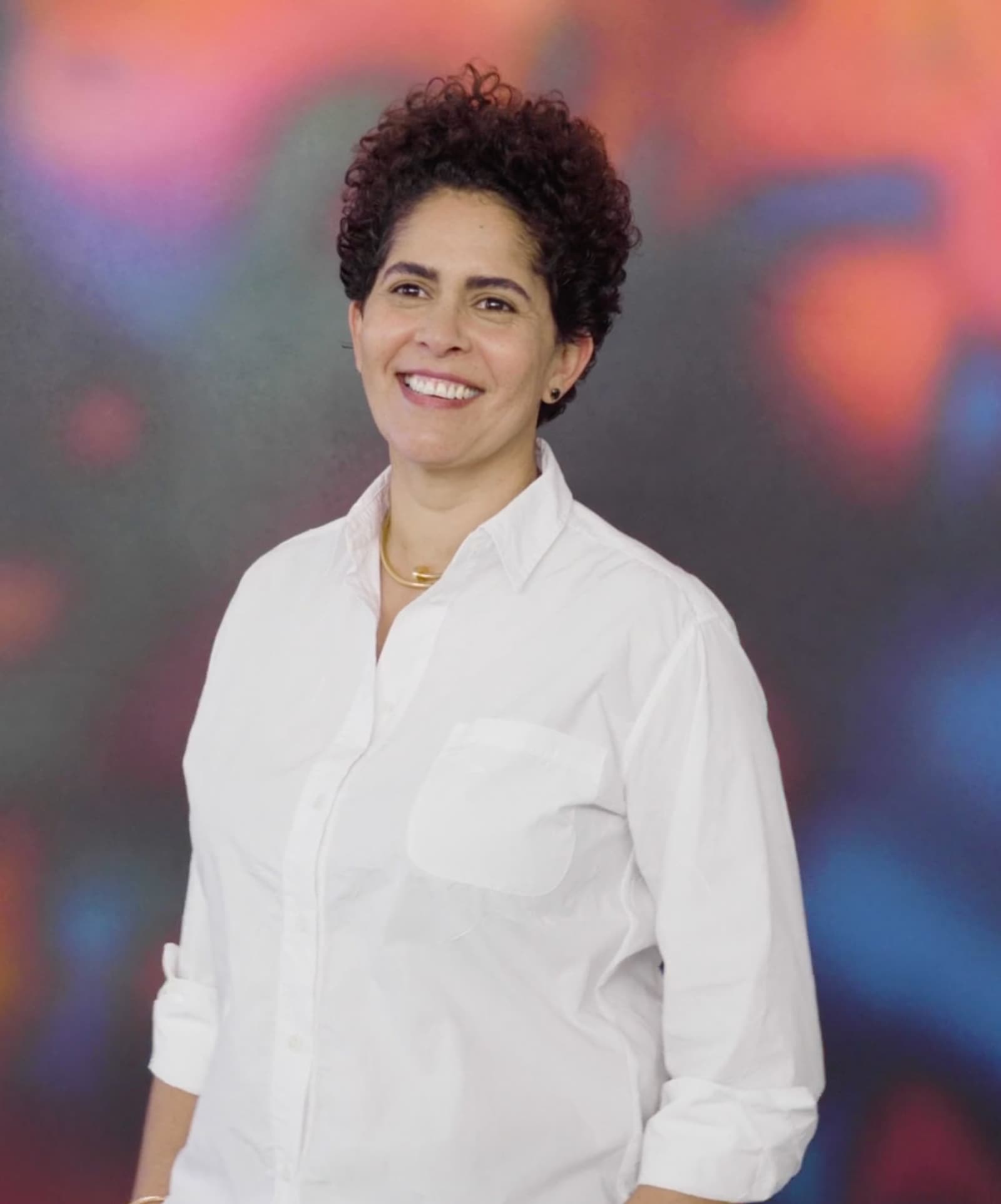
The cover photograph is a Whitney Museum installation view from the 2021 survey.[5] It is a real gallery image, not a diagram, chart, screenshot, or generated abstraction. It fits this post because the article's argument depends on seeing Mehretu's work at architectural scale: paintings filling a room so that the viewer faces a surface behaving less like a window than like a contested field.
Before watching, hold onto one simple distinction. Mehretu's abstraction is not a retreat from history. Whitney's 2021 survey page describes her practice as drawing from art history, architecture, landscapes, and symbols of liberation movements while remaining firmly abstract.[3] Carnegie Museum of Art's collection record for Stadia II anchors the scale and material reality behind that claim: a 2004 ink-and-acrylic painting more than nine feet high and nearly twelve feet wide.[4] The video helps because it lets that kind of large abstract system move back into process.
The studio turns maps into pressure
The most important thing to watch is not any single finished image. It is the way the video treats the studio as a processing space.[1] Mehretu's paintings often begin from built-world references: maps, architectural plans, stadiums, civic interiors, and other systems that organize bodies in space.[2][3][4] But those references do not stay clean. They are traced, buried, interrupted, sealed, and activated by marks that refuse to behave like ordinary cartography.
That is why her maps do not give directions. They produce pressure. A conventional map promises orientation: here is the street, here is the border, here is the route. Mehretu keeps the map's authority in view, then subjects it to congestion. Lines multiply until the viewer can sense planning without enjoying command. The painting becomes a place where modern order and modern overload occupy the same surface.
Around the sections where the Art21 video shows the Berlin studio and the large canvases being worked through, notice the role of assistants and scale.[1][2] The collaborative setup does not make the painting less personal. It makes the painting answerable to its own ambition. If a work is going to hold stadium architecture, financial history, city plans, and hand-drawn velocity, it cannot pretend to be a quick solitary gesture. The studio becomes a temporary construction site where marks are placed, protected, reopened, and tested.
Whitney's survey language is useful here because it refuses to separate Mehretu's formal intelligence from social life. Her art, the museum says, is invested in lived experience and in forces such as migration, capitalism, and climate change.[3] Those are large nouns, and large nouns can flatten art writing. The video corrects that risk by returning us to procedures: canvases, surfaces, projected references, drawing, acrylic layers, and the slow problem of making complexity visible without merely illustrating it.
Scale is not spectacle by itself
Mehretu's large paintings invite the word "monumental," but the video makes clear that scale is not just spectacle.[1] Big paintings can overwhelm a viewer cheaply. Mehretu's scale works differently because it lets several visual speeds coexist. From a distance, a canvas may register as storm, explosion, or architectural field. Up close, it breaks into marks, fragments, small decisions, and buried routes. The viewer has to keep changing distance to understand what kind of image this is.
The Carnegie record for Stadia II is modest as text, but it matters because it fixes the work as a large physical painting rather than an online image.[4] Its arena-like structure suggests collective gathering, but the floating shards of color, flag-like forms, smoke-like marks, and political references keep the scene unstable. It can feel like a stadium, a parliament, a protest zone, a spectacle, or a site after impact. The painting does not choose one interpretation because its subject is the way mass spaces can flip between celebration, nationalism, violence, and collective desire.
That is the argument to carry back into the Art21 segment. When the camera follows Mehretu's large works, do not ask only what the painting represents. Ask what kind of behavior the painting creates in the viewer. It makes looking restless. The eye tries to organize the field, finds a route, loses it, recovers another path, and starts again. That restlessness is not a failure of clarity. It is the content.
The video also lets the viewer see why Mehretu's marks matter as marks, not only as references.[1] A line in her work can feel like a street, a vector, a scratch, a flight path, a crowd trace, or a private notation. It may touch architecture without becoming architecture. It may imply violence without becoming reportage. This ambiguity is not evasive; it is how the paintings keep multiple kinds of history active at once.
Abstraction can carry the crowd without picturing the crowd
One of the best reasons to embed this video is that it pushes against a lazy assumption about political art: that serious public content must be figurative or documentary. Mehretu's paintings show another route. They can hold public life without turning people into easily consumed images. They can register crowds, systems, and conflict through spatial energy, layered reference, and formal compression.[3][4]
This matters because the subjects around her work are often too large for a single scene. Migration is not one face. Capitalism is not one building. Climate change is not one weather event. Political spectacle is not one flag. Mehretu's abstraction works by refusing the false clarity of one emblem. Instead, she builds fields where the viewer experiences relation, collision, and accumulation.
The PBS episode page and transcript place the segment in 2009 and show the Berlin studio work alongside a monumental project whose scale required unusual workspace and a team-based process.[2] That historical placement is not incidental. The late-2000s setting gives the work a particular charge: images of capitalist development, city power, and institutional scale were being made while global finance itself was visibly unstable. The paintings do not become newspaper commentary, but the timing helps explain their intensity.
At the same time, the best way to read the video is not to reduce Mehretu to crisis illustration. The paintings are more durable because they do not depend on one headline. They study the visual grammar of systems: how power looks when it is spatial, how movement feels when it is organized by plans and borders, how public life becomes a storm of signs before it becomes a story.
What to carry away
The Art21 segment is strongest when it makes the painter's problem feel concrete.[1] How do you make an image big enough to hold collective life without turning it into a flattened overview? How do you use maps without letting them promise control? How do you keep abstraction open while still allowing history to press into the surface?
Mehretu's answer is layering, but not layering as decoration. Layering is the argument. It lets earlier marks remain present without staying dominant. It lets architecture become a scaffold rather than a cage. It lets public symbols appear as fragments rather than slogans. It lets the hand intervene in systems that would otherwise look too complete.
That is why the paintings feel like weather systems. Weather is structured but unstable. It has pressure, movement, front, drift, accumulation, and sudden change. A city has those qualities too, especially when seen through migration, capital, spectacle, and unrest. Mehretu's art does not give the viewer a clean map of that city. It gives a more honest experience: the feeling of trying to read a place while the forces that made it are still moving.[1][2][3][4]
Sources
- Art21, "Julie Mehretu in 'Systems' - 'Art in the Twenty-First Century'" - YouTube video embedded in this post.
- PBS, "Art21: Systems, Season 5 Episode 4" - episode page and transcript for the 2009 program featuring Julie Mehretu, John Baldessari, Kimsooja, and Allan McCollum.
- Whitney Museum of American Art, "Julie Mehretu" - 2021 survey page describing the artist's abstract practice, sources, and social concerns.
- Carnegie Museum of Art, "Julie Mehretu, Stadia II" - collection record for the 2004 ink-and-acrylic painting.
- Whitney Museum of American Art, "Julie Mehretu" - exhibition page hosting installation photography from the 2021 survey used as the cover reference.