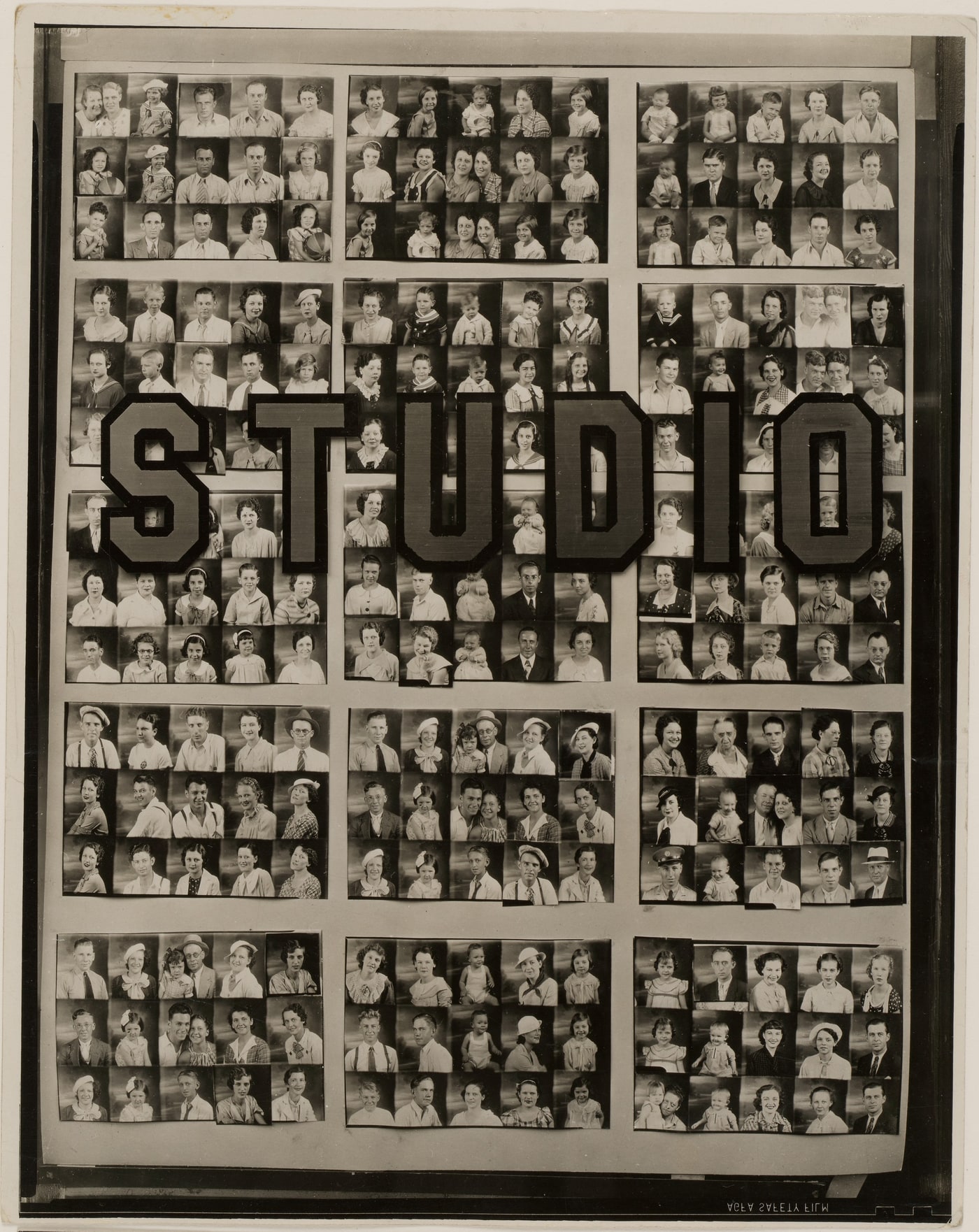
A word gets in the way of the faces. In Walker Evans’s Penny Picture Display, Savannah (1936), the dark-edged capitals of STUDIO spread across ranks of small portraits. They help a passerby recognize the business while making some of its customers harder to see. The advertisement works by showing what a photograph can preserve, then partially covering that evidence with its own name.[1]
Evans did not take the individual portraits. He photographed a display assembled by a local studio operator, whose customers could buy a likeness for a penny.[1][2] That distinction gives the picture its particular tension. We are looking at people who had already been posed, photographed, printed, selected, and arranged before Evans arrived with his camera.
A crowd that never stood together
From a distance, the display has the regularity of a tiled surface. Move closer and that order breaks into collars, hats, bright foreheads, dark jackets, and changes in the angle of a head. The pale strips between groups of portraits give the eye routes through the crowd. Yet there is no central sitter to settle on: a face near the edge receives roughly the same small allotment of space as one near the middle.
MoMA counts fifteen blocks containing fifteen pictures apiece, before allowing for the lettering that conceals some of them. Many sitters recur. The number of portraits therefore exceeds the number of people represented.[1] Repetition can briefly turn looking into a matching game: is that another person, another exposure, or another appearance of a face already encountered?
This is a peculiar kind of group portrait. Its subjects share a display rather than a moment. They did not have to meet, recognize one another, or consent to belonging to the same crowd for the shop window to bring their likenesses together. Their proximity is the work of an arrangement.
That makes the picture’s apparent inclusiveness complicated. A grid can grant everyone similar space, but similar space is not the same as equal attention. The letters cover some images much more heavily than others. A viewer can skim the whole field and register abundance while barely looking at anyone. Read this way, the photograph asks how easily a collection of portraits becomes a surface.
The repairs inside the order
The display was practical workmanship. According to the Metropolitan Museum of Art, the studio photographer fitted fifteen individual portraits onto each large negative. He then covered exposures he considered unsuccessful with more satisfactory pictures cut from other contact sheets.[2]
Those substitutions matter. The orderly advertisement was already edited; it was not a neutral inventory of everyone who had passed through the studio. Its maker wanted to demonstrate a service. A disappointing exposure could be replaced because the display’s job was to persuade the next customer that the photographer could produce a desirable likeness.
Look again at the borders. Near the lower right, a small portrait of a woman projects below the line of its neighbors. The overall grid promises regularity, while individual edges and overlaps disclose assembly. The patches make the operator’s choices part of the visible object. Evans records the people and the labor of making them presentable in public.
Princeton’s collection commentary connects the photograph’s lettering, grid, and collage to the visual devices of modernist art.[3] The connection becomes more interesting when we remember their commercial purpose here. An arrangement can look formally adventurous without having been built for a gallery. The shopkeeper needed examples and a readable sign; Evans recognized a picture in the result.
The word STUDIO is essential to that recognition. It gives the mass of faces a use and a location in everyday exchange. Remove it in imagination and the display might resemble a school roster or a collector’s album. With it, the portraits become promises: this is the sort of image you can obtain inside. Their intimacy is doing sales work.
Another photographer enters the picture
Where, then, does Evans’s authorship begin? It begins with seeing this arrangement as worth photographing, and with a frame that lets it occupy almost the whole image. The surrounding street gives us little help. Attention stays on the relations between the small pictures and the large letters.
Evans also reused the subject. The Met holds a detail printed on postcard stock from a larger negative of the sign. Its account places that print alongside his interest in ordinary picture postcards and a mid-1930s attempt to interest MoMA in postcards made from his photographs of the South.[4] The display could become a photograph, and that photograph could become another small object designed to circulate.
This movement between uses helps explain his resistance to treating “documentary” as a complete definition of his art. In the statement quoted by MoMA, Evans says that art “can adopt that style.”[1] Directness is a choice about appearance. It does not make selection disappear.
The same problem expands in American Photographs, the book published alongside Evans’s 1938 MoMA exhibition. MoMA describes its two-part organization as moving from people and their social settings to cultural artifacts and architecture; connections emerge through recurring forms and subjects.[5] Looking at the Savannah display, we can already feel those categories meeting. The faces belong to people. The display is something people made.
The original portrait photographer’s name is absent from the museum accounts cited here.[2][3] Evans’s is attached to the whole. Remembering that imbalance changes the pleasure of the picture. Its intelligence depends on an earlier intelligence: someone’s economical production, substitutions, spacing, and salesmanship.
Return to one face beside a letter. For a moment, the advertising field becomes a portrait again. Then the neighboring images pull it back into the crowd. Evans keeps both experiences available, leaving us to do the patient work of moving between them.
Sources
- The Museum of Modern Art, “Walker Evans. Penny Picture Display, Savannah. 1936” — collection record, 2019 gallery label, and MoMA Highlights commentary on the display and documentary style.
- The Metropolitan Museum of Art, “Penny Picture Display, Savannah” — accession 1987.1100.482; image source, object metadata, and account of the studio operator’s negatives and replacement portraits.
- Princeton University Art Museum, “Penny Picture Display, Savannah” — collection commentary on the existing arrangement, lettering, grid, and modernist affinities.
- The Metropolitan Museum of Art, “Detail of Penny Picture Display, Savannah” — accession 1996.165.1; postcard-stock print and Evans’s interest in vernacular postcards.
- The Museum of Modern Art, “Walker Evans American Photographs” — 2013–14 exhibition account of the 1938 book and exhibition, their two-part structure, and visual connections.