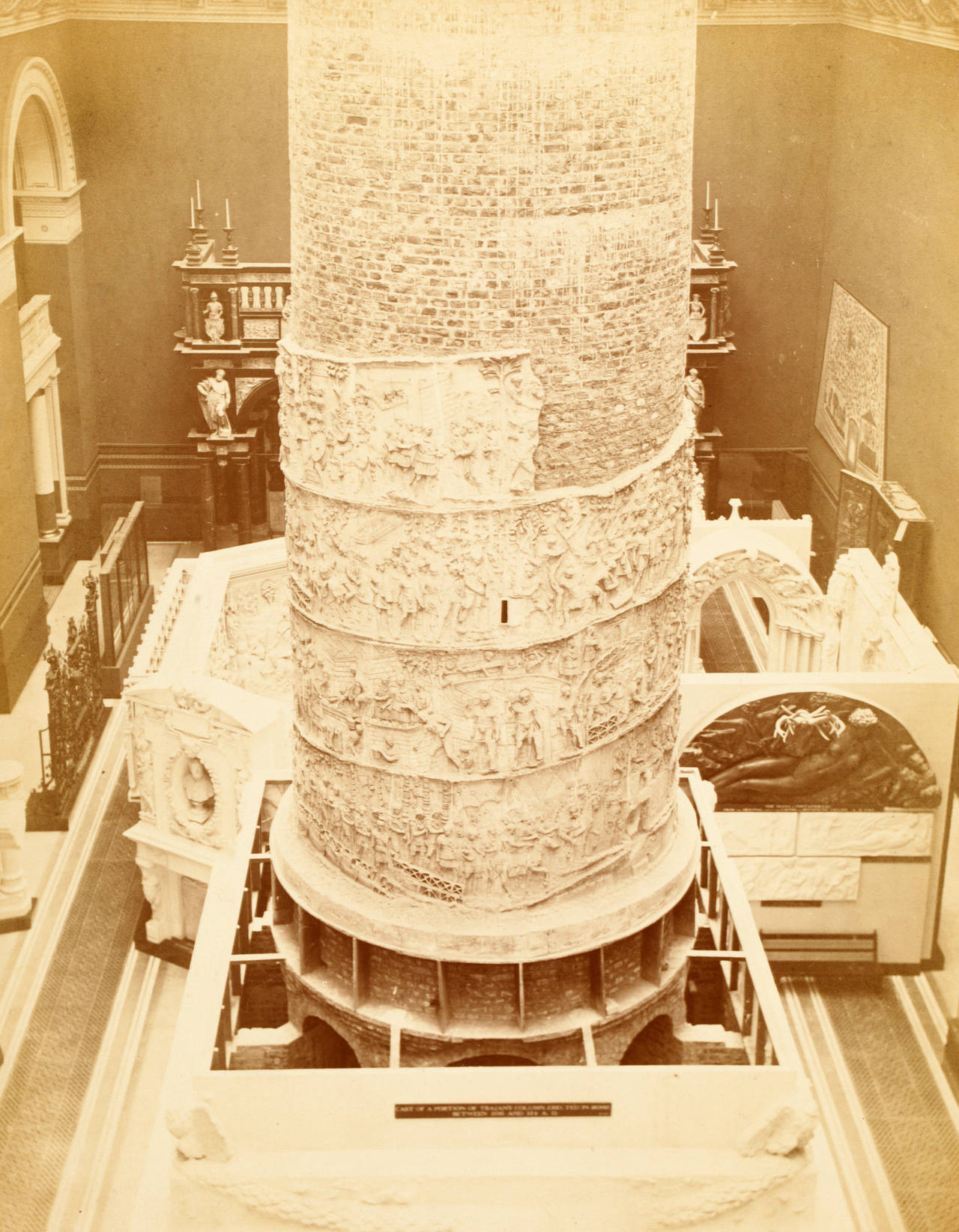
A monument looks different while it is being put together. In Isobel Agnes Cowper's photograph of the installation of Trajan's Column, taken around 1873, bands of pale figures wrap the lower shaft; above them, bare brick takes over. Plaster reliefs are being assembled around this core. Rome's carved history has arrived in London as something that must be fitted into place.[1]
The photograph makes a useful entrance to the Cast Courts. Here, copying becomes visible as work: transferring a surface, supporting it, arranging it, deciding how another audience will encounter it. A reproduction begins by referring elsewhere. Once made, it also starts a life that belongs to this particular object, in this particular room.
The distance a copy removes
When the Cast Courts opened in 1873, they gave visitors who could not travel abroad access to the scale and bodily presence of distant sculpture and architecture. The museum's educational ambitions helped make reproductions central to its early collecting. These were objects to study, including through drawing.[2]
There is a practical difference between knowing that a sculpture is tall and having to lift your head to see its face. Cambridge's Museum of Classical Archaeology makes this point in explaining its own casts: full-size replicas occupy space in ways a photograph cannot. They also let viewers compare works whose originals are scattered among collections.[3]
Such proximity can repair a separation. Cambridge brings the two parts of the Lyons Kore together in cast form, although the originals belong to different museums.[3] The copy supplies an encounter that the surviving original fragments, under their present custodial arrangements, cannot supply in one place.
But relocation also changes the experience. At the V&A, Trajan's Column stands in two sections. A 1928 report to the museum's Advisory Council objected that this arrangement misrepresented the monument and recommended disposing of the cast collection.[2] The objection identifies a real tension even if its proposed remedy now seems drastic. Making something available for study involves choices about what to retain and what to alter. Surface detail, height, setting and sequence do not all travel equally well.
A surface made to resemble another surface
Even the word plaster can give us the wrong picture. It suggests a uniform white population of statues. Conservator Sarah Healey's account of the V&A casts describes surfaces treated to resemble bronze, ivory, stone, wood and gilding. Close examination revealed brush marks, drips and exposed material at worn edges.[4]
Those observations shift attention from the copied design to the person who finished its substitute. A mould can transfer relief; a coating helps tell the eye what kind of substance that relief is meant to be. The finished cast is already an interpretation of appearance.
Healey's 2011 report lists possible historical coatings while describing scientific investigation still under way.[4] Those possibilities are not established recipes for every cast. A brown surface alone cannot identify its binder.
A worn edge makes this double identity tangible: the sculpture whose appearance the cast borrows, and the worked plaster that actually stands before us. Looking closely can make imitation more interesting precisely where it becomes visible.
A copy has a date
The V&A's column involved more than a single transfer. Moulds taken from the Roman monument at Napoleon III's request in 1861 were used to produce copper electrotypes. Those, in turn, supplied the patterns for the museum's plaster casts in 1864.[1] Each stage required another material to carry the form.
That chain complicates the idea of a cast as an uncomplicated window onto antiquity. Cambridge notes that some of its casts preserve restorations added to ancient statues after their rediscovery, including additions subsequently removed from the originals.[5]
A replica can therefore be accurate to a historical condition without representing the object's earliest condition. The distinction matters whenever a cast seems more complete than a sculpture photographed today. Completeness might record an old restoration decision. An apparently intact limb is evidence requiring a history, not automatic proof of an ancient arrangement.
Preservation can work in the other direction too. Cambridge's cast of the Lysikrates Monument retains figures that later erosion erased from the monument itself.[3] In that case, the secondary object carries information the original has lost.
These examples make the date of copying part of what the object means. We need to know when a surface was recorded, what had already happened to it, and what happened afterwards. “Copy” describes a relationship; it cannot, by itself, settle which object is the better witness to a particular detail.
The history inside the column
In 2015, Jorge Otero-Pailos attended to a part of the V&A column that its sculptural likeness normally hides. For The Ethics of Dust: Trajan's Column, he used conservation latex to lift accumulated dirt from the cast's hollow interior. The resulting latex skin was displayed beside the column.[6]
This was material the replica had acquired by existing in the museum. It did not belong to the ancient scene reproduced on the outside. Otero-Pailos made that quiet accumulation available to look at, joining cleaning to an account of time and care.[6]
The work offers a way to understand the Cast Courts without asking their objects to impersonate originals perfectly. Their value includes the encounters they make possible, the earlier surfaces they record, and the evidence of their own manufacture and survival. Those forms of value can coexist with the losses caused by removing a design from its setting.
Return to Cowper's photograph. The unfinished column makes its dependence on construction plain. Once completed, the reliefs would encourage attention to the monument they reproduce. The photograph holds open another view: this copy had to be made, and from that moment onward it had something of its own to preserve.
Sources
- Victoria and Albert Museum, “Trajan's Column: the making of an epic Roman replica” — moulds, electrotypes, plaster casts, brick supports, and Isobel Agnes Cowper's installation photograph.
- Victoria and Albert Museum, “History of the Cast Courts” — the 1873 opening, educational purpose, access to distant works, and the 1928 criticism of the collection.
- University of Cambridge, Museum of Classical Archaeology, “Why Casts?” — scale, comparative viewing, the Lyons Kore, and the Lysikrates Monument.
- Sarah Healey, “Sculpture conservation shines a light on the plaster casts,” V&A Blog, September 21, 2011 — imitation finishes, traces of application, and research into historical coatings.
- University of Cambridge, Museum of Classical Archaeology, “Cast Collection” — casts as records of restorations subsequently removed from original sculptures.
- Victoria and Albert Museum, “The Ethics Of Dust: Trajan's Column by Jorge Otero-Pailos” — the museum's written account of the latex cleaning and installation, April 1–July 19, 2015.