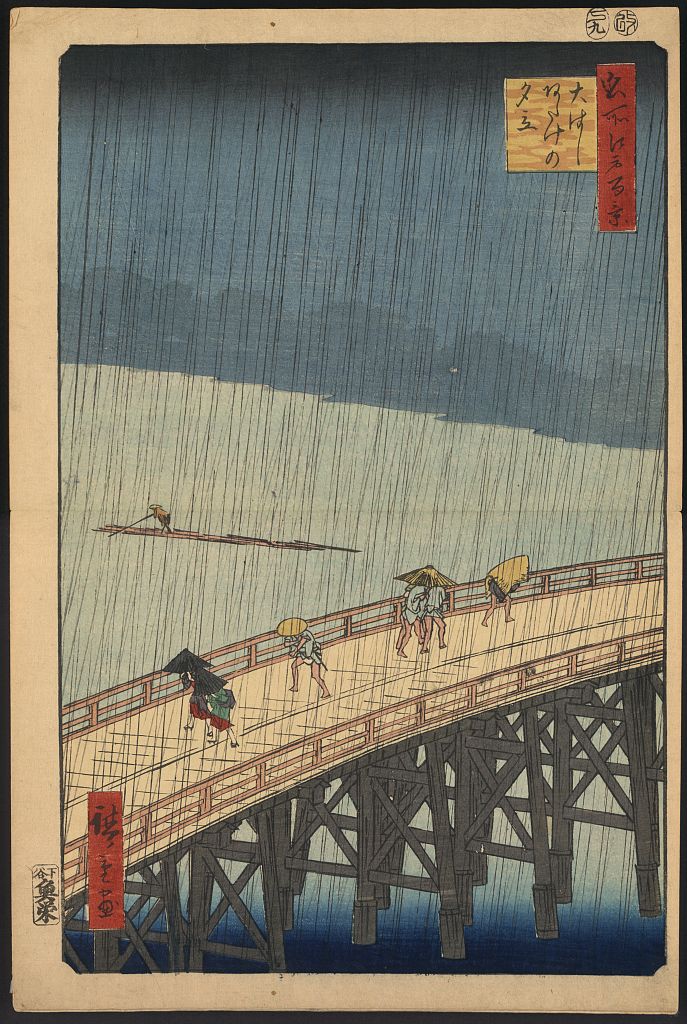
Utagawa Hiroshige's Sudden Shower over Shin-Ohashi Bridge and Atake is often remembered as a beautiful rain picture, but its real force is more exacting. The print does not simply show weather falling on Edo. It makes rain into an instrument that tests the city: the bridge has to carry bodies, the river has to hold distance, the far bank has to remain barely readable, and every pedestrian has to decide how to move through a shared emergency.[1][2]
The Library of Congress record gives the basic structure with useful plainness: the 1857 color woodcut shows pedestrians crossing the great bridge at Atake during a rain storm; it belongs to Meisho Edo hyakkei, or One Hundred Famous Views of Edo.[1] The Metropolitan Museum of Art's collection API adds the material frame: woodblock print, ink and color on paper, oban format, made in the Edo period by Hiroshige.[3] These facts matter because the print's drama is not atmospheric vagueness. It is a technical and social arrangement compressed into a narrow vertical sheet.
The image used here comes from the Library of Congress digital file made from the original print.[1] It is the right image for this close reading because every claim in the essay depends on visible evidence: the repeated black rain strokes, the slanting bridge, the tiny gestures of protection, and the way the riverbank dissolves without vanishing.
The Bridge Becomes A Weather Gauge
The composition begins with a diagonal that feels almost too steep for ordinary crossing. Shin-Ohashi cuts from lower left toward the upper right, lifting the viewer's eye across the Sumida River. Bridges usually promise connection. Hiroshige makes connection strenuous. The bridge is still usable, but the shower has changed its meaning from route to exposure.
Cleveland Museum of Art notes that the print was published two years after the 1855 earthquake and fire and depicts the newly rebuilt Great Bridge over the Sumida River in Edo, now Tokyo.[2] That setting sharpens the image. A bridge recently returned to service appears under a sudden meteorological stress test. The design does not need to show ruins. It shows infrastructure doing its public work while the sky turns against it.
The people on the bridge become a scale for that pressure. Some crouch under umbrellas. One figure bends under a round hat. Another throws cloth over the head. A small group compresses beneath shared cover. Their bodies do not face one heroic direction. They move in opposite directions, caught in separate errands, briefly unified by the same rain.[2] The city is present as traffic, not as architecture alone.
Rain Draws The Print
The rain is the print's most aggressive mark. It is not mist, wash, or background mood. It arrives as long black strokes dragged across the image, cutting over bridge, river, boat, shore, and figures. The storm does not respect pictorial compartments. It crosses every zone and makes the whole sheet answer to one force.
That force depends on woodblock discipline. Rain looks spontaneous in the finished impression, yet each line has been planned, cut, inked, and printed. The tension between sudden weather and deliberate making gives the image its charge. The viewer sees an instant, but the instant has been built through repeatable craft.
The Metropolitan record tags the work with bridges, rain, and umbrellas; those simple tags are also the print's grammar.[3] Bridge gives structure. Rain gives pressure. Umbrellas reveal human adaptation. None of the three is merely decorative. Remove the bridge and the storm loses its public stage. Remove the rain and the bridge becomes an ordinary crossing. Remove the protective gestures and the scene loses its social pulse.
Distance Is Still Working
The far bank at Atake is not erased. It is reduced, darkened, and pushed back behind the rain. That restraint is crucial. Hiroshige does not turn the storm into a blank wall. The viewer can still read a shoreline, a boat, and depth across the river. The city remains legible, but only under strain.
This is why the vertical format matters. The print holds near action and far weather in one compressed field. The lower bridge is close enough to feel bodily; the upper riverbank is distant enough to become memory. Between them, rain stitches the sheet together. A viewer does not look at the storm from outside. The eye has to cross the same diagonal field the pedestrians cross.
Cleveland's description emphasizes Hiroshige's skill in capturing atmospheric conditions, while noting the people trying to protect themselves from sudden sheets of rain and the Atake neighborhood in the distance.[2] The description is concise, yet it points to the print's full mechanism. Atmosphere is not only optical. It changes posture, pace, and the relation between foreground and distance.
The City Appears Under Pressure
Many famous views behave like civic invitations: come here, recognize this place, admire its stability. Hiroshige's famous view is stranger. It lets a known site appear at the moment when recognition becomes difficult. Rain interrupts the postcard function of the view and replaces it with an event.
That event feels public because no one in the print owns the scene. The bridge belongs to everyone who must cross it. The weather belongs to no one. The river holds both connection and separation. The pedestrians are individualized by their gestures, yet none is singled out as the protagonist. The work's intelligence lies in that distributed attention. Edo is not represented by a monument, but by many bodies managing the same changing condition.
This also explains the print's unusually modern afterlife. Van Gogh Museum's record for Bridge in the Rain (after Hiroshige) states that Vincent van Gogh based his 1887 painting on Hiroshige's rain-bridge print, intensifying the colors and preserving the original proportions by leaving a border filled with Japanese characters copied from other prints.[4] Van Gogh did not treat Hiroshige merely as an exotic subject. He treated the composition as a machine strong enough to be rebuilt in oil.
The borrowing clarifies Hiroshige's own achievement. What traveled into Van Gogh's Paris painting was not only the theme of rain. It was a way of organizing sight through pressure: diagonal passage, strong surface marks, a frame that feels both flat and deep, and a scene where weather makes human movement newly visible.[4]
The Suddenness Lasts
The word "sudden" in the translated title can sound like a small narrative detail, but the print makes suddenness structural.[1] Suddenness is the angle of the bridge, the interruption of errands, the conversion of empty air into black strokes, and the way distance becomes harder to read in a few seconds. Hiroshige does not need before-and-after storytelling. The sheet holds the instant when ordinary passage has already changed.
That is why the image remains fresh. It respects the city's everyday mechanics while showing how quickly those mechanics can become visible. A bridge is usually background to intention. In the shower, it becomes the condition of intention. Umbrellas are usually accessories. In the shower, they become signs of improvisation. Rain is usually weather. In Hiroshige's print, it becomes the tool that reveals what public life is made of: crossings, exposure, shared routes, and the fragile skill of continuing.
The close reading therefore returns to the simplest visible fact. Black rain falls across a bridge. Yet those lines do more than describe a storm. They activate the whole city surface. They make the woodblock sheet feel audible, crowded, and briefly unstable. Hiroshige's achievement is to make a famous view depend on the moment it can barely hold still.[1][2][3]
Sources
- Library of Congress Prints & Photographs Online Catalog, "Ohashi atake no yudachi" - record for the 1857 Hiroshige print, translation, summary, series note, rights advisory, and archival image file.
- Cleveland Museum of Art, "Sudden Shower over Shin-Ohashi Bridge and Atake, from One Hundred Famous Views of Edo" - object page with date, artist, medium, measurements, public-domain status, earthquake/rebuilt-bridge context, and description.
- The Metropolitan Museum of Art Collection API, object 55433 - public object metadata for Hiroshige's Sudden Shower over Shin-Ohashi Bridge and Atake, including medium, dimensions, image URL, date, culture, and tags.
- Van Gogh Museum, "Bridge in the Rain (after Hiroshige)" - collection page for Van Gogh's 1887 painting after Hiroshige, with object data and notes on the Japanese woodcut source.