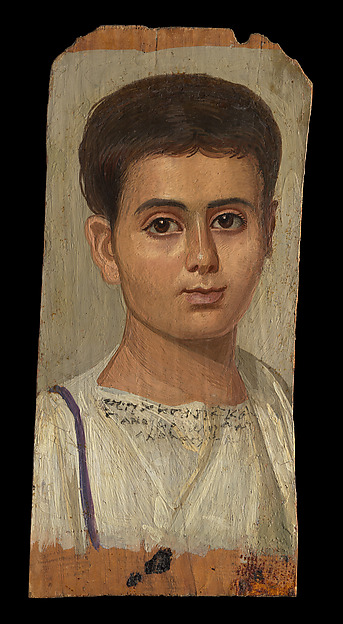
Encaustic is one of those mediums that can sound more archaic than it looks. The recipe itself is simple enough: pigment is suspended in warm wax and applied to a support, often wood, with brushes and other tools.[4] But that plain description hides the thing viewers actually register. Encaustic does not merely color a surface. It leaves paint with body. Each passage seems to settle into place while still retaining the memory of heat.
That is why the medium can connect works that otherwise sit very far apart. In Roman Egypt, mummy portraits used encaustic and tempera to produce some of the most intimate faces in ancient art.[2] In twentieth-century America, Jasper Johns used encaustic to make a flag look less like a symbol floating in pictorial space than a dense object built stroke by stroke.[5] The shared point is not style. It is surface behavior. Wax keeps paint close to the status of matter.
The Met's Portrait of the Boy Eutyches makes a clean entry into that logic. The museum dates the panel to A.D. 100-150, identifies it as encaustic on wood, and places it within the Roman-period funerary portrait tradition in Egypt.[3] Looking at it, the medium does not disappear behind likeness. The face feels deposited rather than dissolved. That distinction matters.
1) Wax changes what a brushstroke is allowed to keep
Oil paint can be luscious, fresco can be absorbent, tempera can be exact, but encaustic has a particular way of preserving decision. Because the binder is warm wax, the mark congeals quickly instead of leveling into a fully even skin.[4][5] Johns's Three Flags is useful here even if the painting belongs to a completely different era and subject. The Whitney describes encaustic there as pigment suspended in warm wax that firms up as each stroke is applied, creating an accumulation of discrete marks and an almost sculptural surface.[5]
That modern description helps explain the ancient work too. In encaustic, a stroke does not want to vanish into a generalized finish. It tends to remain locally legible. The painting can still form an image, but the image never fully escapes its material support. You read face and facture together.
This is where the medium's famous immediacy comes from. Encaustic does not have to be thick to feel solid. Even in relatively small panels, it can make color seem pressed close to the support, as if the paint has weight and contour without needing the large build-up associated with relief.[3][4] The eye reads not only hue but the compactness of the deposit.
2) Roman Egyptian mummy portraits use that compactness to startling effect
The funerary context matters. The Met's Ancient Faces exhibition notes that mummy portraits from Roman Egypt were typically painted between the first and third centuries A.D. and inserted into the wrappings covering the deceased.[2] They are not independent easel paintings in the later modern sense. They are portraits bound to burial practice, and many were executed either in encaustic or in tempera on wood.[2]
That setting changes the force of the medium. These faces had to hold likeness, status, and presence in a narrow format attached to an actual body. Wax was well suited to that task. Getty's APPEAR project, which studies ancient panel paintings with a strong focus on mummy portraits, shows just how materially specific these works are: wood species, beeswax, pigments, gilding, resins, and textile all matter to how the object was made and understood.[1] Encaustic belongs to an object-system, not just to a picture-system.
The result is that a Fayum portrait can feel uncannily near without depending on deep illusionistic space. Eutyches's eyes, hair, and mouth are not suspended in a broad atmospheric environment.[3] They are brought forward by a medium that keeps the face near the panel's plane. The portrait feels intimate because it never stops being materially bounded.
3) The surface stays image-like and thing-like at once
This doubleness is the medium's deepest strength. Getty's audio guide for Mummy Portrait of Isidora describes encaustic plainly as wax and pigment applied with brushes and other tools to wood.[4] That description sounds technical, but it points toward an aesthetic consequence: the painting retains evidence of handling. The surface is not just a transparent delivery system for representation. It remains a worked thing.
That is why encaustic can make even still faces feel active. Light does not disappear into a perfectly matte field, yet the surface is not slick in the way later varnished oil can become. Instead, the viewer meets a shallow, stubborn zone where color, skin, and support stay visibly entangled.[3][4] Looking slows down because the painting keeps asking two questions at once: who is pictured here, and what exactly is this surface doing?
The medium also resists an easy split between illusion and objecthood. The APPEAR project is especially helpful on this point because it treats ancient panel paintings not as generic images but as technical constructions with analyzable layers and materials.[1] Once you see encaustic through that lens, the medium's appeal stops looking mysterious. It is good at preserving the fact that paintings are made things without giving up their ability to carry a face, a symbol, or a presence.
4) Jasper Johns did not revive encaustic for nostalgia
Johns matters here because he proves the medium's long life is not a museum accident. In Three Flags, encaustic is not chosen to make a work look antique. It is chosen because wax can keep each stroke separate enough to call attention to construction.[5] The Whitney's description is precise: the painting becomes sensuous and almost sculptural, and the stacked flags project outward instead of receding in classical perspective.[5]
That outward pressure is the bridge back to Roman Egypt. In both cases, encaustic frustrates the idea that painting should disappear into pure image. With Johns, the flag becomes something the viewer must inspect as structure and surface, not only as emblem.[5] With the mummy portraits, the face remains insistently attached to wood, wax, and funerary function.[1][2][3] The medium keeps saying that a picture is also an object in front of you.
This does not mean the ancient portraits and Johns's paintings mean the same thing. Their cultural stakes are completely different. What carries across is a technical disposition. Encaustic makes painting dense, close, and a little resistant. It asks the viewer to look with the eyes but to register matter almost as if by touch.
5) Why the medium still feels current
A lot of old techniques survive because they are historically important. Encaustic survives because it still solves a live visual problem. It gives painters a way to keep marks present, to keep surfaces tactile, and to prevent an image from becoming too frictionless. In the Roman Egyptian portraits, that meant preserving a face inside an object of burial and remembrance.[1][2] In Johns, it meant slowing down an overfamiliar sign until it became newly visible as paint and structure.[5]
Seen that way, encaustic is not interesting because it is ancient. It is interesting because it never quite lets painting turn into pure optical fiction. Heat enters the making, wax cools into place, and the final surface holds onto that sequence. The medium keeps presence local. It makes you feel that the image has been laid down, not simply projected.
That is why encaustic never looks fully dry. Even when the wax has long since hardened, the surface continues to imply process, pressure, and touch. It keeps the painting close to the condition of a made thing, and that closeness is what makes works like Portrait of the Boy Eutyches feel startlingly alive nearly two millennia after they were painted.[3]
Sources
- Getty, "APPEAR Project" - overview of ancient panel-painting research with medium descriptions for mummy portraits and related works.
- The Metropolitan Museum of Art, "Ancient Faces: Mummy Portraits from Roman Egypt" - exhibition overview on date range, funerary use, and major techniques.
- The Metropolitan Museum of Art, collection entry for Portrait of the Boy Eutyches - object date, medium, and collection record.
- Getty, "Explore Ancient Worlds: Mummy Portrait of Isidora" - object guide describing encaustic as wax and pigment applied to wood with brushes and tools.
- Whitney Museum of American Art, collection entry for Jasper Johns's Three Flags - explanation of encaustic's quick-congealing stroke and sculptural surface effect.