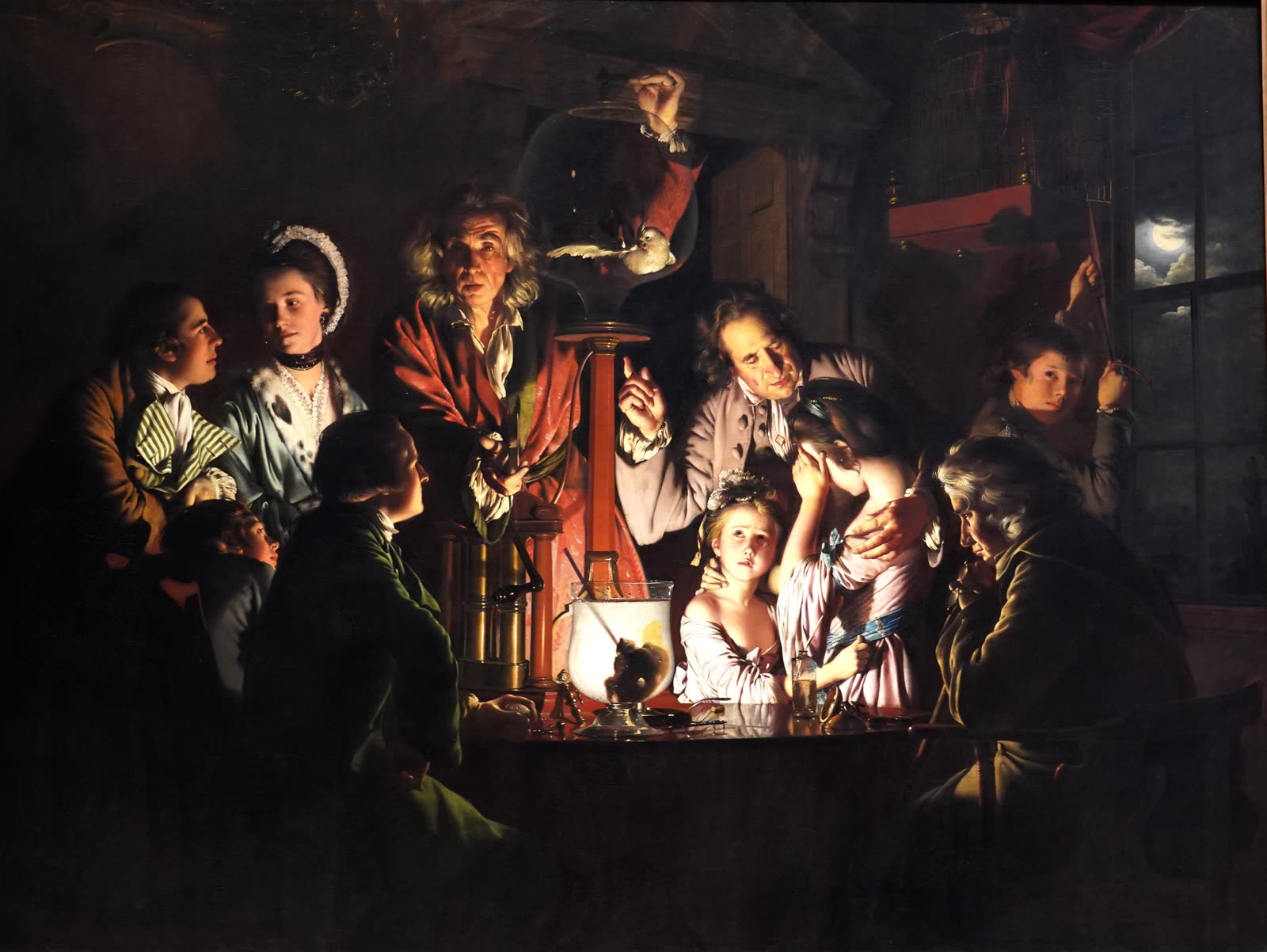
Joseph Wright of Derby’s An Experiment on a Bird in the Air Pump (1768) is often introduced as a great Enlightenment painting, which is true as far as it goes. The National Gallery’s object page gives the basic facts plainly enough: this is a large oil on canvas, 183 x 244.1 cm, showing a natural philosopher demonstrating an air pump with a white cockatoo at the center of the room.[1] But the picture’s real force lies elsewhere. Wright is not satisfied with painting scientific knowledge as triumph. He paints the social weather around knowledge when that knowledge is suddenly felt as pressure on a living thing.
That is why the painting still looks sharper than a generic “science and progress” emblem. The experiment matters, but spectatorship matters more. Ten people gather around the apparatus, and Wright distributes them into a sequence of incompatible responses: curiosity, distress, calculation, distraction, consolation, and thought.[2][3] The room becomes a theater in which science is public, emotional, and morally unfinished all at once.
1) The painting is organized by reactions, not by information
The National Gallery’s 2019 Picture of the Month essay is especially useful here because it describes the group almost as Wright wants us to read it: the two young girls are upset, the man behind them either comforts them or explains the demonstration, the boy opposite leans in, one man times the experiment, another folds his hands in thought, and the young couple remain absorbed in each other.[3] This is not background detail. It is the composition’s real subject.
Wright arranges the audience as a map of possible ways to witness modern knowledge. No single reaction is allowed to dominate. The distressed children do not cancel the absorbed boy. The stopwatch does not cancel the clasped hands. The courting couple do not stop the scene from being serious; they make it more serious by showing that ordinary life continues beside possible death. The painting therefore refuses consensus. It stages a public around one machine and lets that public remain divided.
This is what keeps the work from reading as straightforward propaganda for science. If Wright only wanted admiration, he could have painted unanimous wonder. Instead he paints a room in which attention breaks into different moral speeds.[2][3]
2) The lecturer behaves less like a scientist than a director of suspense
The scholarly National Gallery catalogue makes a crucial point: the experiment itself was not novel by 1768. Wright’s innovation was to make it pictorially commanding and dramatically theatrical.[2] That difference begins with the lecturer. He does not merely operate equipment. He controls pacing.
His hand hovers near the stopcock, and the whole composition is built around the instant before irreversible knowledge arrives. We are not shown a completed result. We are held inside a decision. The painting’s energy therefore comes from timing rather than explanation. Even the man with the watch reinforces that structure: the room is not only seeing, it is counting.[2][3]
That theatricality helps explain the work’s scale. At nearly room size, the painting does not feel like an illustration clipped from a scientific manual.[1] It feels like a staged event large enough to involve the viewer physically. Wright pushes the demonstration out of specialist space and into shared civic-emotional space. Science becomes spectacle, but spectacle here is not empty decoration. It is the form through which ethical pressure becomes visible.
3) The hidden candle and the skull keep mortality inside the light
Wright’s most unsettling move is that the light source is also an argument. In the National Gallery catalogue, the candle is described as the painting’s only source of light, but it is partially concealed by a glass vessel in which a human skull can be made out.[2] The same essay explains the iconographic pairing cleanly: candle and skull traditionally belong together as reminders that time consumes life and ends in death.[2] The 2019 National Gallery essay reads the skull in related terms, as a memento mori placed inside the experiment’s visual logic.[3]
That matters because the painting does not place mortality in a corner as a separate symbol. Mortality is folded into visibility itself. The faces around the table glow because death sits inside the mechanism of illumination. In formal terms, Wright makes the scene legible by hiding its most troubling content inside the very thing that allows us to see.
The glimpse of the full moon above the clouds pushes the point further.[2][3] The room is both domestic and cosmic, intimate and exposed. Candlelight gives the scene warmth, but the moon keeps a colder scale available in the background. The result is not merely “dramatic lighting.” It is a layered time system: the ticking experiment, the burning candle, the skull’s long horizon, and the moonlit night outside.
4) Suspense, not cruelty, is the painting’s real medium
The catalogue’s best observation may be its simplest. A boy by the window holds the cords of a birdcage, waiting for his cue: will he lower the cage because the cockatoo will be revived, or pull it away because the bird is dead?[2] Wright leaves the answer unresolved. That suspended outcome is the painting’s core device.
Because of that suspension, the painting does not reduce to an anti-science warning, and it does not settle into a celebration of rational mastery either. It is a picture of ethical spectatorship under pressure. The children in the National Gallery’s 2019 reading are especially important on this point. The essay argues that they belong to the generation that will inherit the new world made by Enlightenment science and industrial change, and must decide where they stand within it.[3] Wright’s room therefore doubles as a historical proposition. Modernity will not arrive to one emotional register. It will arrive as argument.
This is why the painting still feels alive. It understands that progress is never experienced in the abstract. It is experienced by particular bodies, in particular rooms, through fear, fascination, boredom, flirtation, compassion, and technical curiosity at the same time.[2][3]
5) Wright turns candlelight into a public test
Derby Museums describes Wright as a “painter of light” and as an artist deeply associated with the Enlightenment.[4] That reputation is deserved, but Air Pump shows what the phrase really means at full stretch. Light is not just an atmospheric effect. It is the medium through which Wright tests a society’s capacity to look at what it is doing.
The painting’s greatness lies there. It does not offer one stable moral instruction. It offers a room in which knowledge, feeling, and mortality have all become visible at once. The air pump is the pretext. The real subject is what a public becomes when the demonstration on the table can no longer be separated from the life inside the glass.[1][2]
Sources
- The National Gallery, “Joseph Wright of Derby: An Experiment on a Bird in the Air Pump” - object page with dimensions, medium, and overview.
- The National Gallery, “An Experiment on a Bird in the Air Pump” in The British Paintings catalogue - scholarly entry on iconography, suspense, and theatrical structure.
- The National Gallery, “Picture of the Month August 2019: An Experiment on a Bird in the Air Pump” - interpretation of the audience reactions, skull motif, and ethical stakes.
- Derby Museums, “Joseph Wright of Derby” - collection context on Wright as a painter of light and major Enlightenment artist.