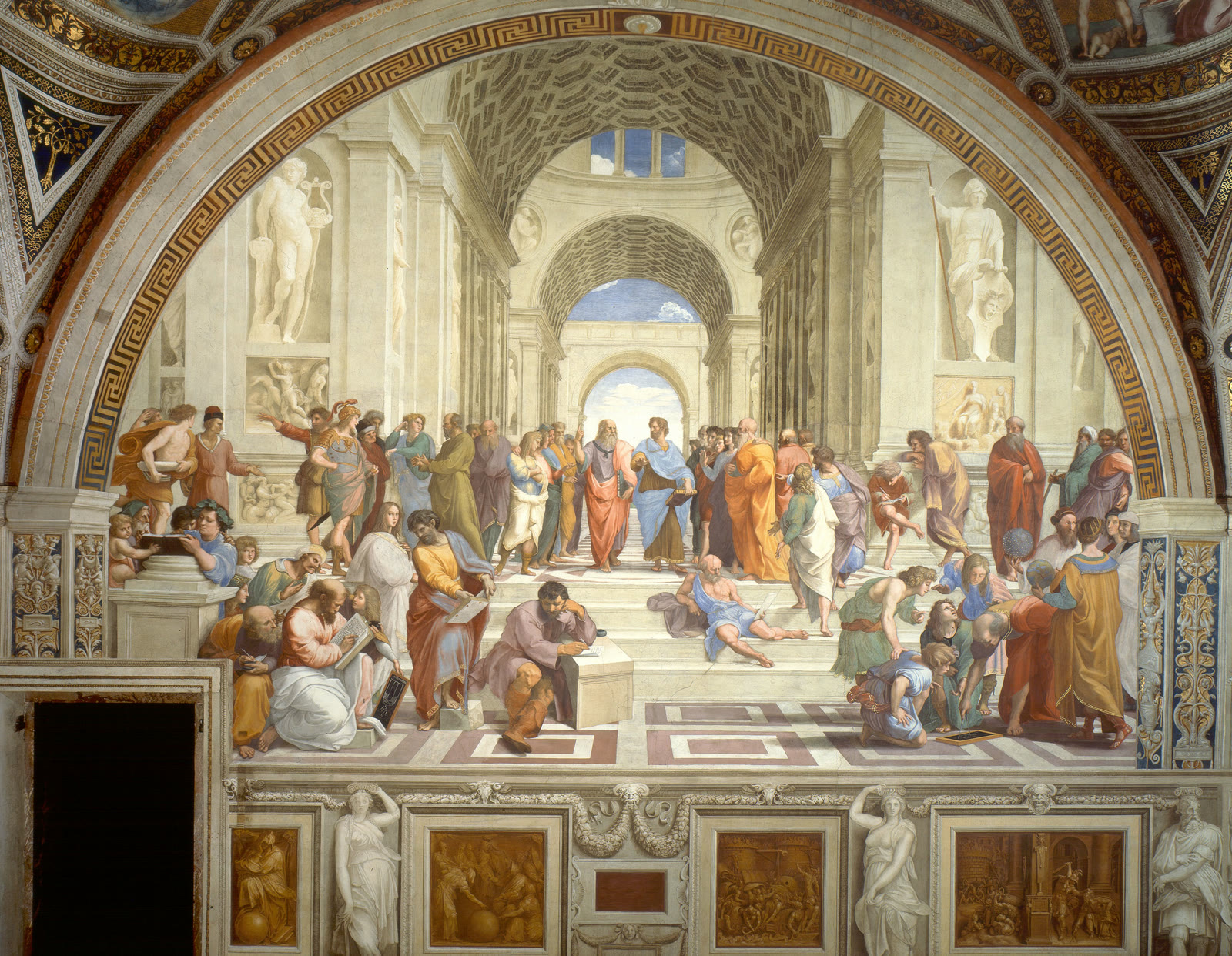
Raphael’s School of Athens is one of those works that can become less legible the more famous it gets. It is often remembered as a grand reunion of philosophers, a High Renaissance crowd scene in which Plato, Aristotle, Socrates, Pythagoras, Euclid, and others appear under one ideal architecture.[1][3] That summary is correct, but it flattens the painting’s real achievement. The fresco does not work because it assembles great names. It works because Raphael builds thought into space.
The factual frame matters. School of Athens was painted between 1509 and 1511 in the Stanza della Segnatura, one of the Raphael Rooms in the Vatican, where the wall program distributes major domains of knowledge across the room.[1][3][5] In that system, this fresco represents philosophy. But Raphael refuses the static dignity that could have made the subject merely commemorative. He gives philosophy a stage on which bodies move, turn, interrupt, teach, doubt, and separate.
That is why the painting still feels so available to modern viewers. It does not ask you to admire learning from a respectful distance. It places you at the foot of an argument and makes the whole room read as a sequence of positions.
The first move is architectural: Raphael opens the foreground instead of sealing it
The most important part of the fresco may be the space that is not filled. Before the eye settles on any individual philosopher, it meets the broad stair and the open center foreground.[1][3] Raphael does not crowd the lower edge with decorative obstruction. He leaves a threshold. That decision matters because it turns looking into entry. The viewer is not pressed against a wall of authority; the viewer is invited into a navigable field.
From there, the architecture takes over as a machine for thinking. The barrel vaults, coffers, and receding arches pull the eye inward with unusual calm, while the central vanishing structure stabilizes what could otherwise feel like a ceremonial crowd.[1][4] This is not architecture as backdrop. It is architecture as grammar. The room teaches you how to read before any philosopher does.
That is part of Raphael’s brilliance. He stages the authority of antiquity without making it inert. The architecture is monumental, but the open stair keeps monumentality from becoming distance. The fresco feels elevated and accessible at the same time.
Plato and Aristotle matter because they divide the whole picture’s logic
Most viewers begin with the central pair, and Raphael clearly wants that. Plato and Aristotle occupy the axis of the composition, each with a book, each walking forward, and each turning the body into a proposition.[1][3] Plato gestures upward; Aristotle extends his hand horizontally outward. Even before one identifies the figures by name, the contrast is readable as a split between ascent and immanence, ideal order and worldly inquiry.[1][3][4]
What matters in close reading terms is that Raphael does not isolate that contrast in a neat emblem. He lets it radiate through the whole fresco. Plato’s vertical emphasis gives the upper architecture and the lifted vaults a metaphysical charge. Aristotle’s grounding gesture pulls attention back toward the human plane, the steps, the bodies, and the practical work of thought among others. The painting’s balance comes from the fact that neither claim is allowed to win outright.
This is why the fresco feels more alive than a symbolic chart. Raphael gives philosophy not a conclusion but a productive split. The center holds because it is divided.
The side groups keep the painting from collapsing into hero worship
Once the eye leaves the center, the fresco becomes even stronger. Socrates counts off points with his fingers as if thought were a public exercise in argument rather than a private glow of wisdom.[1][3] Pythagoras bends to write, surrounded by readers who look over his shoulder. At the right, Euclid or Archimedes stoops with compass in hand, turning geometry into a demonstration performed in front of students.[1][2][3]
Those clusters are crucial because they convert philosophy into social motion. Raphael does not paint isolated geniuses in self-sufficient poses. He paints explanation, persuasion, copying, listening, and disagreement. A viewer’s eye keeps moving because the fresco is full of local pedagogies: one figure points, another records, another turns away, another leans in. Thought here is always relational.
The Ambrosiana’s survival of Raphael’s large preparatory cartoon for the lower right section sharpens this point.[2] It reminds us that the apparent ease of the fresco was carefully built through prior design. The right-hand mathematicians and observers are not incidental filler. They are structural evidence that the painting depends on exchange, not only on iconic centrality.
The famous likenesses matter because Raphael turns philosophy into a present-tense culture
One reason the fresco keeps getting introduced through anecdote is that Raphael folded modern faces into the ancient assembly. The Vatican’s room guide notes the long-standing identification of Plato with Leonardo da Vinci, the brooding Heraclitus with Michelangelo, and the artist himself at the far right edge of the scene.[1] These identifications are more than Renaissance name-dropping. They collapse temporal distance.
Raphael is not pretending to reconstruct a historically accurate Athenian gathering. He is making a claim about cultural continuity. Ancient philosophy becomes newly current by passing through Renaissance artistic intelligence. The painting says, in effect, that the life of ideas survives by being reembodied in new makers, new bodies, and new visual languages.[1][3][4]
That is also why Raphael includes himself. The self-portrait is small, but its function is large. It places the painter inside the republic of knowledge he is depicting. Art is not outside philosophy here, and painting is not a decorative servant to theory. The fresco quietly argues that image-making is one of the ways civilization thinks.
Why the fresco still feels modern
The masterpiece label can make School of Athens sound solved. In practice, it remains fresh because Raphael understood that ideas become compelling only when they are given bodies, spacing, and tempo. He lets a philosophical program become a crowd with rhythm. He lets architecture guide thought without imprisoning it. He lets the central opposition between Plato and Aristotle hold the room together while every side cluster complicates it.[1][3][4]
Seen this way, the fresco is not a museum wall of famous men. It is a designed environment for intellectual traffic. Its lasting power comes from how precisely it stages the movement between contemplation and conversation, authority and access, hierarchy and circulation. The room is built like an argument, and that is why it still pulls viewers in more than five centuries later.[1][5]
60-second viewing drill
Try this sequence in front of the image:
- Start with the open stair and center foreground, not the famous faces. Notice how Raphael makes entry feel possible before identification begins.
- Move to Plato and Aristotle and read only their gestures for a moment. The whole fresco’s internal tension is already there.
- Sweep left and right for teaching scenes, notebooks, compasses, and side conversations. The painting deepens when it stops looking like a lineup and starts looking like circulation.
Sources
- Vatican Museums, "Room of the Segnatura" - official room guide covering the fresco program, central figures, and modern likeness identifications.
- Veneranda Biblioteca Ambrosiana, "The School of Athens" - page on Raphael's preparatory cartoon for the lower-right section of the fresco.
- Encyclopaedia Britannica, "School of Athens" - overview of date, setting, subject, and major figure identifications.
- University of Notre Dame Rome, Christian Classicism and Raphael's School of Athens - interpretive PDF on the fresco's philosophical and spatial program.
- Wikimedia Commons, file page for "The School of Athens" by Raffaello Sanzio da Urbino - image record with dimensions and source metadata.