
Albrecht Durer's Saint Jerome can look at first like a painting about concentration without surprise. The saint kneels before a crucifix in a patch of carefully observed wilderness. Flowers, grasses, a lion, a stream, and two little goldfinches all help stabilize the mood.[2] The image rewards slow looking, and the National Gallery's short video begins from that stillness on purpose.[1][3] But the best thing about the film is that it refuses to leave the picture there.
What makes this panel so strong is not only the front. It is the fact that the work is painted on both sides and was most likely made for private worship as a portable object that could be turned in the owner's hands.[2] That physical fact changes the meaning of everything on the front. Jerome's penitence is no longer a self-contained devotional scene. It becomes one side of a two-sided encounter in which quiet concentration can flip, literally, into cosmic threat.[2][3]
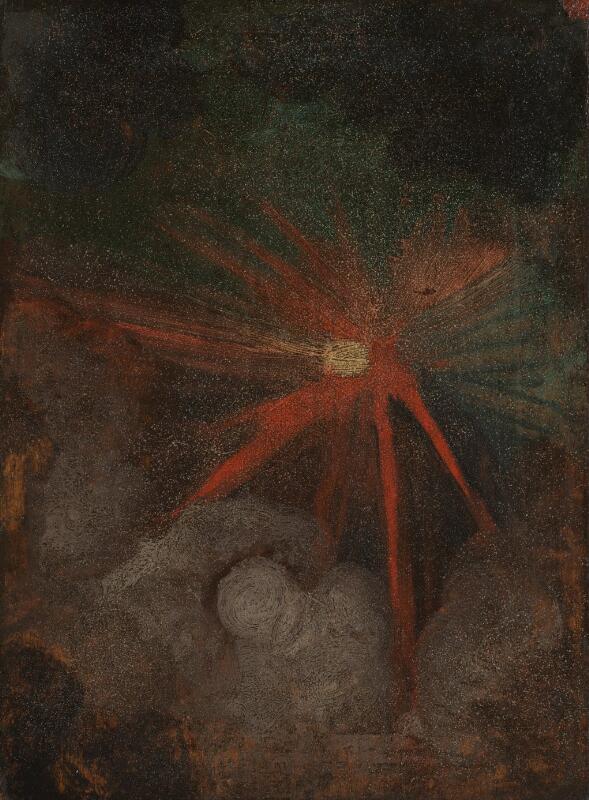
The National Gallery's story page gives the right cue before the video even starts. Art historian Sian Walters describes the painting as contemplative but unexpectedly explosive.[1][4] That is exactly the right balance. Durer does not shock the viewer by interrupting the front image from within. He places the shock on the reverse, where a dark sky erupts with a red streaming form and a yellow burst that the museum catalog describes as possibly a comet, meteorite, or eclipse.[2][3] The panel is devotional on one side and apocalyptic on the other.
Image context: the cover uses the reverse itself rather than a gallery shot, diagram, or generic Durer portrait. That choice matters because the article's claim is not simply that the painting has a hidden back. The stronger point is that the back completes the front. The object was designed to be handled as a sequence of visual states rather than as a single fixed image.[2][3]
The opening minutes matter because they make the front look more intimate before they make it stranger
In its first movement, the video does what a good museum close reading should do: it lets the front panel earn its calm.[1] Walters lingers over the saint's rocky kneeling place, the minute plant life, the lion, and the general feeling that this is a portable world of disciplined attention rather than a grand public altarpiece.[1][2] The National Gallery object page reinforces that reading. Jerome beats his chest with a stone in sympathy with Christ's Passion, while the goldfinch near the stream operates as a traditional sign of that same Passion.[2]
Those details are not decorative extras. They teach the viewer how the painting works in the hand. The panel is small, and its intimacy belongs to scale as much as to subject.[2] A large altarpiece can overwhelm through size or ceremony. This object persuades through nearness. You can imagine the owner bringing it close, following the saint's body, then dropping down to the grasses and the drinking bird, then back up again to the crucifix lodged in the tree stump.[2] The video is strongest when it treats that nearness as part of the picture's meaning rather than as a mere fact of dimensions.[1]
Once the panel turns, the whole front changes retroactively
The turning point in the video is simple and physical: the painting is reversed.[1] That gesture does not add a second illustration; it redefines the first. On the back, the National Gallery identifies a dark sky with a blazing celestial event, perhaps a comet, perhaps a meteorite, perhaps an eclipse, and links it to traditions around Jerome as a hearer of the trumpets of the Last Judgment.[2] The longer catalogue entry pushes this further by describing broad wet-in-wet brushwork and spattered paint on the reverse, techniques that create a sudden sensation of force quite unlike the front's controlled descriptive calm.[3]
This is the key reason the video deserves an annotated viewing. It is not simply teaching iconography. It is teaching object logic. Front and back are painted in different emotional registers because they ask for different kinds of attention. The front is meticulous, inhabited, and penitential. The reverse is abrupt, atmospheric, and unstable.[2][3] One side slows the body into prayer. The other places prayer under the sign of cosmic reckoning.
Around the middle of the video, Walters also stresses how unusual the reverse is in emotional temperature.[1] That observation matters because many viewers are used to treating reverses as secondary. Here the back is not a leftover field for workshop shorthand. It is conceptually sharp. If the front stages Jerome in meditative identification with Christ's suffering, the reverse refuses to let that meditation stay private or merely sentimental. It opens the little panel onto eschatological scale.[2][3]
The reverse matters because it keeps Durer from becoming only a master of detail
Durer's reputation is often compressed into virtuoso observation: fur, foliage, feathers, texture, and line. The front of Saint Jerome can easily confirm that reputation. The reverse complicates it.[2][3] The celestial image is fast, broad, and ambiguous. Instead of descriptive abundance, it gives the viewer a compressed event whose meaning has to be held in suspension. The result is that the whole object moves between two kinds of vision. On the front, you look closely because the world has been minutely made. On the back, you look closely because the world has become hard to name.
The National Gallery catalogue makes that distinction vivid by noting the difference in handling between front and reverse, and by linking the back to Durer's larger fascination with end-time visual drama in the years around his Apocalypse series.[3] That does not mean the panel is secretly a miniature preview for a print cycle. It means the reverse belongs to the same imaginative pressure. Durer is not only a painter of exact visible things. He is also a painter of unstable skies, omens, and last-things tension.[3]
This is why the object feels more modern after the turn. The back does not resolve the front; it makes it less secure. Jerome's wilderness no longer reads as timeless refuge. It becomes a temporary zone of concentration held against a universe capable of interruption.[2][3] Private devotion gains force precisely because it is not sealed off from catastrophe.
What the video finally teaches
The National Gallery's film is only a few minutes long, but it does something substantial.[1] It returns the viewer to a basic but often neglected truth: paintings are not only images, they are objects with use, movement, and sequence. Saint Jerome is not one scene plus an odd surprise on the back. It is a deliberately double-sided devotional machine. The owner was meant to handle it, turn it, and hold together two kinds of time: the daily labor of penitence and the vast, unpredictable horizon of judgment.[2][3]
That is why the reverse should not be treated as a curiosity. It is the reason the front becomes deeper than pious serenity. Durer builds a small work that moves from chest-beating repentance to celestial alarm without changing scale, only orientation.[1][2] Once the video makes that visible, the painting stops being simply a masterpiece of detail and starts looking like a portable drama of how contemplation lives under pressure.
Sources
- National Gallery, "What is hidden on the back of this painting?", YouTube video.
- National Gallery, "Albrecht Durer | Saint Jerome | NG6563" - official object page on the painting's double-sided portable format, front-side iconography, and celestial reverse.
- National Gallery, "Saint Jerome" from The German Paintings before 1800 - scholarly catalogue entry on technique, reverse imagery, and the relation between the panel's two sides.
- National Gallery, "What is hidden on the back of this painting?" - museum story page introducing the video and framing the work as contemplative on the front and explosive on the reverse.