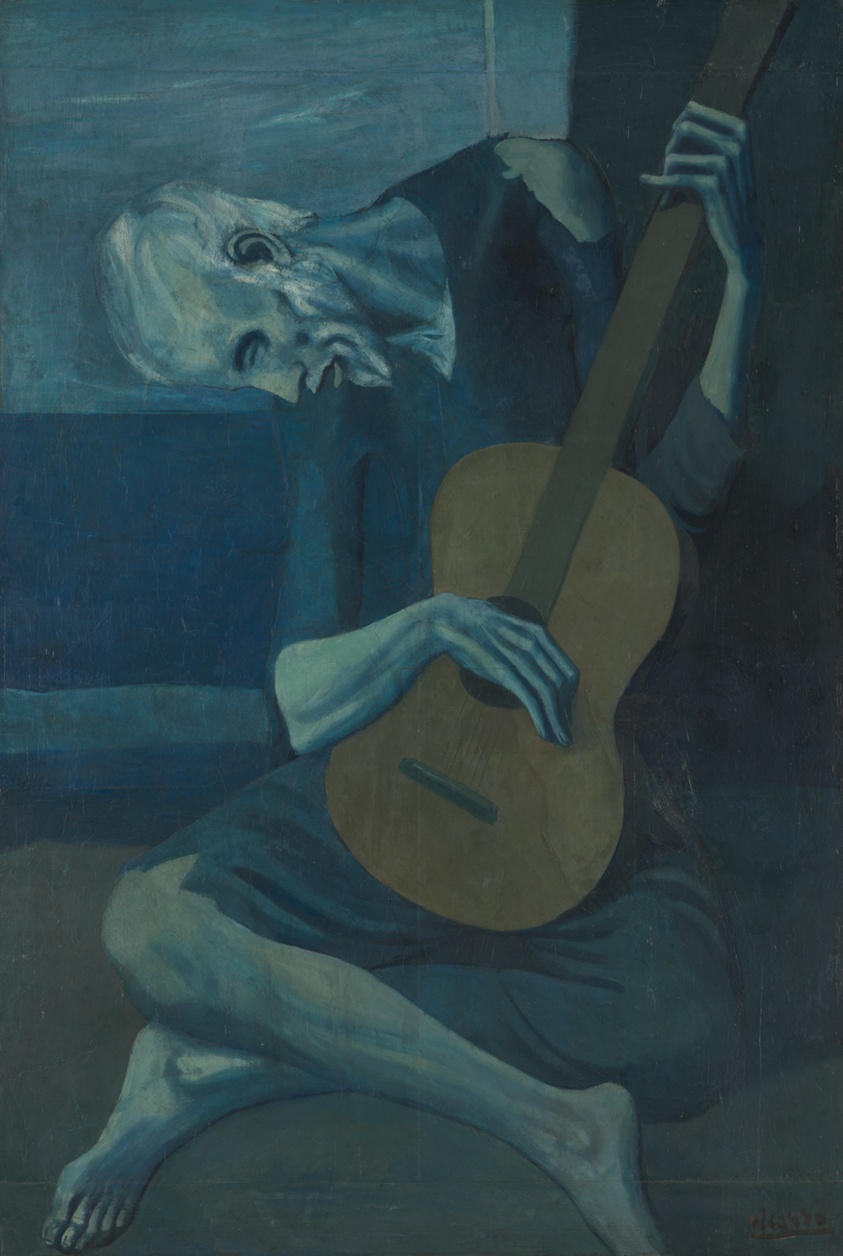
Picasso's The Old Guitarist is often introduced as one of the great Blue Period images of poverty, grief, and social isolation, and the Art Institute's own framing supports that first impression.[1][2] The painting certainly earns it. A blind musician folds himself over a guitar inside a narrow, stripped-down space. The body is elongated, the limbs are gaunt, the room gives almost nothing back. But the picture stays memorable for a more exact reason than sadness by itself. It is built around one stubborn resistance: nearly everything is allowed to sink into blue except the guitar.
That formal split changes the whole emotional logic of the work. If the figure, floor, and air all share the same cold tonal family, then the brown instrument does not function as a prop.[1] It functions as the last compact object in a world otherwise close to dissolution. The painting does not merely show a poor musician with his tool. It organizes vision so that sound, labor, and bodily purpose survive in the one warm shape still able to hold together.
Image context: the lead image uses the full Art Institute reproduction because this reading depends on the relation among the musician's bent spine, the blue-gray ground, and the guitar's warm central mass. A crop would weaken the argument by shrinking the field that threatens to absorb him.[1][2]
The guitar matters because it is the only thing that keeps weight
The Art Institute describes the painting as overwhelmingly blue, with the instrument standing out in a contrasting brown.[1] That is the first structural fact a viewer has to honor. Picasso does not spread warm color across the room to soften the mood. He concentrates it. The guitar lands in the picture like a reserve of matter. It is heavier than the man's arms, clearer than the folds of his clothing, and more stable than the seat or floor beneath him.
That concentration has a double effect. On one level, it directs the eye immediately to the center of the composition. On another, it makes the instrument feel like the last surviving engine of purpose. The musician's body is bent almost into enclosure around it, as though the guitar were not simply being played but physically protected. The painting's grief therefore never becomes fully inert. The old man is exhausted, but the image still contains a task.
This is where The Old Guitarist becomes stronger than a generic symbol of misery. A purely illustrative painting of destitution could have made every surface equally deadened.[1][2] Picasso does the opposite. He gives the one object tied to craft and sound the greatest visual density. The guitar is not a sentimental accessory. It is the reason the body has not yet vanished into atmosphere.
The bent body turns suffering into structure rather than anecdote
The figure's pose is just as important as the color split. The old man does not sit upright and perform for a viewer. He folds inward. Head, shoulders, knees, and instrument lock into a compressed oval that makes the body look both fragile and tensile at once. The Art Institute notes the painting's links to El Greco in the elongated proportions, and that comparison helps because it clarifies that distortion here is not clumsiness.[1] Picasso is stretching the body on purpose so that spiritual and physical strain become one shape.
Blindness deepens that inwardness. The closed eyes remove any exchange with the outside world.[1] There is no social scene, no audience, no room full of witnesses. The painting does not ask us to read the musician through facial theater. It asks us to read him through compression: the neck bent down, the hand wrapped to the fretboard, the legs pulled tightly under the instrument. The whole person curves around the one object still capable of carrying action.
That is why the image feels private without feeling restful. The figure is sealed off, but not at peace. Every line in the body suggests endurance under pressure. Even the seat seems less like furniture than like a temporary brace. Picasso converts a scene of hardship into a formal system of bends, angles, and guarded contact.[1][2]
Blue is not just mood here; it is a way of thinning the world
The Blue Period is often summarized biographically, especially through the death of Picasso's friend Carlos Casagemas and the artist's early years of hardship.[2][3] Those facts matter, and the Art Institute's broader Picasso essay places The Old Guitarist directly inside that climate of mourning, alienation, and social marginality.[2][3] But the painting lasts because biography has been translated into pictorial pressure. Blue here is not just a melancholy label. It is a method of subtraction.
Look at how little resistance the surrounding space offers. The floor barely separates itself from the wall. The drapery of the clothes has volume, but that volume is repeatedly thinned by the surrounding tonal field. The body is present and at risk of dematerializing at the same time. Picasso uses monochrome not simply to unify the image, but to make the world feel poor in usable difference.[1][2]
That is also why the warm guitar matters so much. Once the room has been thinned to this degree, any retained color becomes a declaration. The instrument says that some remnant of making still persists inside deprivation. The old man may be socially abandoned, but the painting refuses to let him become featureless. His relation to the guitar still generates form.
Why the painting still holds
The Art Institute's Picasso and Chicago exhibition page reminds readers that The Old Guitarist was the first Picasso painting to enter an American museum collection, arriving in Chicago in 1926.[4] That institutional fact matters because it helps explain the work's afterlife. The painting became canonical early. Yet its force is not exhausted by fame or by Blue Period mythology. It keeps holding because its design remains severe and legible.
Picasso has built a picture in which one human being nearly collapses into the same tonal weather as the room, while one worked wooden instrument keeps declaring use, sound, and concentrated attention.[1][2] The old man is frail, but the painting is not vague. It is exact about what deprivation threatens to erase and what art, however temporarily, can still keep intact. The Old Guitarist does not offer recovery. It offers a more difficult image: a body reduced almost to blue shadow, still gathering itself around the one object that can answer back.
Sources
- The Art Institute of Chicago, "The Old Guitarist" - official object page with work data, Blue Period framing, blindness, El Greco influence, and the contrast between blue tones and the brown guitar.
- The Art Institute of Chicago, "Made for the Present: The Many Styles of Pablo Picasso" - museum essay on Picasso's Blue Period, the shock of Casagemas's death, and the social isolation that shapes works such as The Old Guitarist.
- The Art Institute of Chicago, "Pablo Picasso" - artist page noting the Symbolist pull, Picasso's early modernist development, and the emotional intensity of his Blue Period.
- The Art Institute of Chicago, "Picasso and Chicago" - exhibition page noting that The Old Guitarist became the first Picasso painting to enter an American museum collection in 1926.